
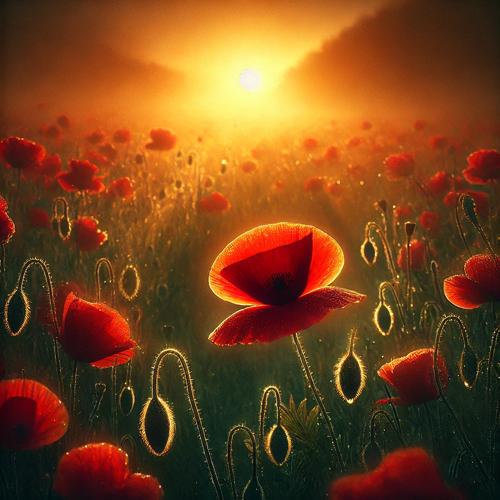
Remembrance Day, observed on November 11th, carries a solemn rhythm — a silence that echoes through history, through memory, and through the soul. Though it is often associated with military remembrance and national mourning, it also holds profound spiritual weight: a meditation on sacrifice, time, mortality, and the fragile, flickering light of peace. The red poppy, the two-minute silence, the bugle’s lament — these are more than rituals. They are portals into reflection, humility, and a shared yearning for something greater than conflict: a world made whole.
At its most mystical, Remembrance Day is not about glory or victory — but the cost of separation, the ache of brokenness, and the sacred responsibility of memory. It becomes a day of spiritual witnessing. We are not only remembering soldiers, but the deep, painful choices of the soul: what it means to stand, to fall, to leave home, to never return. It is a collective facing of the human shadow, and a plea for light not as vengeance, but as healing.
Artists have long found their voice in this space between silence and sound. Poets like Wilfred Owen, Siegfried Sassoon, and Vera Brittain turned blood into verse — not to glorify war, but to expose its inner wound. Their words are not monuments, but sacred cries, exposing the psychological and spiritual chasms war carves in human life. In music, pieces such as The Last Post, Nimrod from Elgar’s Enigma Variations, or Britten’s War Requiem become sonic prayers — not only for the dead, but for those who carry the burden of memory in the marrow of their being.
The visual symbolism of Remembrance Day is richly esoteric. The poppy, rooted in fields torn by shellfire, blooms as a paradox — beauty in destruction, life in aftermath. Its colour mirrors both blood and spirit. In mystical readings, the poppy becomes a flower of sleep and dream, inviting the living into deep reflection. Rows of crosses, sometimes nameless, evoke the spiritual anonymity of sacrifice — a returning to the formless, the universal soul.
In many places, the two minutes of silence are more than ritual — they are sacred threshold. Time itself pauses. In that stillness, some feel a thinning of the veil, a closeness to the dead, to ancestors, to unresolved echoes. It is a kind of collective meditation — a nation, or a world, breathing together in reverence. The moment holds no doctrine, only presence.
Remembrance Day also opens a conversation about peace — not as absence of war, but as spiritual alignment. Peace that begins within. The day whispers that true remembrance is not static. It is active. It is in the way we walk, the way we speak, the way we build. To truly honour those who fell is to become architects of something they never lived to see.
More than a historical day, Remembrance Day is a spiritual mirror. It asks: What do we carry forward? What do we lay down? What does it mean to remember — not with flags, but with compassion, with conscience, with the courage to imagine a different world?
It is not about forgetting war. It is about remembering peace — and those who, knowingly or not, gave their lives to light the path toward it.
