
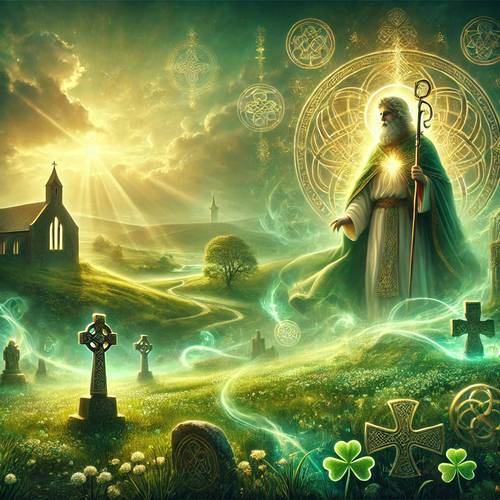
St Patrick’s Day, celebrated on 17 March, honours the life and spiritual legacy of Saint Patrick, the patron saint of Ireland. Though widely known today for its cultural festivities and parades, the feast day has deep religious and mystical significance rooted in Celtic Christianity, monastic devotion, and the transformative power of faith.
Saint Patrick, originally born in Roman Britain in the late 4th or early 5th century, was kidnapped and brought to Ireland as a slave. It was during his years of captivity—tending sheep in the wilderness—that he experienced a profound spiritual awakening. He turned inward, developing a life of deep prayer and connection with the divine. After escaping and returning home, he felt a calling to return to Ireland—not for revenge or escape, but to bring the message of Christ’s compassion, unity, and liberation to the land where he had once been enslaved.
Patrick’s mission in Ireland is remembered as both courageous and visionary. He moved through a land rich with pre-Christian Celtic spirituality, meeting its wisdom not with conflict but with understanding. According to tradition, he used the three-leafed shamrock to explain the Christian mystery of the Trinity—Father, Son, and Holy Spirit—within the context of an already sacred natural world. In this way, he bridged spiritual worlds, sowing the seeds of a Christianity that was deeply interwoven with the rhythms of nature, the poetic soul of the Irish people, and the ancient reverence for place and spirit.
Spiritually, St Patrick’s Day invites reflection on conversion, calling, and resilience. Patrick’s life is not just the story of a missionary, but of a soul transformed by suffering and opened to grace. His response to divine guidance—repeatedly expressed through dreams, visions, and inner voices—models a mysticism that is rooted not in withdrawal, but in service.
In Celtic Christian tradition, which flourished in the centuries following Patrick, the spiritual life was deeply contemplative and nature-connected. God was seen not only in scripture but in stones, stars, and silence. Patrick helped plant the roots of this unique Christian expression, where monasticism flourished in wild places and prayers flowed like rivers through the land.
Philosophically, St Patrick’s Day invites the soul to consider its own journey from exile to purpose, from fear to devotion. Patrick's return to Ireland was an act of trust and reconciliation, a lived embodiment of the Gospel's power to transform captivity into mission. His story reminds us that spiritual power often arises from the places where we have been broken open.
While modern celebrations of the day include music, dance, and the wearing of green, the original heart of the feast lies in gratitude for spiritual courage and the quiet endurance of faith. In Ireland, church services, prayer, and pilgrimage to sacred sites often mark the day, particularly in places associated with Patrick's missionary work.
Artistically, Saint Patrick has been a muse for centuries. He is portrayed in illuminated manuscripts, stained glass, and sculpture, often with a bishop’s staff, a shamrock, and serpents at his feet—symbols of his role in both teaching and spiritual protection. His Confessio, a short spiritual autobiography, remains a powerful testament to humility, divine calling, and inner transformation.
St Patrick’s Day is ultimately a feast of spiritual renewal, vision, and rootedness. It invites the heart to follow its own calling, to listen deeply, and to trust in the quiet voice that leads us—like Patrick—across wild landscapes into the service of something greater than ourselves.
