
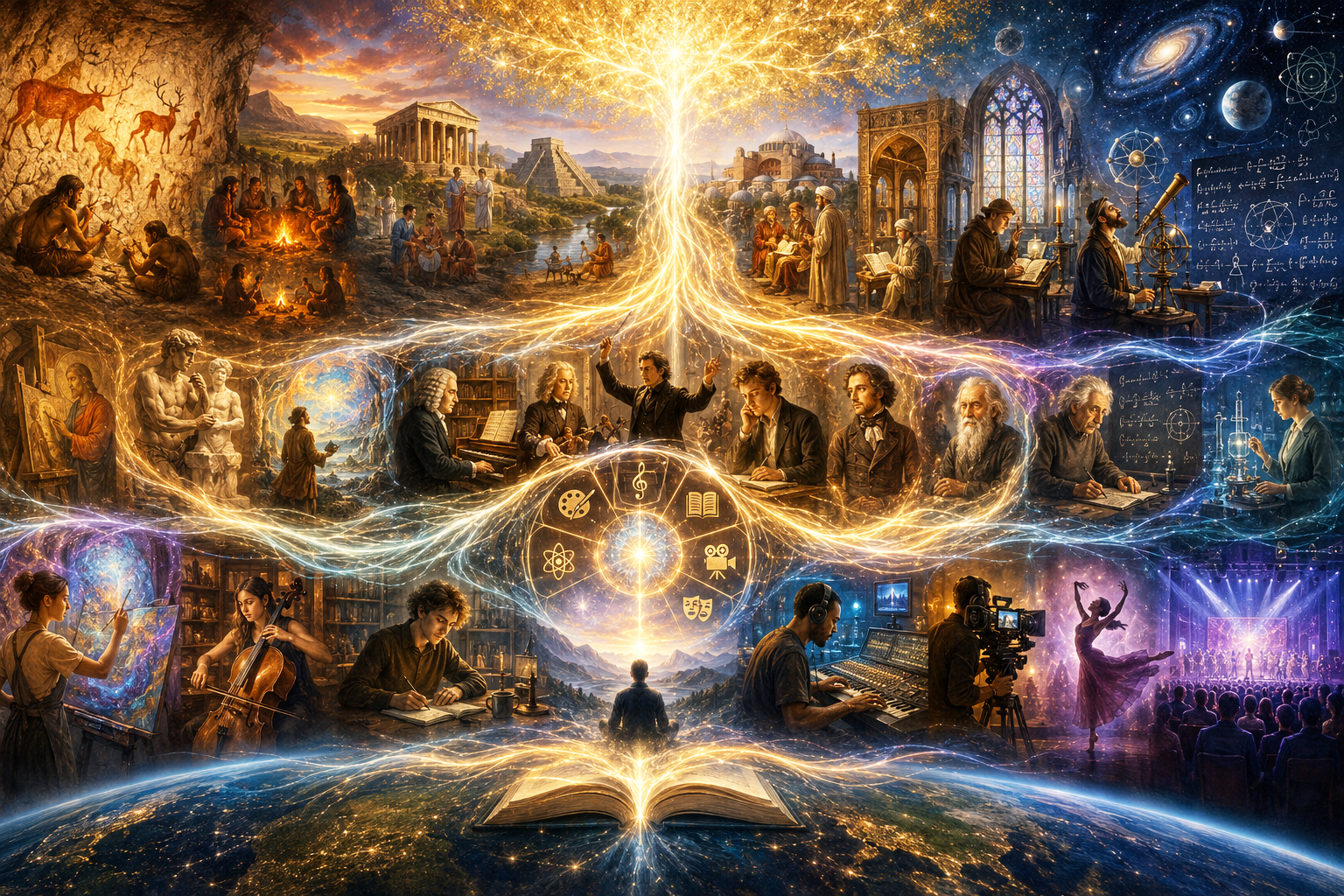
An Introduction to the Spiritual Arts
The relationship between spirituality and creativity is one of the oldest and most enduring themes in human history. For thousands of years, artists, musicians, writers, architects, dancers and storytellers have drawn inspiration from humanity's search for meaning, beauty, transcendence and the mysteries of existence. Yet despite its profound influence upon world culture, this relationship has rarely been recognised as a field of study in its own right.
The Spiritual Arts Foundation uses the term Spiritual Arts to describe this remarkable tradition.
The Spiritual Arts are not a particular style of art, a historical movement or a single philosophy. They encompass creative work inspired by spiritual ideas, experiences and questions across many cultures, beliefs and periods of history. Sometimes this inspiration emerges through established religious traditions. At other times it arises through mysticism, philosophy, mythology, contemplation, symbolism, nature or personal experience. What unites these diverse works is not a shared doctrine, but a shared desire to explore dimensions of human life that reach beyond the purely material.
Although the term itself may be unfamiliar, the tradition it describes is anything but new.
Throughout history, spirituality has been one of the great driving forces behind human creativity. Some of the world's most celebrated works of art, music, literature and architecture were created not simply to entertain or decorate, but to express humanity's deepest questions about existence and our place within the universe. Whether those questions were approached through organised religion, esoteric philosophy, indigenous wisdom, meditation or personal revelation, they have repeatedly inspired extraordinary creative achievement.
This becomes clear as soon as we begin to look across the arts as a whole.
In the visual arts alone, the influence of spirituality is impossible to ignore. From Sandro Botticelli, Giovanni di Paolo and Albrecht Dürer during the Renaissance, to J. M. W. Turner, John Martin, Caspar David Friedrich and Edward Burne-Jones in the nineteenth century, artists repeatedly explored biblical narratives, mystical symbolism, visionary landscapes and the search for transcendence. Later generations continued this tradition in new ways. Gustave Moreau, Odilon Redon, Paul Gauguin, Franz von Stuck, Mikhail Vrubel, Salvador Dalí and M. C. Escher each investigated profound philosophical or spiritual ideas through highly individual visual languages, while pioneers of abstraction such as Piet Mondrian, František Kupka, Paul Klee and Hilma af Klint sought to reveal realities that lay beyond the visible world. Alongside them stand remarkable visionary artists including Georgiana Houghton, Emma Kunz, Madge Gill, Agnes Pelton, Augustin Lesage, Rudolf Steiner and many others whose work was shaped directly by spiritual experience.
The same pattern appears throughout the history of music. Johann Sebastian Bach regarded his compositions as acts of devotion. George Frideric Handel, Wolfgang Amadeus Mozart, Ludwig van Beethoven, Franz Schubert, Felix Mendelssohn, Franz Liszt, Anton Bruckner, César Franck, Johannes Brahms, Antonín Dvořák and Edward Elgar all created works deeply influenced by religious belief or spiritual reflection. In the twentieth century, composers such as Alexander Scriabin, Olivier Messiaen, Arvo Pärt and John Tavener continued to demonstrate that music remains one of humanity's most powerful means of exploring the sacred, the contemplative and the transcendent.
Nor is this tradition confined to painting and music. It extends through literature, poetry, theatre, dance, architecture and, more recently, photography, film and digital media. Every artistic discipline contains creators whose work has been shaped by spiritual ideas and experiences. Some have worked within recognised religious traditions, while others have pursued philosophical, mystical or deeply personal explorations of consciousness, morality, imagination and human purpose. Together they form a creative tradition that spans continents, cultures and centuries.
What is perhaps most remarkable is that this immense body of work has rarely been viewed as a whole.
Art history studies painting. Music history studies composition. Literary criticism examines novels and poetry. Religious studies explore faith and belief. Each discipline has developed its own specialists, institutions and traditions of scholarship. Yet comparatively little attention has been given to the relationship that connects them all. As a result, the influence of spirituality on human creativity has often remained fragmented across many different fields of study, despite being one of the most consistent themes running through them.
Recognising the spiritual arts does not require us to redefine the arts themselves. Rather, it allows us to recognise an important thread that has always been present. It enables us to see connections that might otherwise remain hidden and to appreciate how artists working in different cultures, centuries and disciplines have often been engaged in remarkably similar explorations of meaning, beauty and human experience.
The purpose of this publication is not to suggest that every great work of art is spiritual, nor that spirituality is the only source of creative inspiration. Human creativity is far richer and more varied than any single explanation can encompass. Rather, our aim is to demonstrate that spirituality has been such a significant and persistent influence throughout the history of the arts that it deserves to be recognised, studied and celebrated as an important field in its own right.
The chapters that follow explore this tradition in greater depth across the visual arts, music, literature, film, theatre, dance and other creative disciplines. Together they reveal a picture that is both inspiring and surprisingly consistent: for thousands of years, spirituality has not stood at the margins of human culture. It has been one of the forces helping to shape it.
