
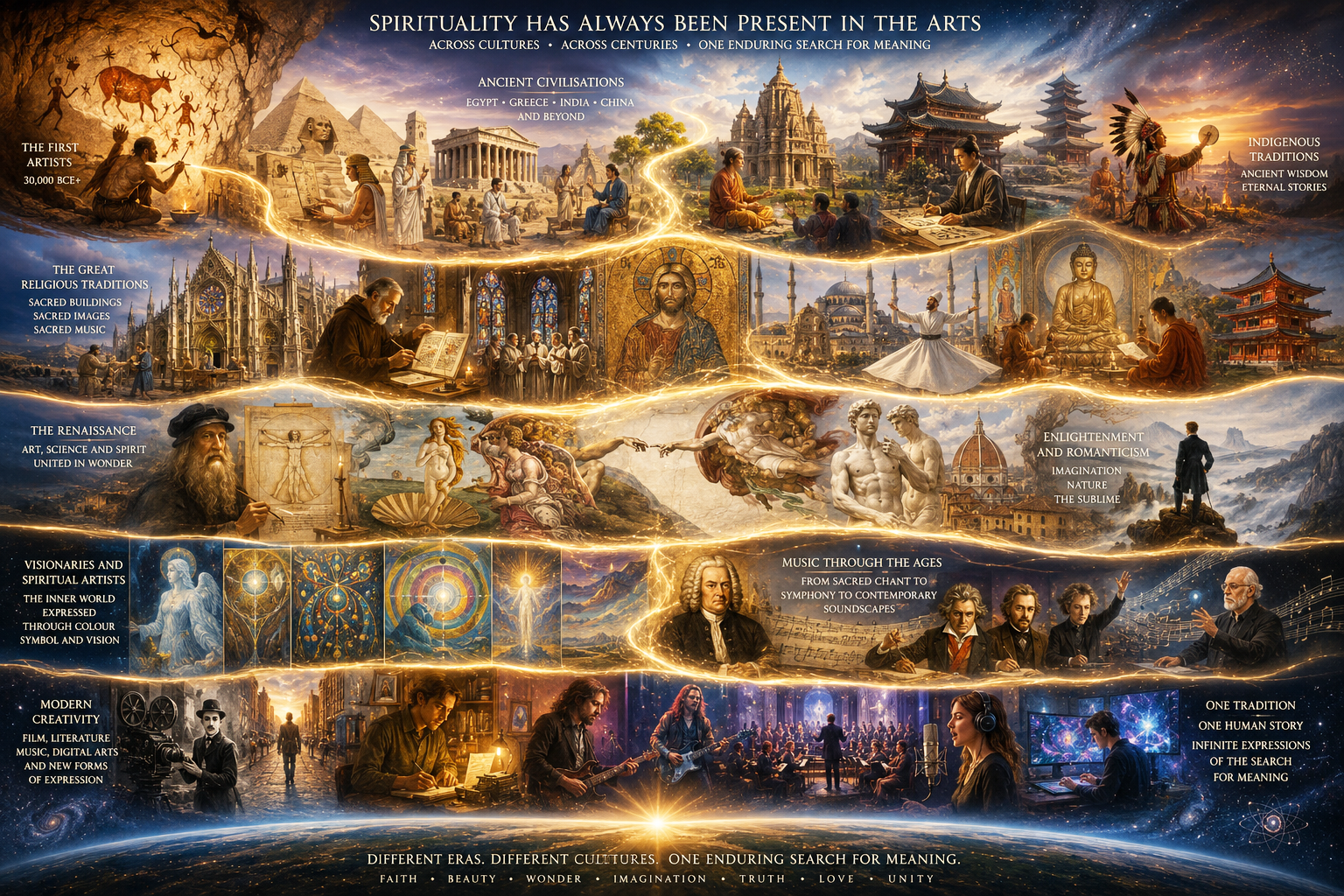
Spirituality Has Always Been Present in the Arts
Spirituality is often treated as a specialised subject, separate from mainstream culture and creative life.
Yet a closer examination of human history reveals something very different.
From the earliest cave paintings to contemporary films, from sacred music to modern literature, spirituality has been one of the most enduring sources of artistic inspiration ever known.
Indeed, it could be argued that spirituality is not a peripheral influence upon the arts at all.
It is one of their foundations.
The First Creative Impulse
Long before the rise of cities, kingdoms and organised religions, our ancestors were already creating art.
The remarkable cave paintings of Europe, Australia, Africa and Asia reveal that early human beings were not concerned solely with survival. They were also seeking meaning.
Animals, symbols, ceremonies and mythic imagery appear throughout prehistoric art. Whether these works were devotional, ritualistic, educational or symbolic, they suggest that creativity and spirituality have been intertwined since the dawn of human culture.
The desire to express what lies beyond immediate experience may be one of humanity's oldest creative instincts.
Sacred Stories and Ancient Civilisations
As civilisations emerged, spirituality became inseparable from artistic expression.
The temples of Egypt, the myths of Greece, the sacred architecture of India, the artistic traditions of China and the ceremonial works of countless indigenous cultures all reveal the same pattern.
Art was not merely decorative.
It was a means of exploring humanity's relationship with the cosmos.
Sculpture, painting, music, poetry and storytelling became vehicles through which people attempted to understand existence, celebrate the sacred and pass wisdom from one generation to the next.
The forms differed.
The impulse remained remarkably consistent.
The Great Religious Traditions
Many of humanity's most celebrated artistic achievements emerged within religious and spiritual contexts.
Cathedrals, temples, mosques, monasteries and sacred sites were often built not only as places of worship, but as works of art in their own right.
Paintings, sculptures, manuscripts, hymns and choral works sought to communicate truths that words alone seemed unable to express.
For centuries, some of the world's greatest artists, musicians and writers devoted their talents to exploring spiritual themes.
Much of our cultural heritage would not exist without this relationship.
The Renaissance and Beyond
The Renaissance produced some of the most influential artistic works in history.
Figures such as Botticelli, Michelangelo and Leonardo da Vinci explored subjects that combined technical mastery with profound philosophical and spiritual questions.
Yet spirituality did not disappear as society became more modern.
It simply evolved.
The Romantic artists looked towards nature, imagination and the sublime.
The Symbolists explored dreams, visions and inner realities.
The Pre-Raphaelites rediscovered myth, mystery and transcendence.
Again and again, artists returned to the same enduring questions.
Visionaries and Mystics
Some creators engaged with spirituality more directly.
Artists such as Georgiana Houghton, Hilma af Klint, Agnes Pelton, Emma Kunz, Anna Mary Howitt and Madge Gill produced works inspired by visionary, mystical or intuitive experiences.
Many of these artists were ignored or misunderstood during their lifetimes.
Today, however, their contributions are increasingly recognised as important chapters in the history of modern art.
Their work reminds us that creativity has often been used to explore realities that lie beyond ordinary perception.
Music and the Search for the Infinite
The same pattern can be found throughout the history of music.
Johann Sebastian Bach regarded music as an expression of divine order.
Beethoven wrestled with profound questions of destiny and transcendence.
Liszt, Bruckner and Messiaen drew inspiration from spiritual traditions.
Scriabin attempted to unite music, philosophy and mystical experience.
In more recent times, composers such as Arvo Pärt and John Tavener have created works that continue this tradition.
Across centuries and cultures, music has provided one of humanity's most powerful means of expressing awe, wonder and connection.
Literature, Poetry and Myth
Writers and poets have long explored spiritual themes through stories, symbols and imagination.
From ancient epics and sacred texts to modern novels and visionary poetry, literature has repeatedly addressed questions of purpose, mortality, consciousness and transcendence.
Many of the world's greatest literary works are, at their heart, explorations of what it means to be human.
The language changes.
The questions remain.
Modern Creative Culture
Spirituality did not vanish with the arrival of modernity.
It continues to appear throughout contemporary culture.
Films explore life after death, destiny, consciousness and personal transformation.
Musicians write about transcendence, connection and meaning.
Artists continue to create visionary works inspired by inner experience.
Writers explore timeless questions through new forms and media.
The spiritual arts remain alive because the human search for meaning remains alive.
The Overlooked Pattern
When viewed individually, these examples may appear unrelated.
A Renaissance painter.
A visionary artist.
A classical composer.
A filmmaker.
A poet.
A scientist.
Yet when viewed together, a remarkable pattern emerges.
Across thousands of years, countless creators have used their work to explore humanity's deepest questions.
The relationship between spirituality and creativity is not unusual.
It is one of the most persistent themes in cultural history.
And yet it remains surprisingly overlooked.
A Tradition Worth Recognising
The Spiritual Arts Foundation believes this tradition deserves greater recognition.
Not because all spiritual artists share the same beliefs.
Not because spirituality belongs to any one religion or philosophy.
But because the evidence of history is clear.
Spirituality has inspired some of humanity's greatest artistic, musical, literary and cultural achievements.
It has shaped civilisations.
It has enriched lives.
It has expanded the boundaries of imagination.
And it continues to inspire creative people today.
The spiritual arts are not a new movement.
They are an ancient tradition that has been quietly unfolding throughout human history.
