
Interfaith Understanding & Cultural Diversity
Britain is one of the most culturally and religiously diverse societies in its history. The familiar image of a largely Christian nation has given way to a far more complex landscape shaped by multiple faith traditions, people with no religion, spiritual seekers, humanists and individuals whose beliefs draw from a variety of sources.
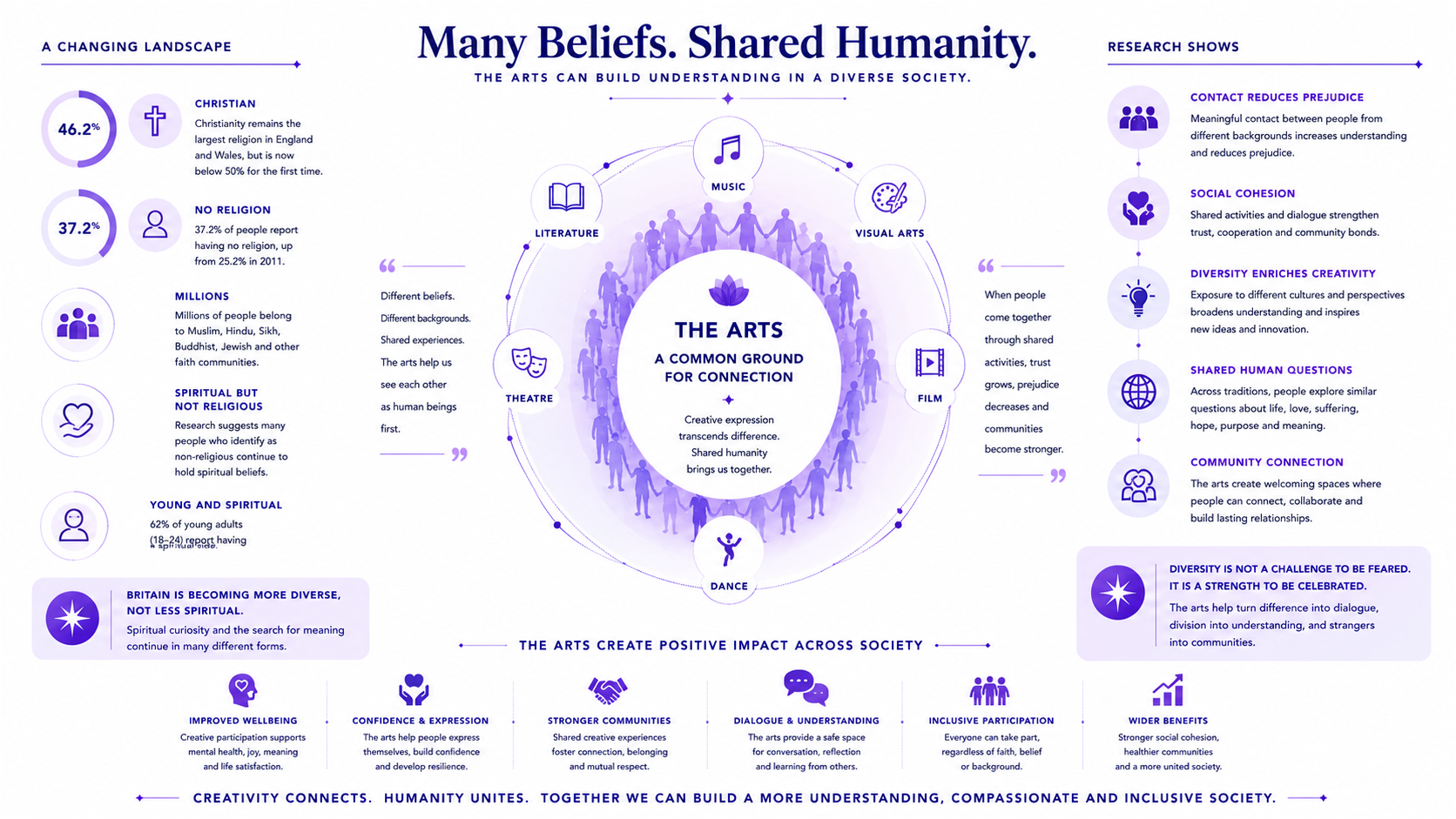
The scale of this change is reflected in the 2021 Census for England and Wales. For the first time, fewer than half of the population identified as Christian, with the figure falling to 46.2 per cent. During the same period, the proportion reporting no religion rose from 25.2 per cent in 2011 to 37.2 per cent in 2021. Alongside these shifts, Britain is home to substantial Muslim, Hindu, Sikh, Buddhist, Jewish and other faith communities numbering millions of people.
Such figures do not point towards a society becoming less diverse in its beliefs. They point towards a society in which a growing variety of religious, cultural and philosophical perspectives coexist.
The rise in those identifying with no religion is often interpreted as evidence that spirituality itself is fading. Research suggests a more complicated reality. Studies have found that many religiously unaffiliated people continue to hold spiritual beliefs. Among this group, 33 per cent report believing in an afterlife, 25 per cent believe in God and 45 per cent believe in some form of spiritual existence beyond the physical world.
Younger generations appear to reflect a similar pattern. Although they are often less likely to participate in traditional religious institutions, interest in meaning, purpose, mindfulness and personal growth remains widespread. One survey found that 62 per cent of people aged 18 to 24 reported having a spiritual side. The forms of engagement may be changing, but the underlying questions remain.
These questions matter not only at a personal level but also within society as a whole. Research into social cohesion has consistently suggested that meaningful contact between people from different backgrounds can reduce prejudice and strengthen trust. Often described as the "contact hypothesis", this principle proposes that shared activities and common goals create conditions in which understanding becomes more likely.
The arts are particularly well suited to this role. People may hold very different religious, spiritual or philosophical convictions, yet still engage with the same music, literature, visual art, theatre, film or dance. Creative experiences allow individuals to encounter one another through imagination, emotion and shared participation rather than through debate alone.
This capacity is strengthened by the fact that artistic expression has always drawn energy from diversity. Exposure to different cultures, traditions and perspectives broadens understanding and generates new possibilities. Many of the most influential artistic movements emerged through exchange rather than isolation, demonstrating that cultural interaction is often a source of creative vitality.
Beneath these differences lies a set of enduring human concerns. Questions of love, suffering, beauty, hope, mortality and purpose appear across cultures and throughout history. Traditions may answer them in different ways, but their persistence reveals a common human inheritance that transcends individual belief systems.
For The Spiritual Arts Foundation, this shared ground is central. Its audience is not defined by adherence to a particular faith or philosophy. It includes people from many traditions, as well as those who identify with none. What brings them together is an interest in creativity and a willingness to engage with questions that reach beyond everyday concerns.
As Britain becomes increasingly plural, opportunities for meaningful encounter become more valuable. The arts occupy a distinctive place within this landscape because they make room for complexity. They allow people to explore profound questions without requiring uniform answers and to recognise elements of themselves in experiences that may initially seem unfamiliar.
A diverse society inevitably contains differences of belief, culture and worldview. The challenge is not to erase those differences but to find ways of living with them creatively and constructively. At their best, the arts remind us that understanding does not begin with agreement. It begins with attention, curiosity and the willingness to encounter another person's experience as fully human.
Key Findings
- Christianity remains the largest religion in England and Wales at 46.2%, but is now below 50% for the first time.
- 37.2% of people report having no religion, up from 25.2% in 2011.
- Millions of people belong to Muslim, Hindu, Sikh, Buddhist, Jewish and other faith communities.
- Research suggests many people who identify as non-religious continue to hold spiritual beliefs.
- One survey found that 62% of young adults reported having a spiritual side.
- Research suggests meaningful contact between people from different backgrounds can reduce prejudice and strengthen social cohesion.
- Shared creative activities can help build trust, understanding and community relationships.
- Cultural diversity enriches artistic expression and broadens creative perspectives.
Sources & Further Reading
Office for National Statistics – Religion, England and Wales: Census 2021
https://www.ons.gov.uk/peoplepopulationandcommunity/culturalidentity/religion/bulletins/religionenglandandwales/census2021
The Inter Faith Network for the UK
https://www.interfaith.org.uk
Theos Think Tank – Religion and Society Research
https://www.theosthinktank.co.uk
British Religion in Numbers
http://www.brin.ac.uk
What Works Centre for Community Cohesion
https://www.gov.uk/government/publications/what-works-in-social-cohesion-and-overcoming-tensions
Coventry University – Interfaith Contact Research
https://pure.coventry.ac.uk/ws/portalfiles/portal/46236140/Peacock_Contact_based_interfaith_programmes_A4.pdf
Pew Research Center – Religion and Spirituality Studies
https://www.pewresearch.org/religion
