
Loneliness & Community
Human beings have always depended upon one another. Families, friendships, neighbourhoods and communities have long provided the relationships through which people find support, identity and belonging. The need for connection is not simply a social preference; it is woven into the fabric of human life.
Yet loneliness has become an increasingly prominent feature of modern society. Millions of people experience feelings of isolation and disconnection despite living in an age defined by communication technologies and constant connectivity. As a result, loneliness is now recognised not only as a personal struggle but as a public health concern with consequences that extend far beyond the individual.
Understanding loneliness requires more than counting social contacts. It is possible to feel lonely in a crowded room and entirely content while living alone. Loneliness arises when there is a gap between the relationships people have and the relationships they desire. At its heart lies a lack of genuine connection: the feeling of not being fully seen, understood or valued by others.
Research has consistently associated persistent loneliness with lower life satisfaction, increased stress, anxiety, depression, reduced confidence and poorer overall wellbeing. Over time, its effects can reach beyond mental health, contributing to physical health difficulties and a diminished quality of life. Increasingly, researchers regard social connection as a fundamental ingredient of wellbeing rather than a secondary benefit.
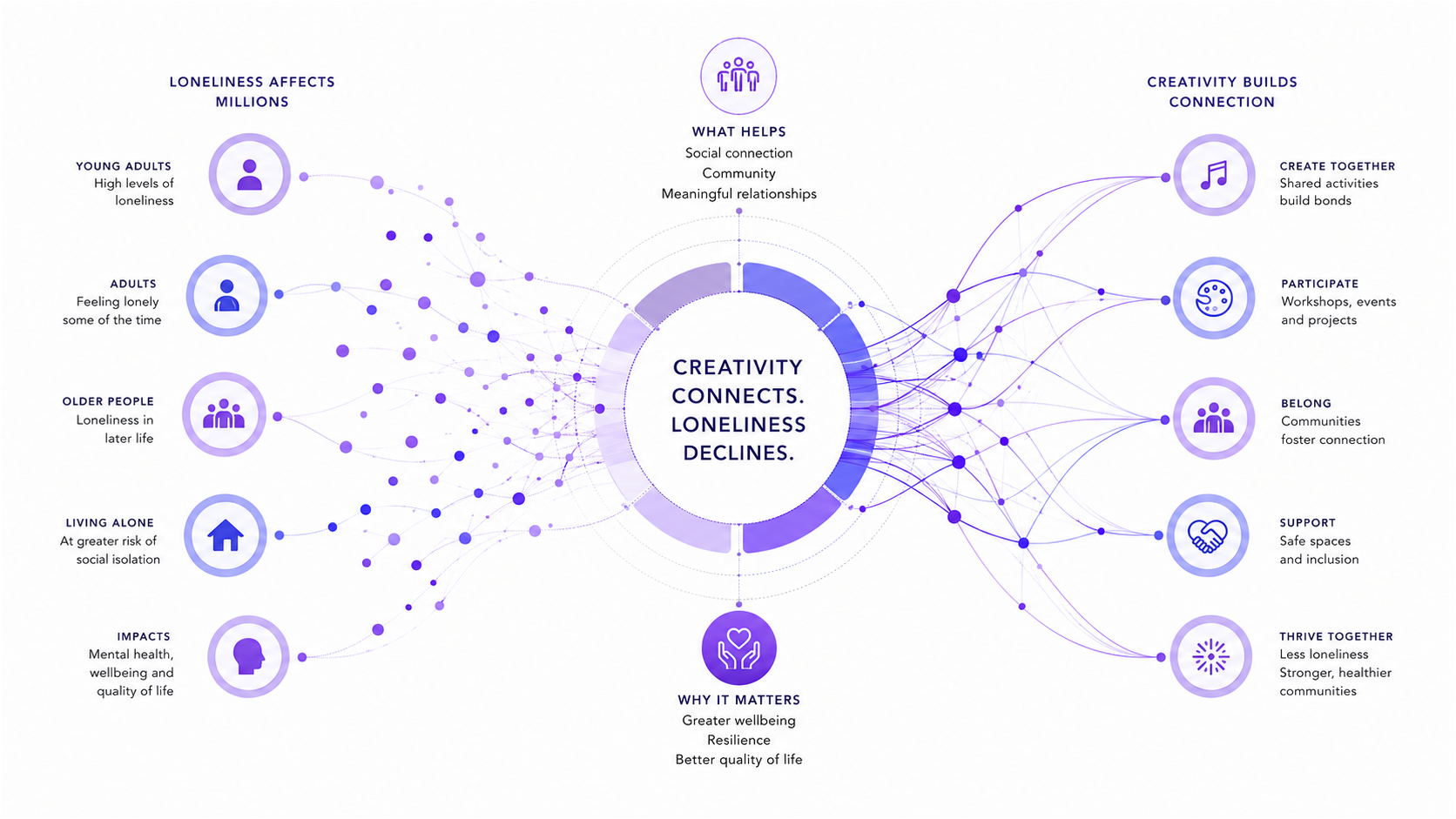
Contrary to popular assumptions, loneliness is not confined to old age. Recent studies suggest that young adults are among the groups most likely to report feeling lonely. Social media, educational pressures, economic uncertainty and changing patterns of community life have all been identified as possible influences. The finding highlights a paradox of contemporary life: the ability to communicate instantly with hundreds of people does not necessarily create a sense of belonging.
Older adults often encounter loneliness through different circumstances. Retirement, bereavement, mobility limitations and changing family structures can gradually reduce opportunities for regular social interaction. For some, meaningful contact becomes increasingly rare, making participation in community life particularly valuable.
This points towards a broader truth. Human connection is sustained not merely through proximity but through participation. Communities provide the settings in which relationships develop, trust grows and people come to feel part of something larger than themselves. Research has linked involvement in community life with stronger social networks, higher wellbeing and greater resilience during difficult periods.
The arts occupy a distinctive place within this picture because they create opportunities for participation rather than passive observation. People gather to sing, perform, learn, volunteer, create and share experiences. Creative activity offers a common purpose that can make social interaction feel easier and more natural, helping people connect across differences of age, background and belief.
For many individuals, these experiences become pathways into wider community life. Friendships emerge, confidence grows and networks of support begin to form. What starts as participation in a workshop, choir, festival or creative project often develops into something more enduring: a sense of belonging.
This is one reason arts organisations are increasingly recognised within public health, social prescribing and community development initiatives. Their contribution cannot be measured solely through artistic output. They also create environments in which relationships can flourish and social isolation can be reduced.
For The Spiritual Arts Foundation, this human dimension is central. Whether through music, literature, visual arts, film, theatre, festivals, retreats or artist networks, creative activity provides opportunities for people to come together around shared interests and experiences. The value of such activities lies not only in what they produce, but in the connections they help make possible.
The arts cannot eliminate loneliness, nor should they be expected to. What they can do is create spaces in which strangers become participants, participants become communities and communities become sources of support. In a society where many people feel disconnected despite being constantly connected, that may be one of the most valuable contributions creativity can offer.
Key Findings
- One in four UK adults report feeling lonely at least some of the time.
- Around 3.8 million people in the UK experience chronic loneliness.
- Young adults are among the loneliest groups in society, with approximately 40% reporting regular loneliness.
- More than 940,000 people aged 65 and over report feeling lonely often.
- Research consistently shows that social connection, community participation and meaningful relationships are important contributors to wellbeing and quality of life.
Sources & Further Reading
Office for National Statistics (ONS)
Public Opinions and Social Trends, Great Britain
https://www.ons.gov.uk/peoplepopulationandcommunity/wellbeing/bulletins/publicopinionsandsocialtrendsgreatbritain
Loneliness - What Characteristics and Circumstances are Associated with Feeling Lonely?
https://www.ons.gov.uk/peoplepopulationandcommunity/wellbeing/articles/lonelinesswhatcharacteristicsandcircumstancesareassociatedwithfeelinglonely
UK Government
Government's Work on Tackling Loneliness
https://www.gov.uk/guidance/governments-work-on-tackling-loneliness
A Connected Society: A Strategy for Tackling Loneliness
https://www.gov.uk/government/publications/a-connected-society-a-strategy-for-tackling-loneliness
Campaign to End Loneliness
Facts and Statistics
https://www.campaigntoendloneliness.org/facts-and-statistics/
Research and Evidence
https://www.campaigntoendloneliness.org/research/
Age UK
Loneliness Research and Resources
https://www.ageuk.org.uk/our-impact/policy-research/loneliness-research-and-resources/
Understanding Society / Age UK
The Impact of Loneliness in Later Life
https://www.understandingsociety.ac.uk/impact/age-uk-loneliness/
National Academy for Social Prescribing
Arts and Culture Social Prescribing
https://socialprescribingacademy.org.uk/what-is-social-prescribing/arts-and-culture-social-prescribing/
University College London (UCL)
Arts and Health Research Programme
https://www.ucl.ac.uk/behaviour-change/arts-health
Arts, Society and Public Health Research
https://www.ncbi.nlm.nih.gov/books/NBK553773/
