
Creativity & Wellbeing
For much of the modern era, progress has been measured through economic indicators such as income, employment and productivity. Useful though these measures are, they reveal only part of the picture. People also care about health, purpose, belonging, relationships and the quality of their everyday lives. Increasingly, governments, researchers and public institutions have recognised that wellbeing deserves attention not merely as a by-product of prosperity, but as a measure of human flourishing in its own right.
This broader understanding has prompted a closer examination of the factors that help people thrive. Among the most intriguing findings is the role played by creativity and cultural participation.
Creativity has often been relegated to the category of leisure: something enjoyable, enriching and desirable, yet ultimately optional. Research increasingly challenges that assumption. Through music, visual art, writing, dance, theatre, photography, crafts and countless other forms of expression, people process experience, communicate emotions, develop confidence and engage with the world around them. Creative activity appears less like a luxury and more like one of the ways human beings make sense of their lives.
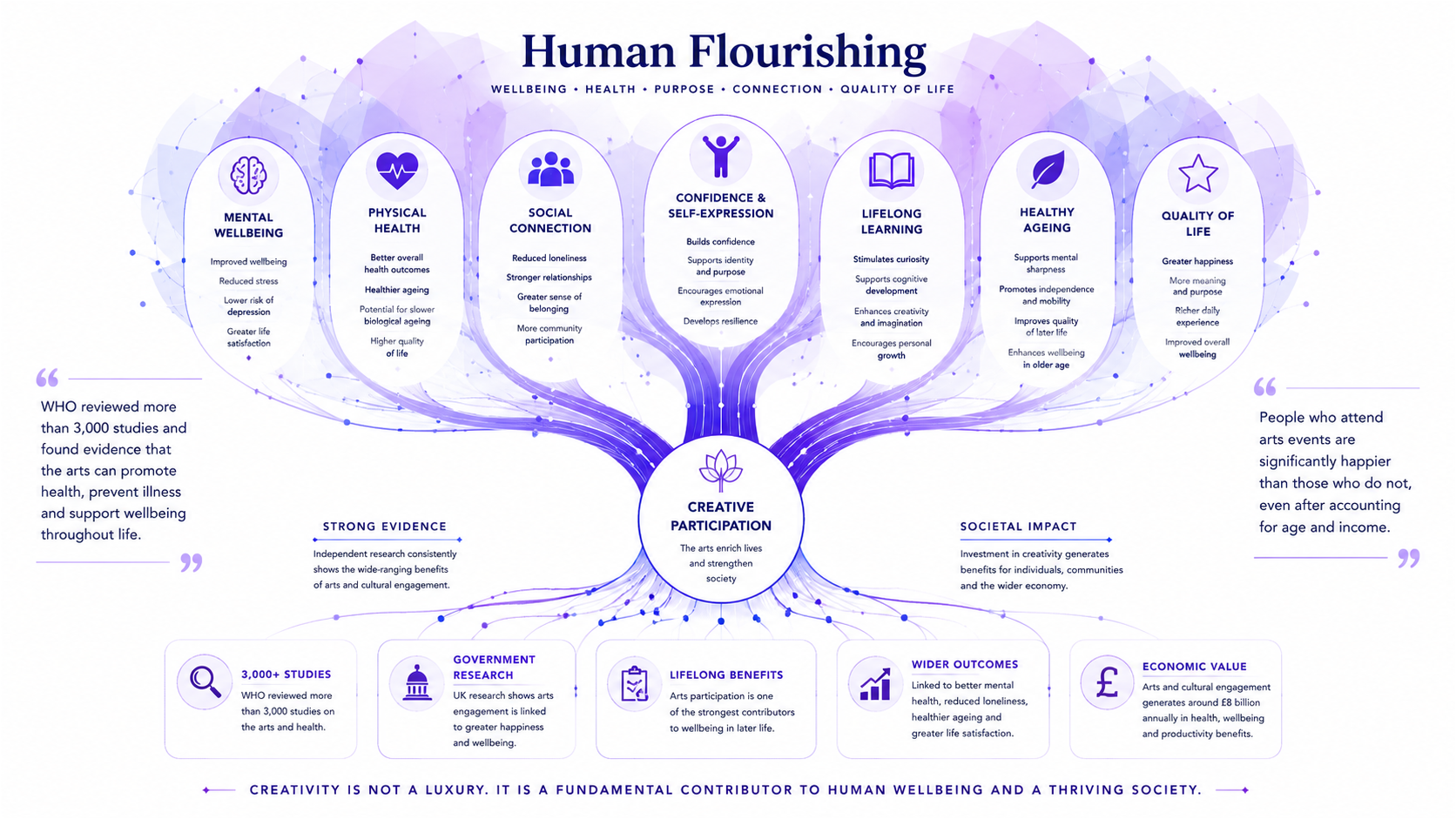
The evidence supporting this view has grown considerably in recent decades. A landmark review conducted by the World Health Organization examined more than 3,000 studies exploring the relationship between the arts and health. Its conclusion was clear: the arts can contribute to the promotion of health, the prevention of illness and the support of physical and mental wellbeing throughout life.
Much of the subsequent discussion has focused on mental wellbeing. Studies have associated creative participation with higher life satisfaction, improved wellbeing and lower levels of psychological distress. The act of creating offers space for reflection, emotional expression and personal exploration, helping people navigate challenges while strengthening resilience and self-understanding. Notably, these benefits are not confined to professional artists. The evidence repeatedly suggests that participation itself carries value, regardless of technical ability or accomplishment.
The relationship does not end there. Research reviewed by the World Health Organization also identified links between arts engagement and improved physical health, healthier ageing and a better quality of life. More recent studies have suggested that regular participation in arts and cultural activities may even be associated with slower biological ageing and more favourable long-term health outcomes. Such findings point towards a reality that people have often sensed intuitively: human wellbeing cannot be neatly divided into separate mental, physical and social compartments.
The social dimension is particularly revealing. Creative activity frequently brings people together through performances, workshops, choirs, exhibitions, festivals and countless other forms of shared participation. These experiences create opportunities for connection and belonging, qualities that have attracted increasing attention amid growing concerns about loneliness and social isolation. The arts provide a setting in which relationships can form naturally through common interests and shared experiences.
This capacity to enrich life appears remarkably consistent across the lifespan. For children and young people, creative engagement has been associated with confidence, emotional development, resilience and social skills. For adults, it can offer opportunities for learning, self-expression and renewal. Among older people, cultural participation has been linked to stronger social connections, enhanced wellbeing and a higher quality of life. Creativity changes its role as circumstances change, yet its relevance endures.
The implications extend beyond individual experience. Government-commissioned research has estimated that arts and cultural engagement generates approximately £8 billion annually through improvements in health, wellbeing and productivity. The benefits therefore reach far beyond the cultural sector itself, influencing communities, public services, workplaces and the wider economy.
For The Spiritual Arts Foundation, these findings illuminate a simple but often overlooked truth. The value of creativity cannot be measured solely by the artworks, performances or cultural achievements it produces. Its deeper contribution lies in the ways it supports human flourishing, helping people find expression, connection and a richer engagement with life.
The growing evidence base is striking not because it reveals something entirely new, but because it lends empirical weight to an insight that artists, musicians, writers and creative practitioners have long understood through experience. Creativity is woven into the fabric of wellbeing. When people are given opportunities to create, they are often doing far more than making art; they are participating in one of the processes through which human beings sustain and enrich their lives.
Key Findings
- The World Health Organization reviewed more than 3,000 studies and found evidence that arts engagement can support health promotion, disease prevention, mental wellbeing and quality of life.
- UK government research found that people who attend arts events are significantly happier than those who do not, even after accounting for factors such as age and income.
- Creative and cultural participation has been identified as one of the strongest contributors to wellbeing in later life.
- Arts engagement has been linked to improved mental wellbeing, reduced loneliness, healthier ageing and greater life satisfaction.
- Government-commissioned research estimated that arts and cultural engagement generates around £8 billion annually in health, wellbeing and productivity benefits.
Sources & Further Reading
World Health Organization (WHO)
What is the evidence on the role of the arts in improving health and well-being? A scoping review
https://iris.who.int/items/ba079951-0beb-4b7f-a1c5-a75cc66c283e
UK Government
Culture, Sport and Wellbeing: An Analysis of the Taking Part Survey
https://assets.publishing.service.gov.uk/media/5a80bd37ed915d74e62302ba/Culture_Sport_and_Wellbeing_-_An__analysis_of_the__Taking_Part__Survey.pdf
The Role of Arts in Improving Health and Wellbeing
https://www.gov.uk/government/publications/evidence-summary-for-policy-the-role-of-arts-in-improving-health-and-wellbeing
Office for National Statistics (ONS)
Wellbeing Statistics
https://www.ons.gov.uk/peoplepopulationandcommunity/wellbeing
UK Measures of National Wellbeing Dashboard
https://www.ons.gov.uk/peoplepopulationandcommunity/wellbeing/articles/ukmeasuresofnationalwellbeing/dashboard
University College London (UCL)
Arts and Health Research Programme
https://www.ucl.ac.uk/behaviour-change/arts-health
Arts, Society and Public Health Research
https://www.ncbi.nlm.nih.gov/books/NBK553773/
Academic Research
Arts Participation and Positive Mental Health
https://pmc.ncbi.nlm.nih.gov/articles/PMC3449238/
Age UK
Creative Wellbeing Research
https://www.ageuk.org.uk/our-impact/policy-research/wellbeing-research/creative-wellbeing/
National Academy for Social Prescribing
Arts and Culture Social Prescribing
https://socialprescribingacademy.org.uk/what-is-social-prescribing/arts-and-culture-social-prescribing/
National Centre for Creative Health
Creativity and Mental Health in Schools
https://ncch.org.uk/uploads/DfE-Brief-Creativity-and-Mental-Health-in-Schools-1.pdf
