
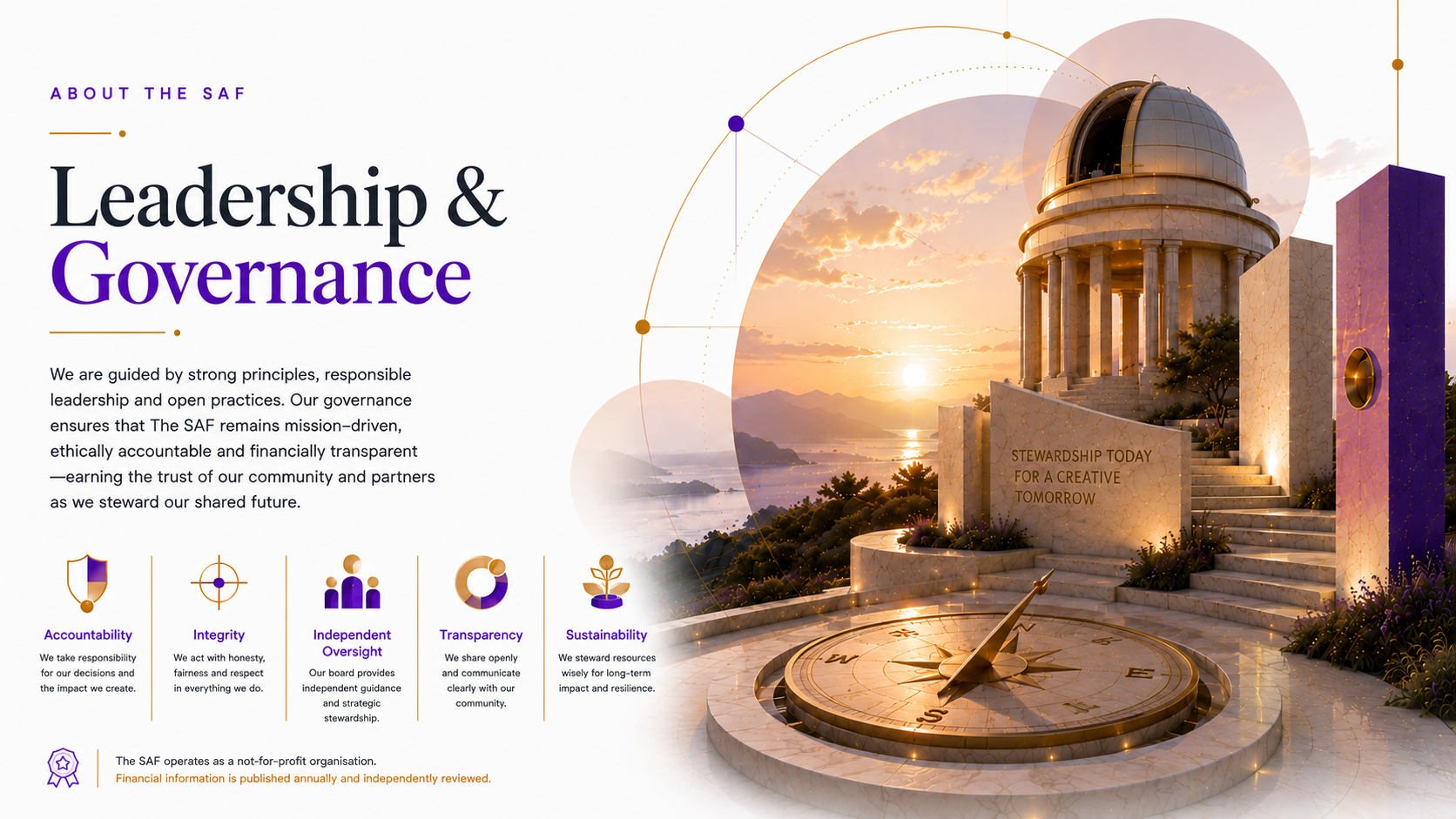
Leadership & Governance
The Spiritual Arts Foundation was established to explore, preserve, develop and promote the relationship between spirituality and creativity as an important field of cultural life. Achieving that mission requires not only vision and creativity, but also strong leadership, sound governance and responsible stewardship.
The Foundation believes that good governance is fundamental to public trust. It provides the framework through which decisions are made, resources are managed, risks are considered and the organisation remains accountable to its supporters, partners and the wider public.
As a young organisation, the Foundation has developed its governance in step with its growth. Rather than creating complex structures prematurely, it has sought to build carefully, ensuring that governance arrangements remain appropriate to its scale while laying the foundations for future expansion.
The following overview explains the Foundation's legal structure, leadership, governance arrangements and plans for continued organisational development.
Legal Structure
The Spiritual Arts Foundation was incorporated as a Company Limited by Guarantee on 27 April 2023.
The organisation is governed by a Board of Directors with collective responsibility for strategic leadership, financial stewardship, legal compliance, governance and the long-term fulfilment of the Foundation's charitable mission and objectives.
The Board brings together experience spanning the arts, creative industries, publishing, education, business management, finance, administration and community development. This combination of creative and professional expertise supports informed decision-making while helping to ensure that artistic ambition is matched by sound organisational practice.
Our Approach to Governance
The Foundation views governance as an ongoing process rather than a fixed organisational structure.
Strong governance is not measured simply by policies or procedures, but by the quality of leadership, thoughtful decision-making, financial responsibility and a willingness to learn and improve over time.
From its inception, the Foundation has adopted a measured approach to organisational development. During its early years, priority was given to demonstrating public value, building communities, developing knowledge resources and testing ideas through practical delivery. Governance arrangements have evolved alongside this growth, ensuring that the organisation remains proportionate, effective and sustainable.
As the Foundation continues to expand, its governance will continue to mature through the recruitment of additional expertise, the development of independent advisory capacity and the ongoing strengthening of organisational systems and oversight.
Decision Making
The Board of Directors is responsible for the Foundation's overall strategic direction and governance.
Its responsibilities include:
- Setting the Foundation's long-term vision and strategic priorities.
- Ensuring financial stewardship and organisational sustainability.
- Approving major policies and significant organisational decisions.
- Monitoring organisational performance and risk.
- Safeguarding the Foundation's reputation and public benefit.
Responsibility for day-to-day management and programme delivery is delegated to the leadership team, operating within the strategic framework established by the Board.
This distinction allows operational decisions to be made efficiently while ensuring that overall accountability remains with the Directors.
Leadership
The Foundation has been developed through a combination of voluntary leadership, professional expertise and community participation.
Since its origins in 2021, the organisation has grown from a small volunteer-led initiative into an international cultural platform supporting a community of more than 2,500 members, delivering public events, developing an extensive online knowledge resource and building relationships with artists, researchers, educators and creative practitioners around the world.
This progress has been achieved through careful planning, incremental growth and a deliberate commitment to building strong organisational foundations before pursuing significant external investment.
The Board meets regularly to review organisational progress, finances, strategic priorities, risks and future opportunities, ensuring that development remains consistent with the Foundation's mission and long-term vision.
Board of Directors
Clifford White - Founder & Director
Clifford White is the founder of The Spiritual Arts Foundation and brings more than forty years of experience across the music, media, education and creative sectors.
His career has included leadership roles in music production, publishing, digital media, education, training and programme development. He founded and managed a London-based recording studio and independent record label, established a specialist training company and film school at Elstree Film Studios, and has worked with organisations including the BBC, ITV, Channel 4, British Telecom and Comic Relief.
Throughout his career he has created and managed businesses, educational initiatives and creative organisations, developing experience in organisational leadership, publishing, marketing, partnerships, events, audience development and strategic planning.
As Founder and Director of The Spiritual Arts Foundation, Clifford leads organisational strategy, programme development, publishing, fundraising, partnerships, communications and audience development. Under his leadership the Foundation has grown into an internationally recognised cultural platform with a substantial knowledge library, an active public community and a growing network of creative contributors and supporters.
Barry Posener - Director & Treasurer
Barry Posener is an artist, entrepreneur and strategic adviser.
He holds a degree in the arts from the University of Hertfordshire and combines creative practice with extensive commercial experience. Barry founded and successfully managed Great Value Jewellery, bringing significant expertise in business management, financial oversight, investment and strategic planning.
As Treasurer, he provides oversight of the Foundation's financial stewardship, budgeting, sustainability planning and long-term organisational development.
Elaine White - Director & Company Secretary
Elaine White is an experienced administrator with a long-standing commitment to both the arts and the charitable sector.
She currently provides bookkeeping services for one charity and administrative support for another, bringing practical experience in financial administration, organisational systems and day-to-day operational management.
Alongside her professional work, Elaine maintained many years of involvement with the amateur dramatic group Spotlighters, reflecting her longstanding interest in community arts and cultural participation.
As Company Secretary, she supports the Foundation's governance, administration, record keeping and organisational development.
Advisory Network
Alongside its Board, the Foundation benefits from the support of a growing network of volunteers, creative practitioners, researchers and professional advisers who contribute knowledge, experience and practical assistance across a wide range of activities.
This wider community reflects the interdisciplinary nature of the spiritual arts. Expertise is drawn from multiple creative and professional fields, enriching the Foundation's work while strengthening its ability to develop partnerships, programmes and new initiatives.
Current areas of expertise represented within the Foundation's wider network include:
- Visual arts
- Music and performance
- Literature and publishing
- Film and media
- Education
- Community development
- Research
- Marketing and communications
- Business and entrepreneurship
As the Foundation develops, this network will continue to grow alongside the organisation itself.
Specialist Advisory Circle
The Foundation is progressively developing a Specialist Advisory Circle to complement the expertise of its Board.
The purpose of the Advisory Circle is to provide independent specialist knowledge across areas relevant to the Foundation's mission, helping to inform strategic thinking, programme development, publishing, partnerships and organisational growth.
Unlike the Board of Directors, whose responsibilities include governance and legal accountability, members of the Advisory Circle contribute professional expertise within their respective fields.
The Foundation expects this network to become an increasingly important part of its organisational development as new programmes and partnerships emerge.
Nigel Peace - Publishing Adviser
Nigel Peace is the founder and publisher of Local Legend, an independent publishing house established in 2012 specialising in spirituality, philosophy and related subjects.
Holding degrees in both Science and Philosophy, Nigel has overseen the publication of more than forty paperback titles and twenty-five eBooks by over thirty authors. He also founded and manages the biannual National Spiritual Writing Competition, which has led to the publication of multiple award-winning books, with several Local Legend publications receiving national literary awards.
As Publishing Adviser to The Spiritual Arts Foundation, Nigel provides guidance on publishing strategy, editorial development, production, distribution and the long-term development of the Foundation's publishing programme.
Future Governance Development
The Foundation recognises that governance must evolve alongside organisational growth.
As capacity increases, priorities include:
- Expanding the Specialist Advisory Circle.
- Recruiting additional independent expertise to strengthen governance.
- Increasing specialist fundraising and organisational capacity.
- Continuing to improve organisational systems, policies and processes.
- Strengthening strategic oversight and long-term planning.
- Ensuring governance arrangements remain proportionate, effective and appropriate to the Foundation's changing scale and activities.
The Foundation's philosophy is to build carefully and sustainably. By allowing governance structures to develop alongside organisational maturity, it seeks to create an organisation that is resilient, accountable and well positioned to serve artists, communities and the wider public for many years to come.
