
Public Participation in the Arts
The arts are sometimes described as a specialist interest enjoyed by a relatively small section of society. The evidence suggests otherwise.
Across the United Kingdom, cultural participation forms part of everyday life for millions of people. They attend concerts and performances, visit museums and galleries, read books, volunteer with cultural organisations, take part in community projects and pursue creative interests of their own. Far from occupying a marginal position, the arts are woven deeply into the social and cultural fabric of the country.
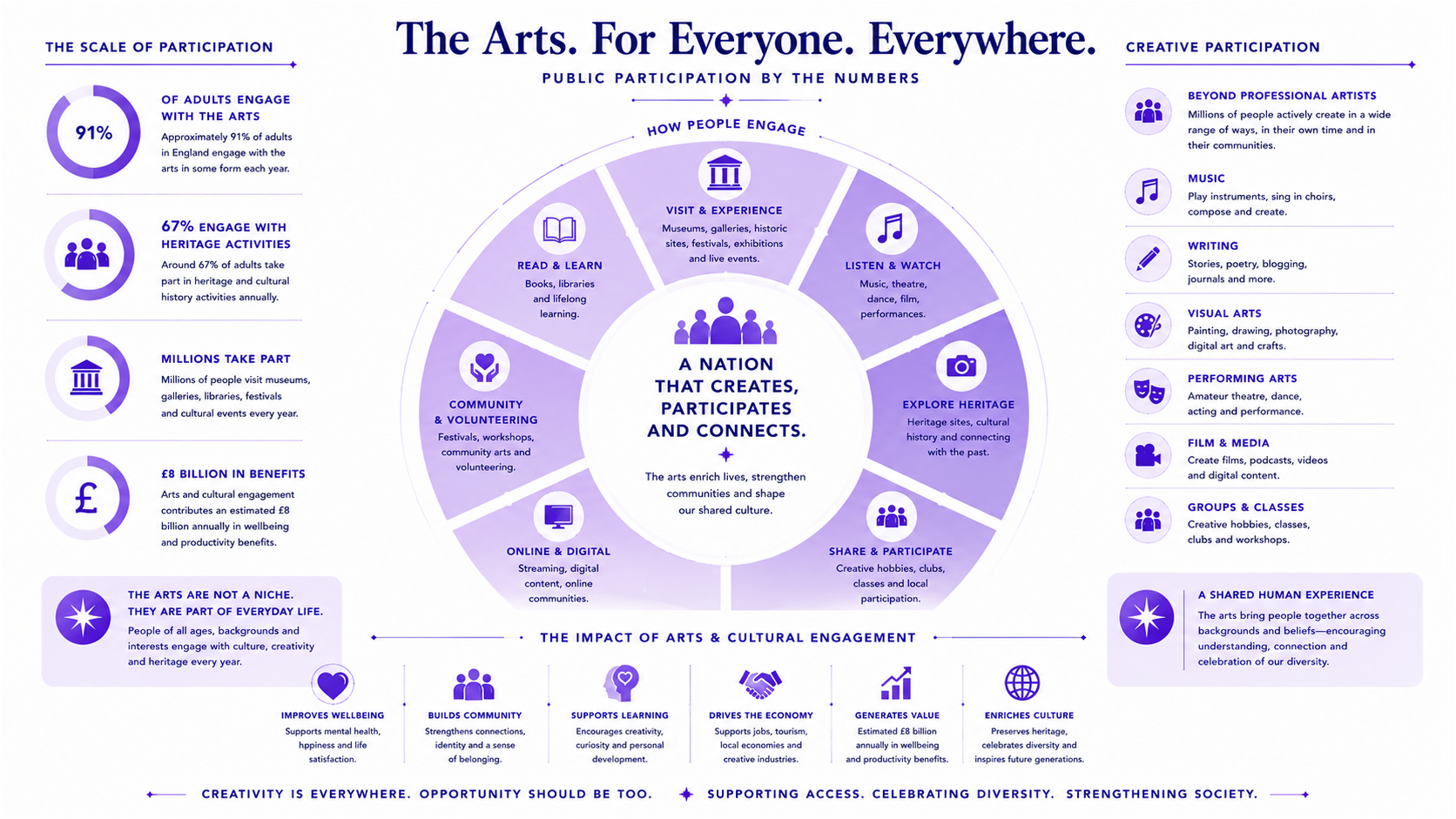
Government research indicates that approximately 91 per cent of adults in England engage with the arts in some form over the course of a year. This includes both attendance and active participation across a broad range of activities, making cultural engagement one of the most widespread forms of civic and social involvement in the country.
The scale of that participation reflects the many roles the arts play in people's lives. They provide enjoyment and entertainment, but they also offer opportunities for learning, self-expression, reflection and discovery. Their influence extends into education, wellbeing, community identity and the ways people understand both themselves and the world around them.
A notable feature of cultural life is that so many people contribute directly to it. Millions write, paint, draw, photograph, play instruments, sing, perform, make films or pursue other creative interests. Culture is not sustained solely by professional artists and institutions; it depends upon the continued involvement of individuals who choose to create as well as observe.
That same spirit of engagement is evident in public interest in heritage. Government research suggests that around two-thirds of adults participate in heritage-related activities each year, visiting museums, galleries, historic sites and other places connected to the nation's history. Such participation reflects a continuing desire to understand the stories, traditions and achievements that have shaped contemporary society.
Literature remains another enduring point of access. Libraries continue to serve millions of people through reading, learning and personal development, while books remain among the most widely enjoyed and accessible cultural experiences. Their enduring popularity speaks to a persistent appetite for knowledge, imagination and reflection.
The arts also provide settings in which social relationships can develop. Festivals, exhibitions, performances, workshops and local creative projects bring people together around shared interests, creating opportunities for collaboration, volunteering and participation. Increasingly, research suggests that these social dimensions are among the most valuable outcomes of cultural engagement, helping to strengthen relationships and foster a sense of belonging.
Technology has expanded these opportunities still further. Performances, exhibitions, publications and creative communities can now be accessed from almost anywhere in the world, reducing geographical barriers and widening participation. Yet the continued popularity of live events suggests that digital access has supplemented rather than replaced the desire for shared, in-person experiences.
The value generated by this activity extends beyond culture itself. Research increasingly links arts engagement with improved wellbeing, stronger communities and greater social cohesion, while recent estimates suggest that the wider benefits may be worth billions of pounds annually. Cultural participation supports volunteering, contributes to local economies and enriches the environments in which people live.
For The Spiritual Arts Foundation, these patterns reveal something more than the popularity of the arts. They demonstrate that large numbers of people actively seek opportunities not only to create and participate, but also to explore ideas, values and experiences that give life depth and meaning. The Foundation exists within this wider landscape, providing opportunities for creative engagement with questions of spirituality, purpose and human experience.
The notion that the arts belong to a cultural minority becomes difficult to sustain in light of the evidence. Millions of people continue to create, attend, read, volunteer, learn and participate. The enduring appeal of cultural life suggests that creativity answers needs that are widely shared. It offers ways of connecting with history, community, imagination and one another—an activity not at the edges of society, but close to its centre.
Key Findings
- Approximately 91% of adults in England engage with the arts each year.
- Most arts participation continues to take place in person rather than solely online.
- Around 67% of adults engage with heritage and cultural history activities.
- Millions of people visit museums, galleries, libraries, festivals and cultural events every year.
- Creative participation extends far beyond professional artists and includes music, writing, crafts, photography, theatre and community arts.
- Arts and cultural engagement contributes an estimated £8 billion annually in wellbeing and productivity benefits.
Sources & Further Reading
DCMS Participation Survey (2024–25)
https://www.gov.uk/government/statistics/participation-survey-2024-25-annual-publication
DCMS Taking Part Survey
https://www.gov.uk/government/collections/taking-part
Arts Council England – Participation and Engagement Research
https://www.artscouncil.org.uk
The Audience Agency
https://www.theaudienceagency.org
Centre for Cultural Value
https://www.culturehive.co.uk
Office for National Statistics – Culture and Wellbeing
https://www.ons.gov.uk
National Centre for Creative Health
https://ncch.org.uk
UK Government – Culture, Sport and Wellbeing
https://www.gov.uk/government/publications/culture-sport-and-wellbeing-an-analysis-of-the-taking-part-survey
Research on the Social and Economic Value of Arts Participation
https://www.theguardian.com/society/2024/dec/17/consuming-arts-and-culture-is-good-for-health-and-wellbeing-research-finds
