
Spirituality and Music
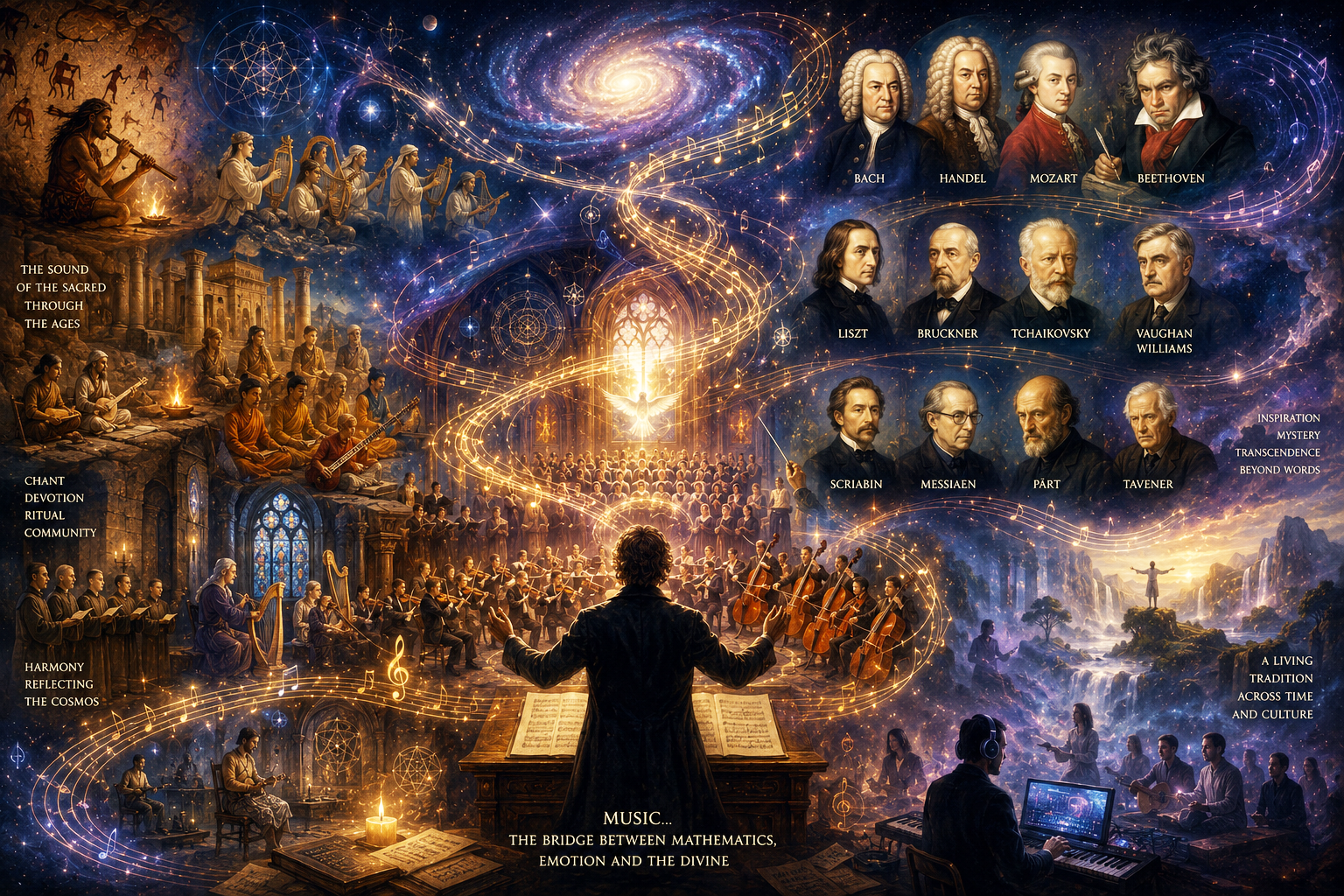
Music has long been regarded as one of humanity's most direct expressions of the spiritual life. Unlike painting or sculpture, it possesses no physical form. It cannot be seen or touched, yet it has an extraordinary ability to communicate emotion, evoke wonder and inspire contemplation. Across cultures and throughout history, music has been used in worship, meditation, celebration, healing and ritual, serving as a bridge between the material and the transcendent. It is therefore no coincidence that many of the greatest composers in history regarded music not simply as entertainment, but as a means of expressing profound spiritual truths.
For centuries, sacred music stood at the heart of Western musical development. The Christian Church provided many composers with both patronage and inspiration, resulting in an extraordinary body of work that continues to shape the world's musical heritage. Yet the spiritual significance of this music extends far beyond its religious setting. Many of these compositions continue to move audiences because they explore universal themes of hope, suffering, redemption, joy, mortality and the search for meaning.
No composer illustrates this more clearly than Johann Sebastian Bach. A deeply committed Lutheran, Bach regarded his compositions as acts of worship, frequently inscribing his manuscripts with the initials S.D.G. (Soli Deo Gloria – "To God alone be the glory"). Works such as the St Matthew Passion, the Mass in B Minor and his numerous cantatas demonstrate a remarkable fusion of technical mastery and spiritual devotion, establishing a standard that has rarely been surpassed.
George Frideric Handel likewise devoted much of his career to sacred music. His oratorio Messiah, particularly the famous Hallelujah Chorus, remains one of the most frequently performed choral works ever written, while compositions such as Israel in Egypt and Judas Maccabaeus drew upon biblical narratives to explore faith, deliverance and human resilience.
Although Wolfgang Amadeus Mozart is often celebrated for his operas and symphonies, some of his most profound music was written for the Church. His unfinished Requiem has become one of the best-known sacred works in the classical repertoire, while his Great Mass in C minor reflects both remarkable compositional skill and a deep engagement with religious tradition.
The relationship between spirituality and music continued into the Romantic period, although it increasingly took more personal and philosophical forms. Ludwig van Beethoven's Missa Solemnis stands as one of the greatest sacred compositions ever written, while the final movement of his Ninth Symphony, with its setting of Schiller's Ode to Joy, expresses an expansive vision of universal brotherhood that many have understood in profoundly spiritual terms. Franz Schubert composed beautiful Masses alongside deeply reflective works such as Ave Maria, while Felix Mendelssohn revived interest in Bach's sacred music and produced celebrated oratorios including Elijah and St Paul.
Other composers found spiritual inspiration through different traditions and perspectives. Franz Liszt wrote numerous religious works after taking minor holy orders within the Catholic Church, including the monumental Christus oratorio. Anton Bruckner combined his deep Catholic faith with vast symphonic structures that seem to reach towards the infinite, while César Franck's organ works and sacred compositions reflected both devotion and contemplation. Johannes Brahms approached spirituality from a more humanistic perspective in Ein deutsches Requiem, choosing biblical texts that offered comfort to the living rather than focusing solely upon the dead.
Throughout the nineteenth century, composers continued to draw upon religious belief, mythology and national spiritual traditions. Antonín Dvořák's Stabat Mater and Requiem remain among the great sacred choral works, while Pyotr Ilyich Tchaikovsky's Liturgy of St John Chrysostom and All-Night Vigil drew inspiration from the rich musical heritage of the Russian Orthodox Church. Gabriel Fauré's gentle and luminous Requiem departed from the dramatic visions of judgement found in earlier settings, instead presenting death as a peaceful passage towards eternal rest. Edward Elgar's The Dream of Gerontius, based upon the poem by Cardinal Newman, traces the soul's journey after death and remains one of the defining achievements of British choral music.
The twentieth century demonstrated that spiritual music continued to evolve rather than disappear. Ralph Vaughan Williams drew inspiration from English folk traditions, hymnody and the natural landscape to create music of quiet contemplation, particularly in works such as The Lark Ascending and the Fantasia on a Theme by Thomas Tallis. Alexander Scriabin developed an intensely mystical philosophy in which music became a means of spiritual transformation, most notably in works such as Prometheus: The Poem of Fire, where he sought to unite sound, colour and consciousness.
Igor Stravinsky, after an early career of radical innovation, returned repeatedly to sacred themes in works including the Symphony of Psalms and Mass. Olivier Messiaen combined his Catholic faith with birdsong, complex rhythms and vivid harmonic language to create music unlike any other, with compositions such as Quartet for the End of Time and Vingt regards sur l'Enfant-Jésus standing among the twentieth century's greatest expressions of spiritual devotion.
In more recent decades, composers such as Arvo Pärt and Sir John Tavener have demonstrated that sacred music continues to hold a powerful place within contemporary culture. Pärt's distinctive tintinnabuli style, heard in works such as Spiegel im Spiegel and Tabula Rasa, seeks simplicity, silence and contemplation, while Tavener's The Protecting Veil and Song for Athene draw upon the traditions of Eastern Orthodox Christianity to create music of profound stillness and transcendence. Both composers have attracted audiences far beyond religious communities, suggesting that spiritual music continues to speak to fundamental human experiences irrespective of individual belief.
While the history of Western classical music provides particularly rich examples, the relationship between spirituality and music is by no means confined to Europe. Sacred chant, devotional song, Sufi music, Hindu bhajans, Buddhist chant, Indigenous ceremonial music, Jewish liturgical traditions, Gospel, Qawwali and countless other musical forms demonstrate that cultures throughout the world have used music to express reverence, celebrate the sacred and deepen human understanding of life's greatest mysteries.
Taken together, these composers and traditions reveal a remarkable continuity. Musical styles have changed dramatically over the centuries, yet spirituality has remained one of the most enduring sources of inspiration. Whether expressed through liturgical worship, personal faith, mystical philosophy, contemplation or the search for universal meaning, music has continually provided composers with a language capable of communicating experiences that often lie beyond words. The history of music is therefore not only a history of artistic innovation; it is also a history of humanity's continuing search for beauty, transcendence and the deeper dimensions of existence.
