
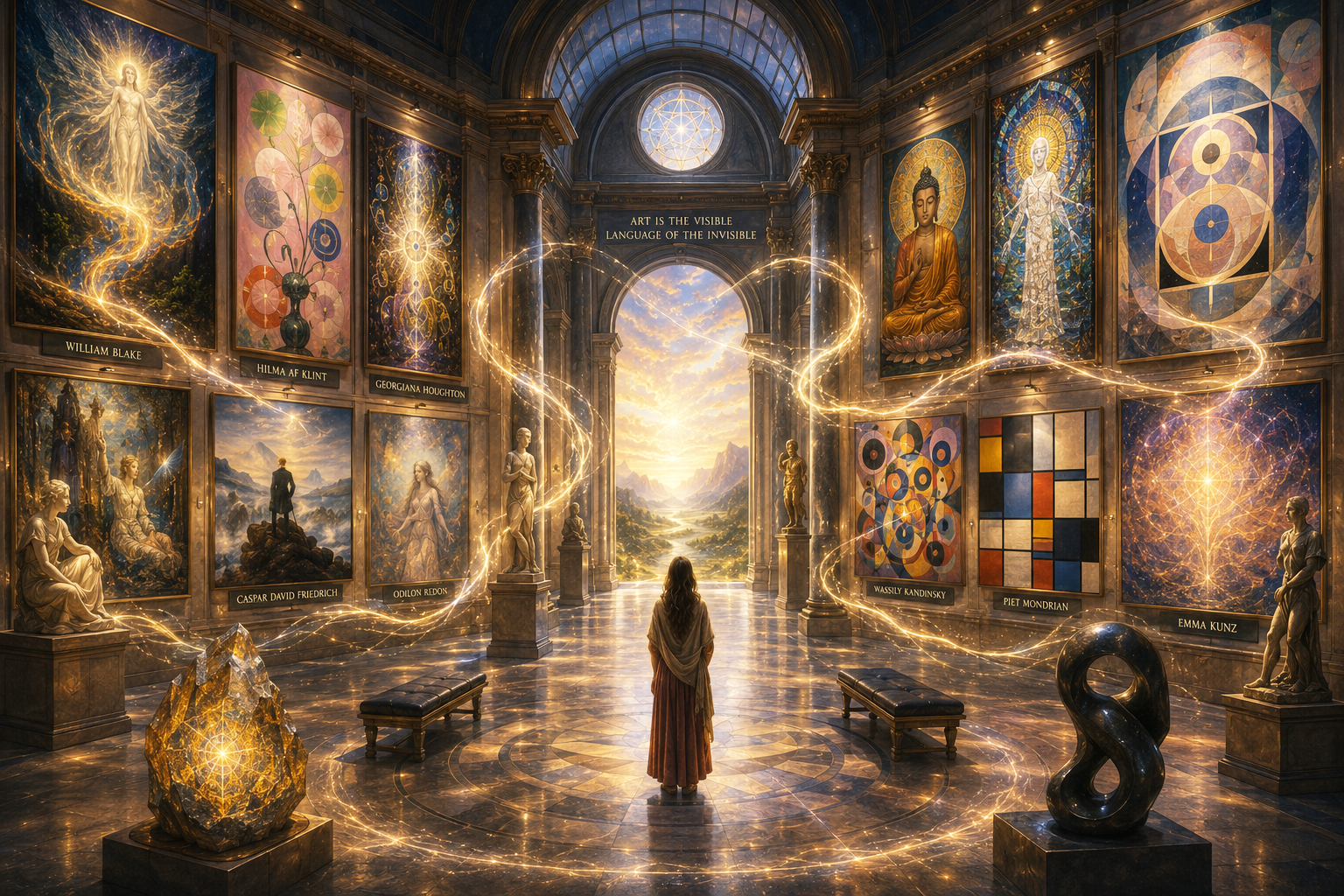
The relationship between spirituality and the visual arts is one of the oldest and most enduring partnerships in human history. From prehistoric cave paintings to contemporary digital art, artists have repeatedly turned to spiritual ideas, experiences and questions as a source of inspiration.
Long before the invention of writing, human beings were expressing spiritual ideas through images, symbols and visual storytelling.
Across cultures and centuries, artists have used their work to explore mystery, beauty, meaning and humanity's relationship with realities beyond the material world.
The history of art is, in many respects, also a history of humanity's spiritual imagination.
The Language of Images
Some experiences are difficult to describe with words.
Artists have long turned to colour, form, symbolism and metaphor to communicate ideas that seem to exist beyond ordinary language.
Through images, they have attempted to depict heaven and earth, life and death, dreams and visions, suffering and redemption, the visible world and the unseen dimensions that many believe lie beyond it.
Art provides a language through which spiritual experience can be explored, shared and contemplated.
Art as a Window into Meaning
Throughout history, many artists have seen their work as more than decoration or entertainment.
For them, art became a means of inquiry.
A way of asking profound questions.
Who are we?
Why are we here?
What is beauty?
What lies beyond the world we can see?
The answers varied.
The questions remained remarkably consistent.
Sacred Art and the Birth of Civilisation
Many of humanity's earliest artistic achievements emerged within spiritual and religious contexts.
Temples, shrines, sacred objects, icons and ceremonial artworks played central roles within ancient cultures.
Art was often used to preserve stories, communicate wisdom and express humanity's understanding of the cosmos.
These traditions can be found across continents and civilisations.
Different beliefs.
Different symbols.
A shared desire to explore the mystery of existence.
The Visionary Tradition
Some artists sought not merely to represent the world around them, but to depict realities they believed existed beyond ordinary perception.
Visionary and mystical art has appeared throughout history, often created by individuals who described profound spiritual experiences, dreams, insights or revelations.
Artists such as William Blake, Georgiana Houghton, Hilma af Klint, Emma Kunz, Agnes Pelton and Madge Gill created works that attempted to give visual form to inner realities.
In many cases, their work was misunderstood during their lifetimes.
Today, many are recognised as pioneers whose influence extended far beyond their own era.
Symbolism and the Inner World
Spiritual art is not always overtly religious.
Many artists have explored spiritual themes through symbolism, mythology, imagination and the subconscious.
The works of Caspar David Friedrich, Gustave Moreau, Odilon Redon, Edward Burne-Jones and others often invite viewers into worlds of mystery, contemplation and wonder.
Rather than offering answers, such works encourage reflection.
They create space for the viewer's own spiritual and emotional journey.
Abstraction and Spiritual Expression
The emergence of modern art opened new possibilities for spiritual exploration.
Artists such as Wassily Kandinsky, Piet Mondrian, František Kupka and Paul Klee believed that colour, shape and composition could communicate spiritual realities directly.
Rather than depicting physical objects, they sought to express states of consciousness, harmony, energy and inner experience.
Their work helped establish some of the foundations of modern abstraction.
Yet at its heart remained a spiritual impulse.
Why Spiritual Art Matters
Spiritual art continues to resonate because it addresses experiences that remain fundamental to human life.
Wonder.
Beauty.
Meaning.
Love.
Loss.
Transformation.
Hope.
These are not merely religious concerns.
They are human concerns.
Spiritual art provides a space where such experiences can be explored without certainty being imposed upon the viewer.
It invites contemplation rather than instruction.
Questions rather than conclusions.
A Living Tradition
The tradition continues today.
Contemporary artists around the world continue to explore spirituality through painting, sculpture, photography, digital art and mixed media.
Some draw upon established religious traditions.
Others explore consciousness, mythology, nature, psychology or personal experience.
What unites them is a desire to engage with realities that extend beyond the purely material.
The tools may change.
The impulse remains.
The Spiritual Artist
At its heart, spiritual art is not defined by style, technique or subject matter.
It is defined by intention.
The spiritual artist seeks to explore, express or illuminate aspects of human experience that touch upon meaning, wonder, transcendence and connection.
Such artists have existed throughout history.
They continue to create today.
And their work remains an essential part of humanity's cultural heritage.
