
Spirituality & Religion
It is often claimed that spirituality and religion are becoming irrelevant in modern life. Falling church attendance, declining religious affiliation and the growth of secular societies are frequently presented as evidence that spiritual concerns belong to the past.
The picture is more complicated.
In the United Kingdom and several other Western nations, traditional patterns of religious participation have changed substantially. The 2021 Census for England and Wales showed that, for the first time, fewer than half of respondents identified as Christian, while the number reporting no religious affiliation rose significantly. Such figures are often interpreted as evidence of an increasingly secular society.
Yet religious affiliation and spiritual interest are not necessarily the same thing. Researchers increasingly distinguish between the two, noting that many people who do not identify with organised religion continue to engage with questions that have traditionally occupied religious and philosophical thought.
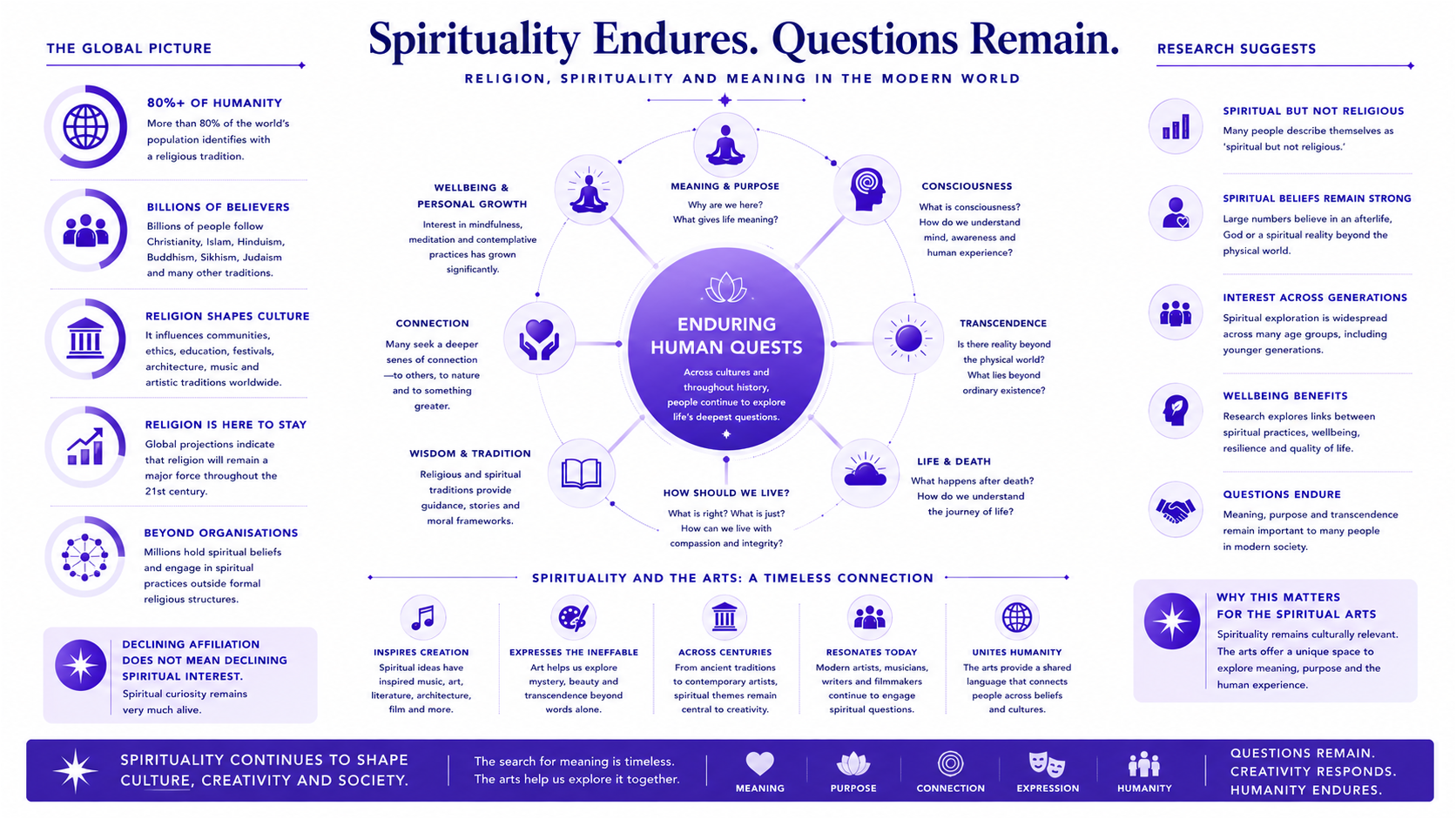
This distinction is reflected in the growing number of people who describe themselves as "spiritual but not religious". They may not belong to a church, temple, mosque or other formal institution, yet they continue to explore questions of meaning, purpose, consciousness, connection, personal growth and transcendence. Practices such as meditation, mindfulness and contemplation have become familiar features of contemporary life, often attracting people whose interests lie outside conventional religious structures.
What appears to be changing, therefore, is not the existence of spiritual curiosity but the forms through which it is expressed.
A wider perspective reinforces this observation. While parts of Western Europe have become less religiously affiliated, religion remains one of the most influential forces in global society. Billions of people identify with traditions including Christianity, Islam, Hinduism, Buddhism, Sikhism, Judaism and many others. Religious beliefs continue to shape cultures, communities, ethics, education, festivals and artistic traditions across the world, and demographic projections suggest that religion will remain a major feature of human civilisation throughout the twenty-first century.
The persistence of religion is perhaps unsurprising when viewed alongside the persistence of the questions from which it arises. Human beings have always sought to understand their place in the world. Questions concerning purpose, consciousness, morality, mortality and the nature of existence appear in every age because they emerge from experiences common to human life itself. Different cultures offer different answers, yet the questions endure.
In recent decades these concerns have also entered discussions surrounding wellbeing. Universities, healthcare organisations and researchers have shown growing interest in meditation, mindfulness and other contemplative practices, many of which emerged from spiritual traditions. Whatever conclusions individuals draw from such practices, their widespread adoption suggests that reflection and inner life remain subjects of continuing interest.
The arts provide one of the clearest expressions of this enduring impulse. Some of humanity's most celebrated creative achievements emerged from attempts to engage with mystery, beauty, suffering, transcendence and meaning. The paintings of Botticelli, William Blake and Hilma af Klint, the music of Bach, John Tavener and Arvo Pärt, and countless other works across centuries demonstrate how deeply spiritual themes have shaped artistic culture.
That relationship did not end with the past. Contemporary artists, writers, musicians and filmmakers continue to revisit many of the same questions, translating them into forms that speak to modern audiences. The language changes; the underlying concerns remain recognisably human.
For The Spiritual Arts Foundation, this continuity matters. The Foundation exists in recognition that spiritual inquiry remains a living part of culture, whether expressed through religion, philosophy, contemplation, personal belief or creative exploration. The arts offer a distinctive space in which such exploration can occur, allowing questions that resist easy answers to be approached through imagination as well as reason.
The evidence suggests that spirituality has not disappeared from modern life. Rather, it has become more varied in its expression, less tied to particular institutions and more likely to emerge across multiple areas of culture. The enduring presence of spiritual themes in art, thought and human experience reflects something deeper than changing patterns of affiliation: a continuing desire to engage with questions that cannot be answered once and for all, yet continue to shape how people understand themselves and the world around them.
Key Findings
- Although religious affiliation has declined in parts of Western Europe, religion remains one of the most significant social and cultural forces in the world.
- More than 80% of the world's population identifies with a religious tradition.
- Millions of people who do not identify with organised religion continue to hold spiritual beliefs and engage in spiritual practices.
- Interest in mindfulness, meditation, consciousness, wellbeing and personal growth has grown significantly in recent decades.
- Spirituality and religion continue to influence art, music, literature, film and culture across the globe.
- The evidence suggests that questions of meaning, purpose and transcendence remain important to many people in modern society.
Sources & Further Reading
Office for National Statistics – Census 2021 Religion Data
https://www.ons.gov.uk
Pew Research Center – The Future of World Religions
https://www.pewresearch.org/religion
British Social Attitudes Survey – Religion and Belief Trends
https://www.bsa.natcen.ac.uk
World Values Survey
https://www.worldvaluessurvey.org
Theos Think Tank – Religion, Values and Society
https://www.theosthinktank.co.uk
YouGov – Religion and Spirituality Surveys
https://yougov.co.uk
Pew Research Center – Spirituality and Religion Studies
https://www.pewresearch.org/religion
