
The Value of Music
Music is often discussed in terms of feeling rather than finance. It shapes memories, reflects cultures and gives expression to experiences that can be difficult to capture in words. Yet alongside its artistic power lies another reality that is sometimes overlooked: music is also a substantial economic force.
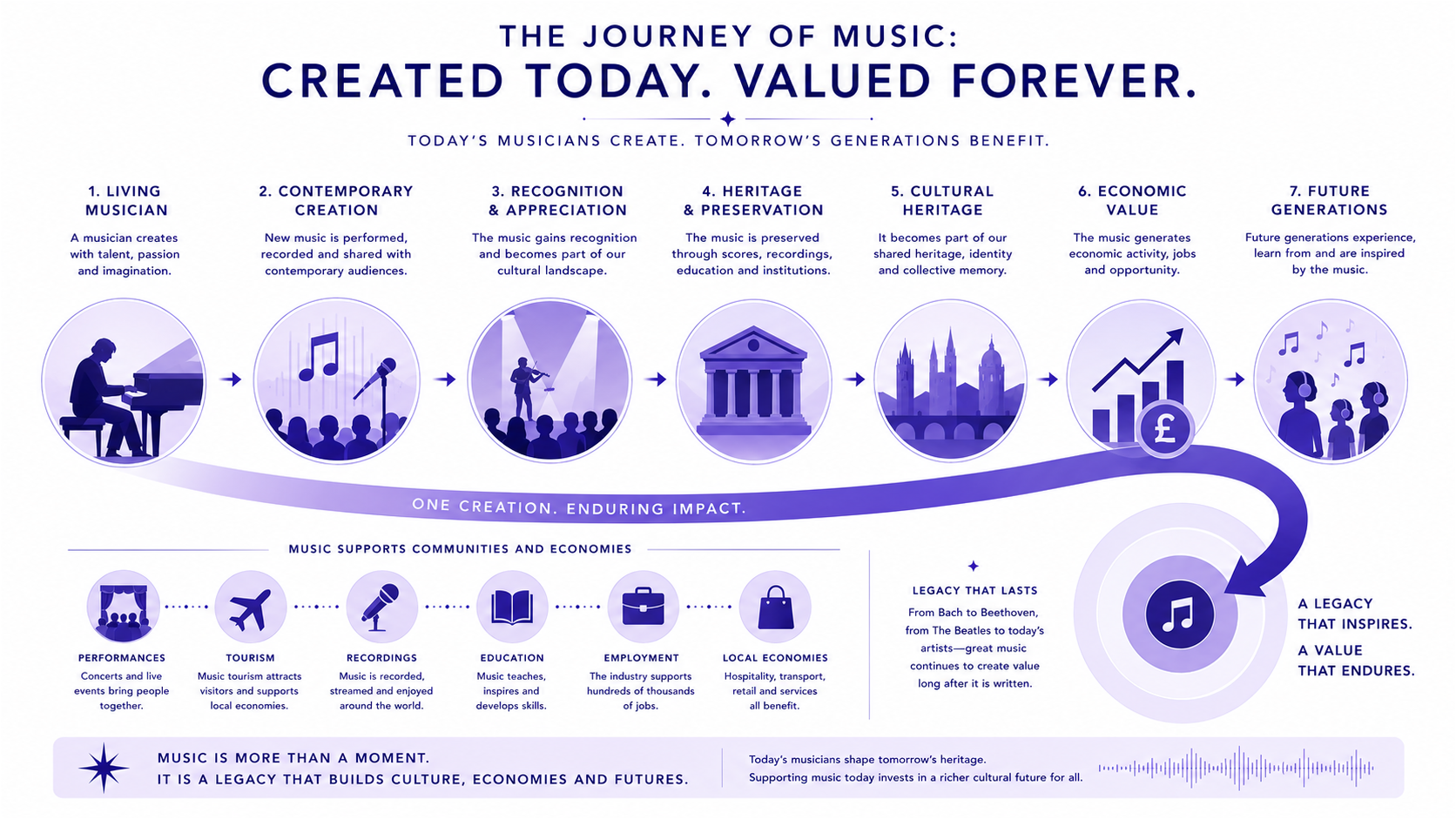
Across the world, it generates employment, attracts visitors, sustains businesses and contributes billions to national economies. Its influence extends far beyond concert halls and recording studios into tourism, hospitality, education, broadcasting, publishing and a host of related industries. Few cultural activities possess such a wide economic reach. Fewer still continue creating value centuries after the original work was produced.
In the United Kingdom alone, the music industry contributes approximately £8 billion annually to the economy and supports around 220,000 jobs. Those figures encompass far more than performers and composers. They include educators, producers, engineers, broadcasters, venue staff, publishers, technicians and countless others whose work depends upon musical activity. What is often viewed primarily as a cultural endeavour is also a major economic sector woven deeply into national life.
The scale of music's influence becomes particularly visible through tourism. Millions of people travel each year to attend concerts, festivals and performances or to visit places associated with artists and musical history. In doing so, they support hotels, restaurants, transport providers, retailers and local services, creating economic activity that extends far beyond the event itself.
Recent estimates suggest that music tourism generates approximately £10 billion in economic impact within the United Kingdom and supports around 72,000 jobs. Similar patterns can be seen internationally, where music tourism has become a rapidly expanding market worth billions of dollars. Cities and regions increasingly recognise that musical culture can attract visitors as effectively as architecture, heritage sites or sporting events.
Yet perhaps the most unusual aspect of music's economic contribution is its longevity.
Most industries rely upon products with finite commercial lives. Music often operates according to a different logic. Audiences continue paying to hear the works of Johann Sebastian Bach, Wolfgang Amadeus Mozart, Ludwig van Beethoven and George Frideric Handel more than two centuries after their deaths. Their compositions still generate revenue through performances, recordings, broadcasting, publishing, education and licensing.
A musical work does not necessarily lose value once it has been created. It can be performed by new musicians, interpreted in new ways and discovered by new audiences across successive generations. Few forms of human endeavour continue producing both cultural and economic returns on such timescales.
The same principle can be observed in more recent history. Liverpool's association with The Beatles has become one of its defining cultural assets, attracting visitors from around the world. Similar examples can be found in places connected with Elvis Presley, ABBA and other artists whose influence continues long after their most active years.
The Beatles remain a particularly striking case. With estimated sales exceeding 600 million records worldwide, they are still the best-selling music act in history. What began as a local band performing in small venues evolved into a cultural legacy that continues to generate tourism, commercial activity and public interest across multiple generations.
The durability of music's economic value reflects something deeper than commercial success alone. Musical works become part of collective memory. They contribute to education, cultural identity, community pride and a sense of connection with the past. Societies preserve musical heritage not simply because it generates revenue, but because it carries stories, traditions and experiences that people continue to find worth passing on.
This perspective also changes how we view contemporary artists. Every work now regarded as part of the world's musical heritage was once new and uncertain. Mozart was a living composer seeking audiences and patrons. Beethoven was writing for the listeners of his own era. The Beatles were an unknown local group trying to find opportunities wherever they could.
Their future significance was not self-evident. The value later generations would place upon their work could not be measured when it first appeared.
For organisations such as The Spiritual Arts Foundation, that lesson is particularly relevant. Society clearly invests heavily in musical heritage, preserving it, performing it and deriving substantial cultural and economic value from it. Yet every part of that heritage began with living musicians experimenting, creating and taking artistic risks.
Supporting musicians today is therefore about more than sustaining individual careers. It is about contributing to a cultural inheritance whose full significance may not be understood for decades.
The enduring commercial value of historic music ultimately reflects a simple truth: people continue to invest in what continues to matter to them. Concert tickets, recordings, tourism and preservation efforts are all expressions of that choice. Music survives economically because it survives culturally. Long after its creators have gone, it remains capable of finding new listeners, new meanings and new reasons to be heard.
Key Findings
- The UK music industry contributes approximately £8 billion annually to the UK economy.
- The industry supports around 220,000 jobs.
- UK music tourism has generated as much as £10 billion in annual economic impact and supports tens of thousands of jobs.
- The global music tourism market is worth billions of dollars and continues to grow.
- Historic composers continue generating economic value centuries after their deaths.
- Music heritage attracts visitors, supports local economies and contributes to cultural identity.
- The music celebrated today was once contemporary creative work created by living musicians.
Sources & Further Reading
UK Music – Economic Contribution Reports
https://www.ukmusic.org
Music Tourism Convention
https://www.musictourismconvention.com
UN Tourism – Cultural Tourism Research
https://www.unwto.org
IFPI Global Music Report
https://www.ifpi.org
British Library Sound Archive
https://www.bl.uk/sound-archive
The Beatles Story
https://www.beatlesstory.com
Gramophone Magazine
https://www.gramophone.co.uk
Royal Philharmonic Society
https://royalphilharmonicsociety.org.uk
UNESCO – Intangible Cultural Heritage
https://www.unesco.org
International Music Council
https://www.imc-cim.org
