

Kevin Kendle is a world-renowned composer and synthesizer musician whose 30+ albums are adored by fans around the world for their exquisite beauty and peaceful, pastoral atmospheres. Recording in his studio in Hertfordshire, Kevin's music reflects the beauty and majesty of the natural world, along with an indefinable something that many cite as spiritual in nature. We asked Kevin to elucidate on this, and on his spiritual journey.
The style of music I create is often labelled as “New Age,” a label which, if I’m honest, I’m not that fond of. It’s a pigeonhole that’s used when instrumental music doesn’t really fit into any of the traditional genres, and covers a vast gamut of styles. My music is created from the heart, and is most definitely not financially inspired – if this were the case, I’d have given up long ago..! There is something deep within me that drives and inspires me to create gentle, instrumental music, that some also describe as “healing.”
I have long been aware of the power of music to alter and enhance moods, right from a very early age. One of my earliest memories, in fact, is a recurring dream that I had around the age of three. I say this, because my sister hadn’t been born at the time, and there are three years between us. My parents’ house backed onto a rather picturesque golf course, and the dream featured lots of coloured lights – like the headlights of multiple vehicles – all moving around on the golf course – it was mesmerising. This was accompanied by strange but beautiful, hypnotic music – featuring repeating patterns. A seed must have been subconsciously sown by this, which did not really germinate fully until my final year at middle school, when an “epiphany moment” occurred… More on that in a moment…

I also remember being baby-sat by my grandparents at a really young age, again before my sister had arrived on the scene, and being instantly moved to tears by the popular version of “Amazing Grace” that topped the charts in the 1970s, which they put on the record player. It proved to me beyond any doubt that music is a very powerful, universal force that MOVES the emotions – right from that very early age. My Mum and Gran were both very spiritual people, but the word “religion” has always made me very uncomfortable, and still does to a degree. For instance, I would happily chat with my Gran about astral travel, mantra, reincarnation, leaving the physical body, and similar subjects as though it was the most natural thing in the world aged 8 or 9. However, I associated orthodox religion with conflict, disagreement and hatred. So I would call myself spiritual, while shying clear of “religious.”
Having said that, my music, while not actually intentional, has been described as spiritual, and I’ve received many letters and messages over the years telling me how much it has helped people over bereavements, illness and difficult times in their lives. And this is one of the things that I’ve come to be most proud of.
In the meantime, the years leading up my “epiphany moment” saw my parents spot some kind of musical ability in me, when I apparently used to sing harmonies to nursery rhymes and school hymns. This led to me having piano lessons around the age of 8, which I confess I didn’t much enjoy. Three years later, I was on the point of giving up, bored with the having to practice the endless scales, arpeggios, exams and having to learn pieces of music I didn’t much like. And then the epiphany happened…

One morning, in the school assembly, we all sat down on the floor in the school hall as we did every morning. Usually, there’d be some “child-friendly” classical music playing, such as “Peter and the Wolf” or such like, but on this particular occasion, some strange, hypnotic music featuring repeating patterns suddenly filled the air and I was instantly transported back to my recurring dream, with all the strange coloured “headlights” moving around on the golf course. I was completely transfixed, and listened like I’d never listened to anything before. After the assembly, I rushed off to find the music teacher, who told me it was Mike Oldfield’s “Tubular Bells.” I just HAD to have the record, and pestered my parents relentlessly until they kindly bought it for me. I played it equally relentlessly and found it utterly amazing that Mike Oldfield had played all the instruments himself – and from that moment forward, music was ALL I really wanted to do, as if a light switch had been turned on in my head. I started writing my own pieces for piano, and by the end of that school year, I was performing my own music in the same school assembly. Were it not for that early dream, and hearing “Tubular Bells” on that fateful day, I can categorically state that I would not be doing music today. I went on to achieve Grade 8 in piano as a result.
My newly-found love of music meant that I ended up going to a different high school than the “default” school that most went to, and it had a wonderful music department with an equally wonderful music teacher, who encouraged my emerging musicality – even letting me take home the school synthesizer at weekends! I also was able to learn classical guitar, oboe and even church organ.
Fast forward to 1992, and, having played keyboards in “conventional” pop and jazz/funk bands for several years, (including the outstanding soul vocalist Noel McCalla’s band for 5 years in the early 1990s) – I produced my first album of nature-inspired “New Age” music, called “Watermusic.” Digital studio technology had advanced to the point where it became (almost) affordable to record at home in CD-quality, even though cassette was still the only affordable method of duplication back then. I was able to start up my own record label to release my own music on in 1994, and called it “Eventide Music,” doing all my own distribution as well as composing, playing, recording and production myself – a true “one-man band..!”

As well as being inspired by nature, the wonders of space have always deeply inspired me with a spiritual intensity, and I had always wanted to produce music to evoke the feelings of wonder that looking up into the night sky conjured up inside me. But it wasn’t until 2003 that synthesizers had evolved to a point where I could do justice to this most Divine of subject matter. As the music was much more ethereal and “floating” in its atmospheric sound, I released it under a sub-series I called “Deep Skies” – and this series continues to this day, with six albums of “spacemusic” released under this moniker at the time of writing.
I also worked closely with the Aetherius Society in 2015, creating the music for the album “Rise” – to accompany a series of spoken work meditations, originating from Cosmic sources. The research I did for this album led me to discover and understand better its founder, Dr George King, in great detail – and the simply extraordinary things he brought to this world. It’s best that one discovers this for themselves rather than go into detail here, but I had the great benefit of working with those who knew him personally and who were able to answer any questions I had. Sometimes the Truth really is stranger than fiction… So amazed was I during this time working on the “Rise” music, that I joined the society and have been a member ever since. I strongly felt that this connection arose as a direct result of my music – it found me, in other words. I have since discovered that the Aetherius Society had been using my music in their various incredible activities for at least 20 years, which is indeed a great honour, of immense proportions. And when, for contractual reasons back in 2004, I had to choose a pseudonym under which to create music for a different record label (other than the one I was signed to,) rather than use my own name, straight away the name “Aetherium” popped into my head, at least a decade before I really knew anything of the Aetherius Society.
Coincidence..? There’s no such thing…

When I was born, in the midst of a wild snowstorm, my grandma took one look at the caul over my face and turned to my mother, saying, “Yes, you have a gifted child here.” Grandma Mac was a seer, the local Wise Woman, and all the local people would come to her for advice; she could talk to spirits and angels but wasn’t allowed to develop her gifts because of the family’s Catholic faith. Nevertheless, as I grew up in the small Yorkshire mining town of Maltby, she taught me all she knew about natural remedies and opening the mind to the world of spirit.
At an early age it became clear that I had inherited her gifts of mediumship. I could see people’s auras and know if they were unwell or unhappy, I could read tealeaves and I always knew if there was danger ahead on our walks in the countryside. When my Grandad died, I saw a mist rise from his body, the silver cord breaking, and then heard him speak seriously to me in my mind saying, “You need to look after your Mam.” A few days later my father left us for another woman and Mam had a nervous breakdown; I suppose that caring for her and for my younger sisters was my first experience of nursing.
All the same, I had no ambitions for that kind of career. I wanted to be a circus acrobat or a mechanic in the Women’s RAF like my Mam, but I had no qualifications. It seems that the universe had a plan, though. There was a definite ‘presence’ beside me at the Job Centre and the first post I saw advertised was for a Nursing Auxiliary at the local hospital; perhaps they were short-staffed because I was offered the job immediately.
And so began the most extraordinary career…
For more than thirty years I worked in hospitals, especially the A&E departments, and in the community, rising to Senior Nurse and even gaining a Bachelor of Medical Science degree in Professional Nursing practice. I specialised in wound care, teaching doctors and other nurses. But every day, I was having to hold my tongue and not let on about the spirits, ghosts and angelic beings that I could see and communicate with in the hospital wards, resuscitation rooms and theatres! It would not have been appropriate to talk of these things because you never knew how others would take it.
For example, one day the Red Emergency Phone rang to tell us that people involved in a road traffic accident were coming in, one of them a lady who was eight months pregnant with internal injuries. She was losing a lot of blood and the doctor warned me that she may lose the baby. Indeed, he examined her and wrote down ‘No foetal heartbeat’ on her notes. Then I clearly saw a Chinese spirit, a man wearing a white coat and a gold earring, put his hand on her abdomen. The baby moved. The doctor and I were both stunned (for different reasons) and she had a healthy baby boy an hour later by Caesarean Section. Well, I couldn’t tell the doctor what had happened, could I?
Actually, though, I came to realise that many other nurses were quite aware of spirit visitors, especially the Grey Lady in a World War I nursing uniform, who often appeared to comfort a patient just before they passed over. My ‘secret’ was soon out and I would be plagued by requests for psychic readings during our lunch breaks.
Sadly, though, one day I hurt my back badly while helping a patient and had to retire early from the work I loved. I even then suffered a brain haemorrhage and was very ill for three years. But it turned out that I was just being prepared for a new career as a psychic medium and writer! I took a mediumship development course and began to develop an even closer relationship with the worlds of spirit. Before long, I met my principal guide Black Feather, a Native American, and realised why I could always smell burning wood when I did a reading. During a deep meditation, I clearly saw this craggy-faced man with one black feather sticking out of a headband, sitting beside a camp fire.

At one psychic event, a spirit lady with red hair and wearing a silver dress met me as I walked in. “My name is Lynne – with an E,” she stressed. “My friend is coming to see you today so please tell her I’m here.” As I started my eleventh reading that day, the lady reappeared and said, “This is my friend, we were school friends. Please say thank you to her.” My client gasped with delight when I described the spirit lady and passed on the message.
“Don’t you know who it is?” she said. “It’s Marti Caine, the singer and comedian. We grew up together and were best friends.” It turned out that the famous performer’s real name was Lynn Shepherd. But why she was so persistent about an E at the end of her first name? Her friend replied, “She thought it was posh so she used to add it to her real name.” So that was pretty good evidence of the afterlife!
I have now given hundreds of private psychic readings and have many regular clients. And in my area I have even developed a particular reputation for finding lost animals; normally I use a pendulum over a map for this but I am also often guided by Black Feather or other spirit people. In fact, I am a great animal lover and pets will also often appear during personal readings.
You could even say that my devotion to animals led to my third career, as an author, rather unexpectedly in my late sixties. Story-telling was always part of my family’s culture and of course by now I had so many ghost and spirit stories to tell, especially of my time as a hospital nurse. At first, I wrote several articles on the paranormal for national magazines and then had the idea of putting all my untold stories together in a book, to help and encourage others in their spiritual lives. But which publisher to approach? I asked my spirit guides for a ‘sign’ and when I then walked into my local animal charity shop, two Local Legend books practically jumped out at me…
My own book, Ghosts of the NHS, was accepted straight away and, to my amazement, became a number one bestseller on Amazon. This has been followed up by The Angels Beside Us, more stories from the NHS front line, and Furry Spirits, communications with spirit pet animals and accounts of the incredible psychic talents of animals.
I am happy that this wonderful life has given me so many opportunities to help others with my gifts and bring knowledge of the spirit worlds to the public. These days, you will often find me at our caravan in Whitby, writing and working at my hobby of making dolls. Then I may be people-watching at the harbour or sitting outside Whitby Abbey, waiting for the ghosts to introduce themselves!
Glynis Amy Allen’s bestselling books are published by Local Legend as paperbacks and eBooks. They are available worldwide at any book store and in all digital formats.

Rawz is an MC and Poet. Growing up in one of the UK’s most deprived areas, Northfieldbrook (Greater Leys) in Oxford, he first discovered lyric writing in his early teens. It was an essential way to channel his emotions and organise his thoughts. A self guided therapy.
Music had always been a big part of his home environment, listening to music was something that he always loved doing. It was in his teens, aged about 14 or 15, that he started to consciously think about making music himself. He was drawn to Hip Hop lyrics because they talked about a lot of things that he was going through; poverty, dad not being around, violence, police harassment, friends being so close they felt like family, being on the outside with no hope of finding a way in. He didn’t really hear any other forum where that was being talked about in a way he could relate to. He wanted to tell his story, to start writing his own lyrics.
He learned by copying. Figuring out how it was done by learning other rappers’ tracks. He can remember rapping along with people like Tupac and Notorious B.I.G. trying to figure out ‘How does he do this? Where do the rhymes land? How does it fit with the beat?. The first was Coolio’s ‘Gangster’s Paradise’ – He bought it for his mum for her birthday. She liked the song but Rawz’ reasons for choosing this present were at least a little bit selfish. He spent the next weeks and months listening to it on repeat for hours at a time, learning every single word.
Rawz started to want to develop and understand his craft, and went to a poetry course that was being run at a local community arts centre called Fusion Arts. That opened his eyes to seeing what he was doing as a form of art: he had never looked at it in that way before. It also gave him more tools to think more about what he was writing: thinking of every word on the paper as a choice, thinking about what he was saying and who he was saying it to. The leader of the course; a poet named Steve Larkin, was impressed and asked Rawz to help out the next time that he ran it. That led to travelling all over Oxfordshire for the next year or two, working in different spaces, teaching poetry to young people. This helped Rawz grow as an artist, to refine his craft, and to think about how it was done, why he was doing it.
Since then, Rawz has performed his craft all over Europe both as a solo artist, and with the Inner Peace Records collective which he helped to form alongside other artists from Oxford and London’s Hip Hop scenes. He has collaborated with musicians from all over the world and shared stages with some of his childhood heroes. Rawz’ music and lyrics share his exploration of our interconnected worlds, and his responses to them, promoting outer change and advancement through inner reflection and positive action. He does this while covering an unlimited range of topics including love, capitalism, nature, community, crime, science, religion and more.

Rawz developed a project recently called ‘Digging Crates’ working in collaboration with friends and colleagues from Inner Peace Records and the Pitt Rivers Museum in Oxford. In it’s essence the Digging Crates project is about healing multi-generational trauma – the legacy of colonialism and slavery. Rawz and colleagues from Inner Peace Records worked with a group of African musicians to explore the museum’s collection of African musical instruments and some of the other items that were taken from Africa by British colonisers. They worked to reinterpret the objects from the collection, taking audio samples from some of the instruments in the collections and also from recordings made of the musicians playing their own music inside the museum. These samples were then used to create new Hip Hop tracks which were also written and recorded inside the museum. Rawz recalls: “This was a hugely spiritual experience for me. I had underestimated the spiritual impact that it would have on me – I thought that it was just going to be fun to make tracks in the museum and sample some old instruments but actually, the project gave us a way to talk about the weight of the history of slavery and the outrageous abuses of the British Empire and colonialism, and share our views with each other. It gave us a chance to inform academics and researchers in the field about the impact that it’s had on us as non-academic people that are living with the legacies of these events.” A documentary film was made of the process, alongside an 8 track album (available at diggingcrates.bandcamp.com).
Rawz looks at music as a language: “Someone once said to me that music is what emotions sound like. That makes total sense to me. You can hear a chord on the piano, or a strum of a guitar, or a sample, and that can express feelings more vividly than hours of conversation. It’s an amazing tool for engaging with people and helping people to express themselves, and for understanding people.
I think that maybe the most important thing that writing lyrics and making music has given me, is that it helped me to realise the power that I have to control my own destiny, and the power and influence that I hold over others through what I choose to do and say. I think the reason that I started writing was partly because I felt voiceless, powerless. I had a vague notion that if I could get good enough at rapping, people would start listening to what I had to say. Now people are starting to listen.”
From leaving school with no GCSEs, to becoming Resident Sound Artist at one of the world’s most prestigious learning institutions, Rawz’ story is one of extreme contrast, determination, and triumph against the odds. Themes that he expertly explores with his lyrics and Spoken Word. An experienced youth worker and teacher, Rawz set up The Urban Music Foundation in 2009, through which he delivers a wide range of creative and learning activities in a variety of settings.

My most recent book, Awakening the Lotus of Peace is a spiritual workbook of yoga meditations to experience more peace in your life. This book, like all my previous books, sprang from a revelation: an influx of light, colour, concept and a feeling about what the book would encapsulate as a whole. These revelations arrive in that spiritually-charged moment between sleeping and waking when we are most receptive to spirit before we assume the mantle of the day. I feel like I have been charged with writing a book which has already been written in the astral world and all I, the body in the earthly realm, need do is to tap into its vibration and download it. This experience is magical! And rich to taste, touch, sound (like tinkling bells) and vision: the book appears in front of me so that I can see the cover and turn the pages in my mind. I feel my role is just to actually ‘birth’ it in the 3D world which has been conceptualised and empowered by higher vibrational beings than I.
My process of writing is to re-read the previous paragraph and then listen. Immediately, the next words pour into my mind as if they are being dictated. I type directly into the laptop: listening and typing for two hours. Once in while I take notes, an idea of supplementary material pops into my head to give context or aid the structure but largely, I type without taking notes.
There is a different creative process for the guided meditations in Awakening the Lotus of Peace. These were channelled through me to my yoga meditation classes during which we worked on embodying aspects of peace over an eighteen month period. First, I tune into God and my spiritual lineage through Paramahansa Yogananda with a prayer and ask for their guidance and blessing for my students. I experience that a second before I speak, the guided meditation script arrives as feeling and impressions via spoken words, mental pictures or feelings. Over the 5 years that I have been teaching meditation, I have come to trust that the guidance is always right for the group. Even if my ego-mind might question the relevance of a visualisation, there is always someone who later relates how much that was just what they needed to experience at that time.
As far back as I can remember, I’ve been aware of the unseen realm and a feeling of needing to live wisely to make this life count. That’s why I chose to go vegetarian in 1969 aged 6, the year of the 1st moonwalk. I was also waking in the night at this early age to a power and heat rising up my spine which expanded into elevated state until I illuminated the room as a sphere of blue light. Was I floating above the bed? Or simply beyond the boundary of my tiny physical frame? I had no words or frame of reference to describe it but after an hour or so, the power would recede and I could move the body once more. It didn’t seem strange and I don’t remember telling anyone. I just accepted the kundalini awakening as normal.
My mother introduced me to yoga and I loved it! I received my first yoga book for my 9th birthday. Meditation naturally followed and I taught myself to meditate at 14, again with that gut feeling that it was vital to start early in life and I’ve rarely missed a day since. I feIt that there was no time to waste and a long road to travel to elevate my level of spiritual consciousness to make a difference in this world.
In my twenties, I was moved to train as a spiritual healer when I heard Ian De Coster speak at a MBS Fair in Glasgow. I was mesmerised by a electric blue surrounding his head which moved with him on the stage. I had seen my first aura! Afterwards, I plucked up my courage to speak with him and he directed me to train with National Federation of Spiritual Healers. That course was the obvious next step for me and it resurrected my dormant kundalini energy again. Suddenly, I was aware of my spirit guide and learned to trust his energy signature and his suggestions as ‘feelings’, not words. I could see streamers of energy between a person and the healer’s hands. I experienced being ‘donned like a surgical gown’ as my guides inserted their arms into mine, while I was channelling spiritual healing.
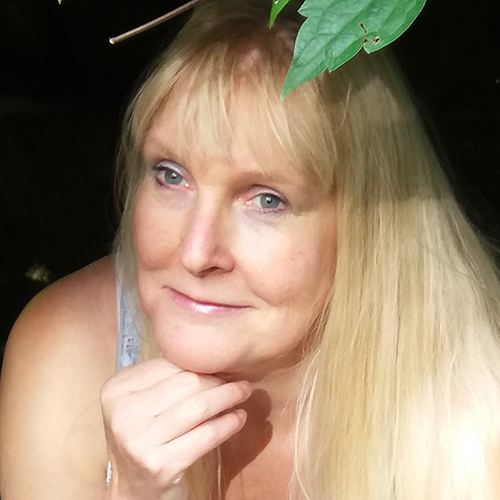
While I experienced an acceleration of my spiritual ascension, I also became acutely aware of dense, closed areas in my aura at the heart and sacral chakras: my ego issues. I have prayed many times to ask Christ to cleanse me of darkness and to fill me with Light.
For me, meditation is a process. Techniques to shed the density of living in a physical body and to raise one’s spiritual vibration higher and higher and to burn off lower vibration knots of karma in the crucible of concentration, on the Divine Oneness. Maintaining a higher and higher consciousness by handing over all issues and density with oodles of trust that the Divine is helping us at every turn. Even when things seem dark, being aware that everything is perfect for what we need to learn at that time, even when we don’t like the lesson!
The spiritual path isn’t all dry mechanical meditation. Love is needed too. My devotional heart burst open wide when I read Autobiography of a Yogi in 2015. Intuitively I knew that here was a man who could take me to God. At last, my spiritual soul searching (of many life-times) had led me to my spiritual master in Paramahansa Yogananda! His vibration fills me as I read his words. I know that this was waiting in the eaves as my path. After all the spiritual exploration of Spiritualism, Findhorn, Spiritual Healing, Shamanism, Dowsing and yoga, I have been guided to The One Path. I feel blessed.
At the time that I wrote ‘Awakening the Lotus of Peace: yoga meditations for inner peace’, I wasn’t to know just how important the inner search for peace was to become as our world spiralled into tumult. This book feels right: the right place, the right time for our stage in human evolution. It is each individual who endeavours to carry inner peace that helps manifest world peace.
Blessings on your own inner journey for peace, Om Shanti, Jenny Light.
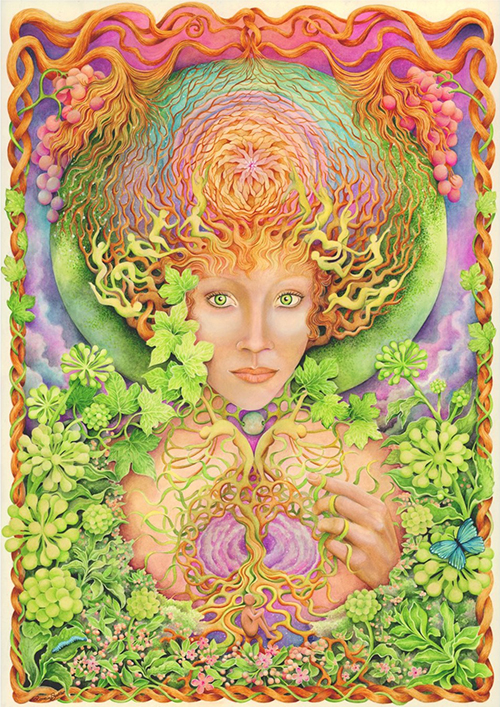
Lorraine describes her paintings as metaphorical mindscapes that materialise from a profound desire to share with others the awe she feels for the natural world. It is a wonderment fuelled by interests in both the natural sciences as well as in the metaphysical realms of fantasy and imaginary realism.
To Lorraine they are intertwined, she believes that to acquire an understanding and appreciation of the earth and its ecological systems and to be cosmically curious is to inevitably bring oneself closer to spirituality, for an awareness of the interconnections throughout the natural world cannot be held without an awareness of ones being beyond the self. To be curious of our place in ‘the grand scheme of things’ is to recognise an identity beyond the ego and to surrender to the mystery of the unknown and unknowable.
Natured and nurtured amid the tranquil surroundings of rural Eastern England, an affinity with the natural world was perhaps inevitable for this artist. A self-confessed dreamer Lorraine admits that she has always lived with her head not far from the clouds both literally and metaphorically speaking!
Much of her childhood was spent out of doors cycling, walking, and climbing trees. Lorraine describes herself as a quietly observant and escapist child who loved to read, write, and draw. Her creative abilities and drawing skills were recognised by a high school art teacher who encouraged Lorraine to pursue an artistic path.
In adulthood she trained in the visual arts, contemporary dance, and aerial circus arts. She went on to have a varied performing career in theatre, circus and later in stunt wing walking. Alongside this she produced her first professional body of artwork which was a collection of finely rendered Wildlife Art drawings inspired by some time spent in Africa. Lorraine was delighted to receive international sales for her drawings but her performing career took precedence over her painting career for a number of years.

Lorraine eventually returned to professional painting with a style now rich in colour and imagination. She attributes her new artistic approach to her experience as a performer, her good fortune to have travelled extensively and to the regular practise of yoga.
As a dancer and aerialist, the practise of yoga helped Lorraine to maintain the strength and flexibility to physically support her career but it also served to provide her with a means of meditation and thus a gateway to accessing her intuitive artist within. She explains her current creative process as being a synergy of physical observation, mindfulness, and intuition. At the heart of Lorraine’s philosophical and richly symbolic art is a process that beats to a palpable rhythm of spirituality.
Lorraine believes that there is an essence to all of nature, an elemental pulsating spirit tangible through vibrating forces and endless interplays of subtle energy. The human experience is but one thread woven within a wondrously diverse tapestry of life rich in patterns, colour, and texture. Lorraine hopes to incite appreciation and mindfulness of the systems and rhythms of our beautiful existence.
By merging studies of nature with philosophical ideas and elements of the esoteric her paintings are journeys of connection. She endeavours to reintroduce the human spirit to its cosmic origins and to unify the soul with its physical environment.
Lorraine has recently worked in collaboration with a US publishing company to have a collection of her work printed as an Oracle deck. The artist authored inspirational passages to accompany each of her 52 selected paintings. The deck will be released for public sale in early mid-2023. She is currently working on an epic 78 new images for an upcoming contemporary tarot deck for the same publisher.
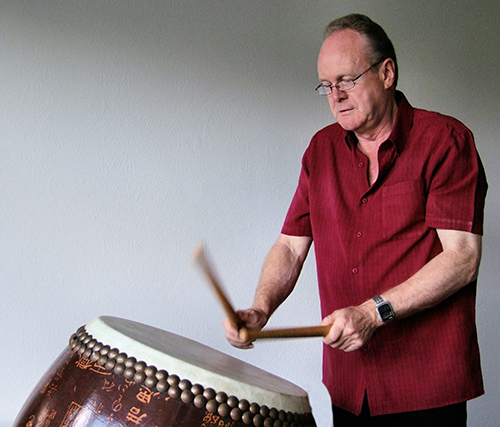
James Asher is an established recording artist with more than 50 albums bearing his name. Comprising of solo albums, library albums and collaborations spanning his 50 years in the music business, James Asher’s music is well known and widely shared, with many of his videos exceeding 100,000 views on YouTube, and Spotify followers in excess of 30,000. In addition, his music has been extensively sampled and used as the basis for other tracks, including the massive seller Corso, by Tyler the Creator. However, James has a significant spiritual aspect to his music that may be little known to his fans. We caught up with him at his studio ‘Starfield’ in Eastbourne to chat about this, and about his musical history in general.
From James Asher’s earliest memories he was made to feel at home and comfortable with music. His father was a teacher of languages and music at a local preparatory school, and he ensured that James began violin lessons at the age of seven. When James was twelve, his father taught him some rudimentary blues styles on the piano, which empowered James to begin improvising on the keyboard. James also enjoyed singing alto parts in the choir, led by his father on organ, and this expanded his grasp of musical structure.

Although James found learning a traditional instrument such as the violin to be an interesting discipline (although his violin teacher always seemed to arrive from having crashed his car, or being distracted by other earthbound mishaps!), his teacher would also enthuse about the teachings of Krishnamurti, the philosopher, speaker and writer. This was to be James’ first introduction into the world of the spiritual. His teacher would encourage James to breathe, and to listen to the wind, and this dual interplay between the grounded-ness of the real world with the realms of the mystic and of the spiritually engaging, would set the stage on which the dynamics of these parameters would play out in James’ music during the years to come. James would spend many years navigating his best path through these mysteries, often struggling to unpack and access the core authentic elements within.
In addition to violin, somehow James happened upon drums, and what an exciting prospect they were! James immediately felt at home with them, and for some reason began playing in a left-handed way, even though he was right-handed. Why were they so familiar? James would often muse on the idea of previous lives.
Always intrigued by the magic of recording, James had diligently been capturing improvisations on cassette for many years, and his fascination with the engineering side of the recording process eventually led him to work for a London based studio as a trainee engineer, where he learned how to mike up instruments, discover what was achievable with effects, and all the other studio disciplines. It also meant that when James finally began building his first (and subsequent) recording studios, his understanding of the technical aspects would stand him in good stead, and help improve the quality of what he would produce.

One of life’s seminal turning points occurred when James attended an interview to study psychology at London Bedford University, at which point it became suddenly clear to him that he was acting more by what was expected of him, than from where his heart was. Jettisoning his prospects at University for the wide-open-world, James went to work on a holiday camp as a bluecoat, leading children on a Noddy train singing ‘If you’re happy and you know it clap your hands’ in howling Norfolk winds. James embraced the reality of ‘paying his dues’!
This latter experience easily qualified James for his next job - working as a drummer on cruise ships in the Caribbean, and in the hours between working sets for duos, trios and quintet line-ups, James would find time to record improvisations on a reel to reel tape recorder that he bought from a fellow musician. In due course these would become some of his first works accepted for publishing by music libraries.

Many of these tracks would involve combining piano recordings at original and double speed; the sort of experimentations that the medium facilitated naturally (given that Revox tape recorders of the day had two speed settings) and a technique associated with the tape’s delay repeat ability was the starting point for James’ first commercially released track Peppermint Lump which appealed to Pete Townshend, who arranged it, played guitar and created lyrics for it. This was released as a single on Stiff Records. Later James went on to play session drums on Pete’s album Empty Glass. Interestingly, Townshend was heavily enmeshed in dedication to the Indian mystic Meher Baba, and his studio Oceanic in Twickenham was often involved with incorporating both the projects (and the devotees) of Meher Baba.
During these times of collaborative performance and recording, James would ask himself deeper questions relating to the nature of improvisation and inspiration. What in fact happens when one improvises? How does the creative process work when one is ‘in the flow’ and generating a stream of ‘in the moment’ music? Is the player the only person present in the process? Or are they (at points) channelling content from elsewhere? And if they are, do they know it, and can they deliberately encourage that element to increase or be enhanced? Is this process somehow connected to the intent? If there is a spiritual aspect to the creative process, how can that be quantified or defined? James began to reflect on these questions (and still does to this day).

Mystical musings aside, back in the ‘real world’ James was faced with the question of what he could do with all of the atmospheric tracks he found he had written, and in time realised that they might be useful to the media world as ‘library tracks’, to be lifted ‘off the shelf’ for a large range of purposes, from slideshows and TV adverts to drama scores and soundtracks. James was lucky to have two imaginative and creative Gemini publishers mentoring him, who both enjoyed his work: Robin Philips, who had migrated from EMI to form Bruton Music, and John Gale of Studio G with whom James started a New Age label called Lumina. James went on to write, produce and record approximately twenty-five library albums, which were used for a wide variety of purposes, establishing James as an innovative writer and producer.
James’ first commercial album release The Great Wheel on his own Lumina label was signed by California’s popular Music West label, the same label responsible for the Billboard charting Deep Breakfast album by Ray Lynch, which proved to be an ideal launch point for James’ career in the USA.

Whilst enjoying the creative output of Peter Gabriel, James’ follow-up album Globalarium heralded his debut into the World Music genre, within which he was able to blend and combine world music elements in a playful and exploratory way. This included the Egyptian percussionist Hossam Ramzy who also played on Peter Gabriel's 'Passion'.
Upon visiting Prediction, a trade show in Battersea, James Asher met Vicky Wall, the founder of Aura-Soma, a system of colour, plant and crystal energies that enhance happiness and vitality, and provides a ‘non-intrusive soul therapy’ for self-discovery and fulfilment. Vicky greeted James as a long-lost soul declaring ‘Ah, here is one of our scribes!’ and this meeting resulted in what was perhaps James’ first spiritual music collaboration, in which Vicky would create a guided meditation using the Great Wheel track from James’ first solo album in the newly created Great Rainbow Wheel, released by Aura-Soma to their network.
Thus began a 30 year collaboration with Aura-Soma, during which James created all of the musical accompaniments to the meditations of Aura-Soma founder and partner Mike Booth. James found great inspiration from spending time amongst people from varying and extensively different cultures, and attuning to the collective quest for their spiritual unfolding provided a powerful carrier for his musical compositions. During this time, James released his Dance of the Light album, which is suffused with a lightness and vibrancy of spirit that reflects the new directions his music was taking. Furthermore, James’ meeting with Aura-Soma’s Australian graphic designer Rory Baxter led to the creation of one of James’ most popular albums Feet in the Soil, which went on to become a bestseller on New Earth Records. On this seminal album Rory played didgeridoo and djembe (a birthday present) and the album has a joyously upbeat, tribal feel that seemed to capture the Zeitgeist of the time.
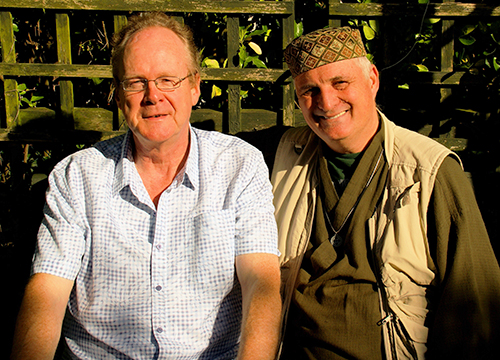
Then James met an elf. And this was no ordinary elf. The elf was famed grandfather of the American drum circle movement Arthur Hull, who was playfully demonstrating Remo drums at the time (dressed as an elf, obviously!). This amusing meeting began a 15 year co-writing partnership during which both Arthur and James fully explored their mutual love of rhythmically musical adventures within what Arthur described as James' sandpit, and enjoying all the expansion and enhancements offered by the studio. Although busy with his worldwide schedule of teaching and workshops, Arthur still managed to schedule regular recording sessions with James over the years, and this has been extremely productive. Most interestingly, the spiritual aspect re-emerges here in a different way, in that the sense of community that runs as a thread through the international world of drum circles provides a fantastic way for people from all walks of life to bond speedily, and without needless preamble.
In recent years, James has enjoyed a degree of industry attention that is perhaps best known to producers of his stature as ‘sampling’. One of the first albums James wrote originally for library purposes ‘Abstracts’ has been sampled by the Chemical Brothers in their track The Sunshine Underground, and ‘Fairground Ghost’ by U.N.K.L.E. for their track Eye for an Eye. To cap it all, James’ track ‘Oriental Workload’ provided the sampled basis for rap artist Tyler the Creator’s massive hit Corso, which has (so far) enjoyed 60 million streams, and 11 million views on YouTube!
With all of this success behind him, James Asher still continues to produce music with as much passion, commitment and enthusiasm as always, and he continues to enjoy playing drum kit for blues and ceilidh bands, percussion for jazz quartets, and busking on violin with his brother playing guitar, amongst many other hybrid mutations!
Nicky Helm is a London based Artist who runs Healing Angel Art, which beautifully brings spirituality and art together. A teacher of Art and Design with a passion for painting angels, reiki healing, crystals, colour and spirituality, she has an optimistic outlook on life with a real sense of inner peace and compassion.
From early childhood, happy memories of creative summers spent painting with her mother and grandfather inspired Nicky to follow an artistic path. Being brought up in a Christian household developed her interest in the afterlife, leading her to study other religions such as Buddhism and Hinduism. She still felt she was searching for a deeper meaning, wholeness and purpose which she began to find once she started to explore spiritual philosophies and practices such as tai chi, crystal healing and reiki techniques.
Nicky has always felt the presence of Angels in her life but it wasn’t until 2013 after a serious illness and life saving surgery that Angels begun to make a much bigger impact on her life.


Rainbow Fluorite Angel inspired by Rainbow Fluorite crystals and a beautiful rainbow on a spring day.
Rainbow Fluorite Angel radiates loving rainbow rays of light, calming the mind, bringing inner harmony and confidence in ourselves, uplifting our hearts, encouraging a positive outlook on life.
Realising she needed to find more of a work life balance and spend more time with her family and painting she went on holiday to Ibiza to recuperate and stay at a friend’s beautiful agriturismo in the northern Ibiza countryside near San Carlos. One lazy sunny afternoon whilst having reiki under the lemon trees Nicky was guided to paint her first angel and a new journey began. As she lay under the trees she felt a golden glow cast around her and a beautiful pure angelic presence. She had woken up…. realising that spirituality comes from our soul, a way of life, connecting us to the universe for the highest good.
Nicky has always been aware of the effects and magical powers different colours can have on our minds and bodies and you can see in her paintings how much she is inspired by the healing colours of nature.
Back at home in London Nicky continued to feel guided to paint Angels who communicated to her through her meditation, dreams, signs and symbols, the more she listened the more they communicated. It became a very self-healing process, creating a happier and healthier life. Soon friends started asking Nicky to paint for them, word spread and now Nicky paints Healing Angels for individuals worldwide gaining many commissions through social media and her Etsy online shop. Her commissions are usually for people who ask for an Angel painting that specifically relates to their energy, or the energy of a loved one in this realm or the afterlife.
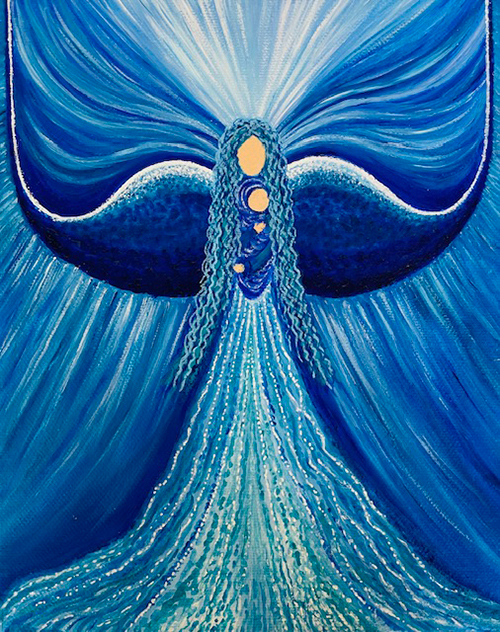
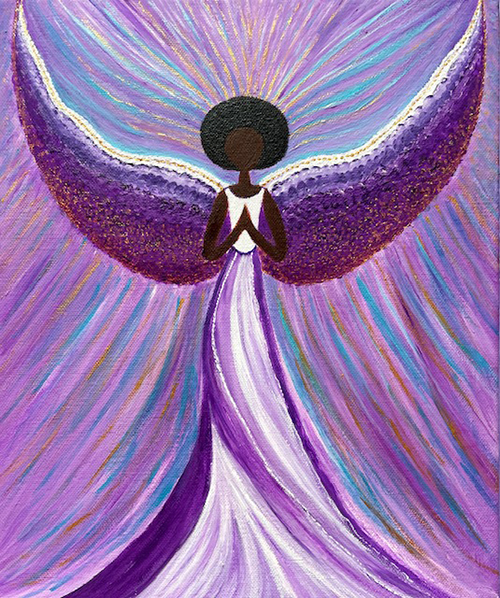
Nicky has a deep understanding of how art and spirituality blend together. She begins her paintings with a reiki crystal meditation, guided by Angels she fills her paintings with positive healing energies of the universe to help heal the mind body and soul. Her paintings are full of love, compassion, and pure light healing energies.
Hanford Flyover are a British-American band who deftly mix elements of psychedelia, rock, electronica and folk to create a unique sound, interwoven with deep lyrical content.
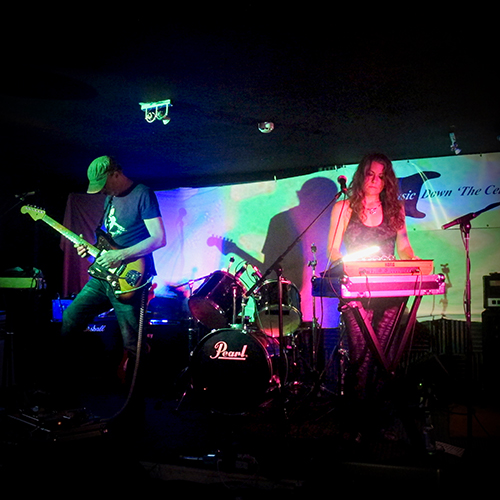
Band members are Josh Bowler from the UK, and Holly Bowler, who was born and raised in Kentucky, USA.
Josh, a multi-instrumentalist, takes his influences from artists of the 60s through to the 90s. Holly’s background was immersed in folk, blues, rock, gospel and bluegrass. It is the combination of these diverse influences that shaped her vocal styles and laid the foundation that gives HF a unique and strong identity.
In 2018, after a 20-year sabbatical from professional music, Josh found new inspiration within Buddhist philosophy and began the Hanford Flyover project. He found it striking how much of this ancient philosophy has been ‘re-languaged’ into modern psychological talking therapies and felt compelled to express musically some of the deep spiritual insights it reveals.
Whilst taking inspiration from the deep learning found within Buddhist philosophical spiritual teachings, their music does not align to any religion. Hanford Flyover strive to promote spiritual development as a way to heal and grow on a personal, community and global level.
“We use music as a way to explore some of the core spiritual philosophical questions and answers about the most fundamental human truths”.
Their first album ‘FreeFall’ was digitally released in late 2018 and has had over 10,000 downloads. The album includes explorations on impermanence, attachment, how we easily become distracted from our true nature and how we might rediscover it. Reviewers depicted it as:
“Deep and meaningful, introspective, proverbial and soothing, this music puts you in touch with your soul. Be still and listen deeply: let yourself unwind”
“A beautiful, rich, full sound, and what beautiful laid-back moods where splendidly soothing, mesmerizing female vocals are poured over a foundation of classic folk prog with a psych edge, featuring great musicianship, and compelling song writing.”
Hanford Flyover followed the release of FreeFall with a 4 track EP entitled ‘All We Have is Now’. With an ever-evolving musical style, the songs on the EP again delved into the spiritual aspects of what it is to be. The EP has been described as:
“A deep river of thematic songs with an irresistibly strong, yet gentle, pull. The lush and trippy instrumentals that complement Holly’s seductively smooth, sage, and down to earth voice add very rich, visual textures. Daydream inducing, for sure. Wonderfully so! It’s so easy to get lost/found in this mesmerizing flow!”
During the lockdown of 2020, Josh decided to take a different approach to producing music. On Midsummer’s Day 2021, Hanford Flyover released an album through the Fruits de Mer Record label entitled ‘Hanford Tape Sessions’, which was recorded entirely on vintage, four-track tape recorders.
The album continues Hanford Flyover’s love for exploring musical styles, and the songs continue to explore aspects of existence and spiritual philosophy as a potential means to illuminate the darker, often hidden corners of our minds.
One reviewer wrote:
“A lovely collection of tracks well produced with that wonderful nostalgic sound which is missing a lot of times in new music. Excellent for repeat listening.”
All vinyl copies of Hanford Tape Sessions sold out on pre-order but a few CDs are still available.
In March 2022, Hanford Flyover released a new 4 track EP, ‘X to the N’, which was also released as a 7” single (sold out) on the Fruits de Mer record label.
“I love their exploratory offerings of sound.”
In August 2022, Hanford Flyover released a single ‘Shadows on the Sun’ as a prelude to a forthcoming album. The song is a study on emptiness of thought form, in that once the thinking mind quiets, within the apparent ‘emptiness’ there is the entire universe for awareness to perceive.
The song has received a lot of attention from BBC radio and has been picked up by numerous radio stations globally.
The band have a strong international following and their music can be found on rotation on many global internet and terrestrial radio stations.
Hanford Flyover’s music is available to stream and download through all the major music streaming services. Physical copies of their music are available through their Bandcamp website (see links below).

As a child, I never minded being sent to bed! The nights were always full of vivid and intriguing adventures, dreams that stretched my young imagination and sometimes even seemed to foretell the future. When these events actually started happening in the real world later, I realised I was on to something. And since nobody believed me, I taught myself to wake up after a ‘significant’ dream and record it, so I could prove precognition and the power of the human mind.
Psychic and paranormal events became second nature then, from knowing what others were thinking to seeing ‘signs’ in everyday life that warned me of trouble (from the local bullies) or encouraged me when I felt lonely (unheard by my conservative family). I knew that I was not alone, even if I never knew who, or what, was guiding me. Mindfulness was not in fashion back then, but it was my way of life.
“To every thing there is a season
and a time for every purpose under Heaven.”
But the road can be tough when it never seems to be ‘the right time’ and you’re not sure what the purpose is. I found myself nudged along a path of science, engineering and Mathematics, living a rather uncomfortable life with one foot in each of two very different worlds. One must make a living in the material world and, to be fair, I loved teaching young people and exploring Maths, especially its irrationality.
Yet the inner world of the psyche was equally real to me, especially the utterly fundamental questions it poses about the nature of human consciousness, such as “How does telepathy work?” and “What happens when we die?” I ploughed the lone furrow of study and investigation of strangely gifted people, my scientific training saving me from swallowing the excesses of New Age gurus. One must never be so open-minded that one’s brains fall out.
So what has all this to do with books? From primary school age, I had always wanted to be a writer. (I still have my first ever book, an eight-page fully illustrated exposition on the life cycle of frogs. Possibly not very original, though.) Later, using every spare minute that career and family life allowed, I wrote a comedy novel set in the afterlife (surely that world is full of just the same narrow-minded and silly people that have just left this one?) and a detailed account of my hundreds of precognitive dreams and daily synchronicities.
And, like so many other aspiring authors, my special drawer filled up with rejection letters. Many of them were even very complimentary, which only seemed to make me feel worse. Yes, there were five books of mathematical investigations but they were never part of my ambition so they don’t count. One novel was even accepted by a major publisher – but they pulled out days before contract, citing their accountants who said that my work was “too risky”! It was beginning to look like a dead end for writing.
Then The Plan swung into action!
A spinal injury suffered in my twenties began to affect my mobility seriously and I had to retire early from teaching. And with just one year to go, I made a new friend who knew people who knew other people… and Spirit Revelations, my book of dreams and synchronicities, was published (kindly endorsed by the world-renowned scientist Dr Rupert Sheldrake). I was invited to give talks and lectures at festivals, the College of Psychic Studies and the Society for Psychical Research. Then my comedy novel Signs of Life was runner-up in a national competition. A new career beckoned.
But it was not the one I imagined. My publisher, Beth, with whom I was now friends, became ill and had to give up the company. But she had set it up in an ethical way, supporting authors who never get a chance with the Big Boys, and was unwilling to sell out to one of them. She offered it to me for £1.
Once recovered from the shock, it didn’t take long to accept. Here was the life of books that I had wanted since childhood, even though it meant caring for other people’s writing rather than developing my own. There was just one small problem: I knew absolutely nothing about the publishing business and Beth was too ill to help. So I made a nuisance of myself with the design and print subcontractors and picked every brain I could get hold of. To test whether I’d learned well, I then wrote and published Lighting the Path, a guide to using the extraordinary Chinese oracle I Ching, or Book of Changes. It worked (and the book still sells)!
I refocused the company, Local Legend, to the Mind, Body and Spirit genre that was always my true passion, maintaining its ethical and non-profit nature (I don’t take any salary for my administrative and editing work). I have expanded the company’s marketing, developed close relationships with leading MBS magazines and run spiritual writing competitions. Whilst unable to do much writing of my own, this has been a joy. Finally, with much guidance from Someone, Somewhere, I had come to understand one of the great spiritual truths:
“The purpose of life is to discover your gift.
The work of life is to develop it.
The meaning of life is to give your gift away.”
David Viscott in Finding Your Strength in Difficult Times, 1993

And yet… I knew there was something very important that I still had to write. As a callow and naïve youth, knowing nothing about girls or politics, I had fallen deeply in love with a Czech girl. This was A Good Thing. One month later, her country was invaded by the Soviet Union and its Eastern Bloc allies. A Very Bad Thing.
Broken Sea is my account of those times, a novel based on real events in which the characters and places are fictionalised whilst the historical and military facts are described truthfully. National runner-up in The People’s Book Prize awards, it is a story of the human spirit, in which two young people struggle to find their own freedom and identity in the face of their families’ rejection, while a young democratic nation is also struggling to achieve freedom and identity, savagely rejected by neighbours with tanks and fighter ’planes.
This book is a tribute to the human spirit, to self-belief and to never giving up on your dreams. And, when we really put our minds to something, we never know where life will lead us… The main characters of that novel kept whispering to me that their stories were not yet over and that I must pour everything I had learned in a lifetime of studying spirituality into one more book. The ideas swirled around my mind for a couple of years until my father turned up in a lucid dream and told me to “Get on with it, for Heaven’s sake.”
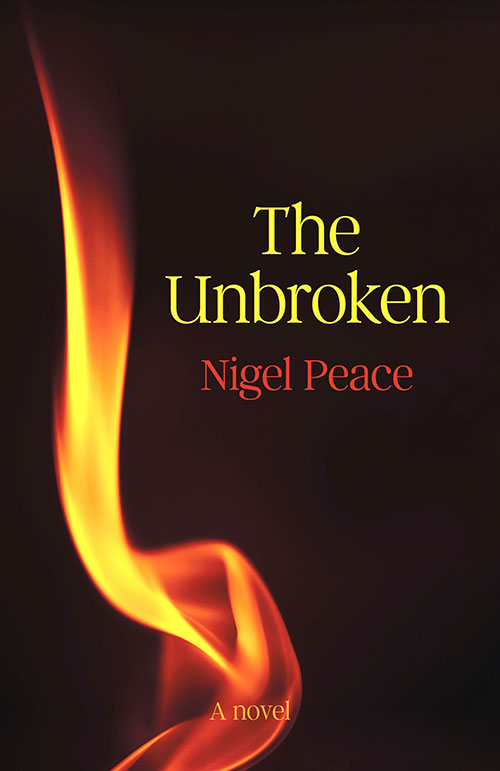
The Unbroken is that book, a story of deep human love and an adventure in mysterious worlds of the mind. It challenges all the common preconceptions about the nature of human consciousness, with some humour and a couple of twists that even I never saw coming…
“…takes the reader on a uniquely spiritual journey… makes us wonder more deeply about things we take for granted… a great, mysterious novel.”
Never give up on your dreams!
Nigel Peace is the author of several spiritual books, and owner of the MBS publishing company Local Legend.

Ruth Frantziska Goldfeld (aka “Spaladonia”) is a multimedia artist in the true sense of the word. Utilizing her talents for art, music, video, poetry and writing, she explores creative landscapes in an intuitive and unconscious way, rarely creating with a specific intention, preferring to open herself up to the mood of the moment, and letting the inspiration flow through her unhindered. Her artistic creations blend elements of the ethereal and the psychedelic, with strange Daliesque landscapes populated by faces and figures. Rich with symbolism and meaning, she readily admits herself that she does not entirely know what her paintings mean, and enjoys leaving her creations open for interpretation and discussion. Her painted compositions often express an orchestrated play between order and chaos, reflecting relationships either within her own hidden psyche, speaking through her paintings, or with people who have played strong roles in her life.
“Recently, I have been creating a series of paintings focusing on ancestral connections to family members I have never met. I drew my inspiration from some group family photos I had seen from before the war, and survival stories of my mother’s family. My mother spent five years of her childhood in concentration camps during the Second World War. She is essentially a Holocaust survivor. Her mother and grandmother were the only ones who also survived. I was also inspired by “Family Constellations”, a work in which I participated for a few years in Brighton, which enabled me to heal family ancestral wounds, allowing me to more deeply relate to the grief in order to heal it. It was a wonderful process of resolution, allowing me to transmute those energies through my paintings.”
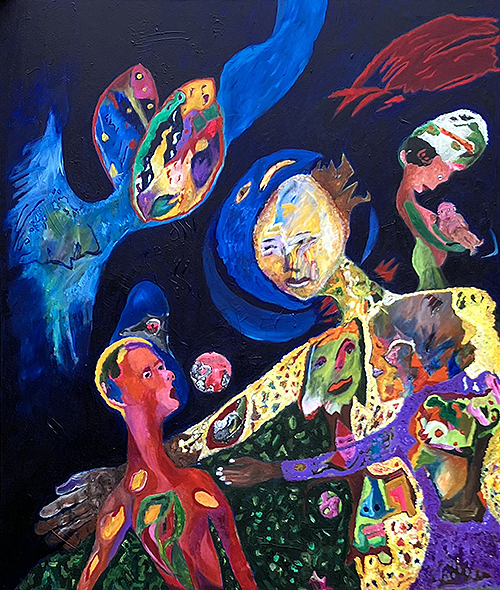
“I tend to paint straight onto the canvas, and work in close contact with my instincts, emotions and passions, allowing for change and transformation to occur as the work develops. Even though some of the subject matters may be dark or difficult, I always aim to make the finished piece pleasing to the eye. I seek harmony in the visual composition.”
Born in Haifa, a mountainous region by the sea in Israel, Frantziska began having classical piano lessons at the age of seven, in addition to drawing and copying faces and portraits from magazines. As well as dabbling in the arts, Frantziska found she was always looking for ‘The Truth’ and realised early on that that the newspapers her parents were reading were full of lies. During the Bible studies she attended she also concluded that ‘God doesn’t write books, people do’. At the age of twelve, her family moved to New York, near Coney Island by the sea, and Frantziska eventually absorbed herself in the alternative lifestyle of the time, hanging out with boys under the boardwalk, smoking grass and listening to a lot of music including The Doors, Led Zeppelin and Pink Floyd.
When her father became ill, at fifteen she and her family returned to Israel which, after experiencing the highs of her American lifestyle, she found frustrating, but she soon accumulated a group of hippie friends in Israel, and she began reading many books on Philosophy, including George Gurdjieff and Pyotr Ouspenskii’s ‘In Search of the Miraculous’. This invigorated her interest in matters of a more metaphysical nature.
“Ouspenskii was a sort of Russian version of Carlos Castaneda, and I was really influenced by his work. Although I had always been interested in such things, his was all about finding your true self. His idea that we are all asleep and need to wake up to our real selves really resonated with me.”

Upon returning to Israel, Frantziska began improvising on piano, but her mother couldn’t fathom the experimental nature of her music, deeming it ‘just noise’, so Frantziska moved to painting instead. Using oils, her first painting of an Arabic old man encouraged her to continue painting faces, people and places. She would also write poetry, and at age sixteen her first poem, an anti-war message entitled ‘Let it be’ was published in a national newspaper. Ironically, a few years later Frantziska would join the Israeli army, after which she went on to study Philosophy, which she excelled at with top marks.
“I had an image of myself back then just being the Philosopher. I could see myself walking through beautiful gardens all day long with my hands behind my back, just talking Philosophy.” At twenty, Frantziska applied to Bezalel Academy of Arts and Design, the best art school in the whole of Israel, and was accepted with a scholarship. However, it wasn’t long until Frantziska realised that academia wasn’t going to be right for her. She wanted to live her life free in the open air, not spend it in dark and stuffy buildings reading books.
“My life has always been about freedom of experience. I have always wanted to experience everything in life: the dark and the light, the passion and the emotion. For me, it’s all about being true to myself. I’ve not tried to be anything or anyone other than a full expression of myself. It’s not very New Age to say, but I’m not interested in working on myself, only to fully be myself. My spirituality is to live my life. I’ve never really thought about jobs or how to get them. I’ve never thought in those terms. Life for me was always about living, and being who I am. It’s a feeling I’ve always had. It’s self-evident that is what I am meant to do. What I do is what I do, and I am what I am. Admittedly though, I have often taken things to the extreme: falling in love, lots of relationships and so on. I was always a bit of a wild child.”
After several years of travelling, at twenty-six Frantziska moved with a friend of hers into a squat in London which was popular with local artists, and this marked a highly creative phase in her life of painting and music, and of course parties, where conversations were often of a philosophical nature, discussing the meaning of life and human existence. Frantziska moved several times during this period, including at one time living with a group of travellers in a house with no electricity, where she says that she painted some of her best paintings.
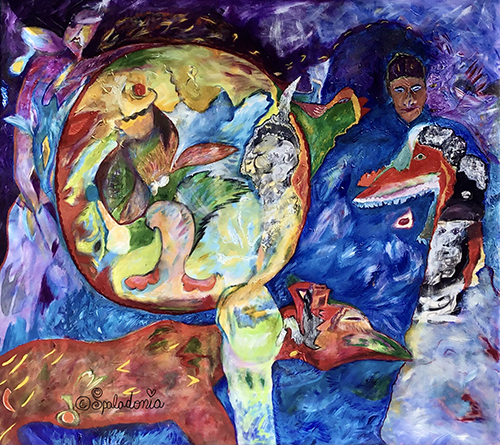
After 7 or 8 years of living in London squats, another friend asked if she could look after her children in the south of England, whilst she continued to teach in London, so Frantziska moved to Exmouth in Devon, and thus began a chapter in her life of cleaner living, nature and rent! Devon was a healing place, where Frantziska was introduced to hands-on healing practices, crystals and the art of visualisation. New Age spiritual practices in Devon were in abundance at that time, and Frantziska attended several courses including ‘Open Spirit’ workshops and a course in ‘Contact Dancing’. Frantziska’s passion for painting continued, and she developed an entire series of art during this period.
“I would say that a lot of my art explores the art of allowing: of allowing things to appear. Like when a sculptor has a piece of wood, and he asks the piece of wood ‘what do you want to be’? Very rarely do I create art with intent. Even when I start with a plan, it often goes somewhere else. Just the other day I started to paint something intentional, but inside me I said ‘No. I’m not doing this. I’m going the other way!’ I would say that my art has always been intuitive and unconscious.”
Saying that, it is also true that Frantziska’s art seems to tell stories, and that these stories are woven out of events that may have occurred in her life, but the meanings of those events are entirely left up to the observer to decide. Arising from her inner self, they find their way onto the canvas, sometimes baffling her as much as they might baffle the viewer.
“Some of my art I understand when I am creating it, but others I don’t. There is one painting I did that I still don’t get. But generally, I do believe that all the faces and images I’ve been painting recently arise from my own psyche, from the inner facets of my mind. From my inner family, and the different aspects of my Self.”

“Oftentimes I don’t realise until afterwards that a painting has a story woven in it. Recently I painted a painting of three woman, a man and a creature. It wasn’t until after I’d finished the painting that I realised: I live with three woman, a man and a cat! I make myself laugh sometimes.”
When Frantziska met Andrew, one of the great loves of her life, she left her painting behind her and they started travelling, at which point she returned to her love of music: playing guitar, mandolin, flute and singing. She started to record songs onto cassette tape, and occasionally she would use two tape recorders - one playing and one recording - to layer her tracks together. Eventually they found themselves travelling to Berlin, Germany, which was a hotbed of musical creativity at the time, and thus began another chapter in her musical life.
“Berlin was incredible. And we experienced such synchronicities there. On the very first night we met the people we needed to meet. It couldn’t have been better. We met a girl who was going away who had a flat she could rent to us straight away. Some others were going to start a huge art project, and we became a part of that. There was a woman who had taken over a big old train station from the Council with many buildings, and they created a project called ‘Raw Temple’, which we became involved with. It was totally ace. Wonderful.”
Frantziska’s life in Berlin initially saw her playing the guitar and singing, but it wasn’t long until she found herself in a couple of groups: one improvisational, the other more tribal in nature. Berlin was the place to be, and from the late 90’s to the early noughties, Frantziska’s musical life continued to evolve. “I could have made a career then. I was good. And I was noticed. But I didn’t have the confidence. Looking back, there was perhaps an opportunity there that I missed.”
“Some people we knew bought an amazing place in Kesselberg, near Berlin, and they let anybody who wanted to live there. Unfortunately, as there was no heating, it was very cold there, freezing, but there was a studio down the hallway, so I did quite a lot of recording there. Back in Israel however my mother was missing me deeply, and she asked me to return, so we packed our bags and headed back to Israel, where we stayed for two years.”

Returning to Israel, Frantziska decided it was time to record an album at a professional studio. Entitled Soul Stripping, the album was recorded in Tel Aviv with the music producer Amos Rozener, who played bass guitar, keyboards and electronic drums, whilst Frantziska performed on electric guitar, clarinet, sang the vocals and wrote the lyrics. In parts experimental and psycadelic in nature, Soul Stripping comprised of eleven songs, and the album was released on CD, accompanied by a video.
After recording her album in Israel, and a brief stint at another squat in London, at fifty-three years old Frantziska’s partner suggested she take a one-year course in electronic music production in London, which she attended and very much enjoyed. Towards the end of the course, Frantziska came in one day to discover everyone on computers applying for University. She hadn’t realised that the course was a music foundation level, and that she might apply for University also, which she promptly did.
Frantziska then moved to Brighton to study music, achieving a BA in Music from Sussex University. Whilst the course included music composition, music for film and electronic music as standard, to study an instrument (her choice was voice) one needed at least a Grade 8 to qualify; yet Frantziska had no grades at all. “So, I went to the head of the department, and I brought in my CD, and I said, ‘I’d like to study voice, but I don’t have any grades’. He invited me to take a test, of which I think he heard me for about 2 or 3 minutes, and he accepted me to the course. He just gave me the f*ing thing! The University was really gifted to me.”
Upon completing her BA in Music, Frantziska decided to remain in Brighton, and to combine her painting, her musical skills, and a growing interest to produce music videos for her YouTube channels. Her passion for creativity continues to express itself in innumerate ways, and she loves exploring her artistry, wherever it may take her.
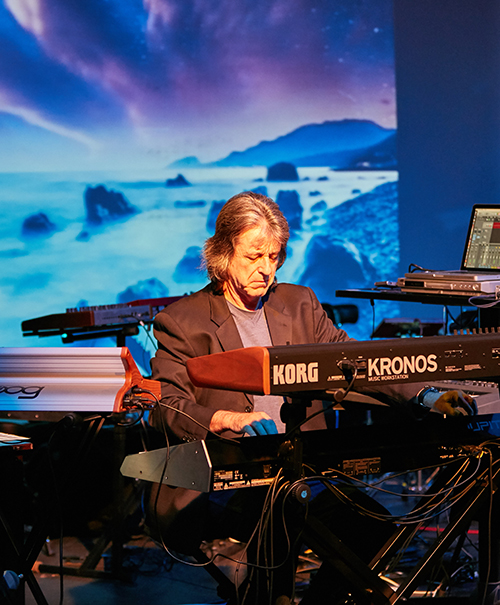
David Wright is the keyboard player and composer of electronic space music who founded the AD Music label in 1989 and who co-founded the avant-garde electronic rock band Code Indigo. His music is melodic, atmospheric and emotive, with a strong emphasis on mood and feel, invoking a deep spiritual connection.
His gently rhythmic style combines piano, synths and multi layered sounds that often incorporate electric and acoustic guitars, violin, percussion, samples and male & female voice textures.
His large catalogue of work includes award winning and award nominated albums that cover Romanticism, Space, Ambient, New Age, Relaxation and Electronic Music, all laced with classical, rock, jazz and cultural influences. His music is featured regularly on cable and internet radio playlists worldwide and has featured on Sky Sports, in Music Libraries and TV in numerous countries.
He has developed his own unique sound and style, that for reference purposes, can been likened to Steve Roach, Kitaro, Vangelis, Tangerine Dream, Jean Michel Jarre and Mike Oldfield.
David’s music has been credited by many fans as being a great source of spiritual comfort during times of stress, and particularly through serious illness.
However, David is at pains to point out that he is not religious. “I don’t equate being spiritual to being religious,” he says. “Just being human with understanding, compassion and empathy is being spiritual,” he continues. “I believe in the power and splendour of the universe, that we are all connected, that the universe binds us.”
The artist has always maintained that the inspiration for his music creation comes from a hitherto unknown and deeply emotional place and that without this ‘unknown spiritual input’, the music wouldn’t flow.
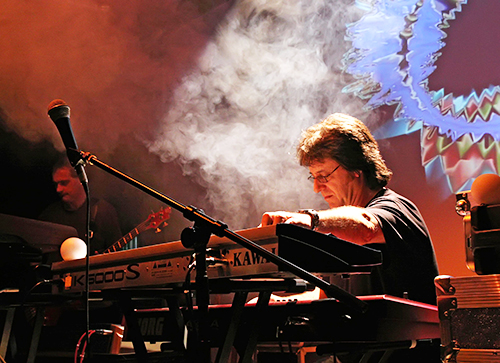
“Perhaps it’s the farthest depths of the universe that calls to us when we’re being creative,” David adds with a smile. But whatever that “input”, wherever it comes from, it has propelled David’s success and he has become a popular and respected composer, live performer and promoter of electronic music. He is now regarded as a veteran of the electronic, space music scene with a perennial sales record and an ever growing fan base.
Indeed, whatever the emotional, or spiritual if you prefer, message contained in his music, the actual process of creating the music is what drives David. Surprisingly, once an album is finished, he rarely goes back to it, effectively passing ownership of the music (in the spiritual sense at least) to the listener, to draw their own emotional and spiritual conclusions.
“That is not to say the music is some kind of unfinished soundtrack for the mind,” David explains. “But rather, if the listener connects to the underlying emotional resonance, then they will make the spiritual connection and be at one with the emotional sensibilities of the music.”
Fans will also point to the occasional Oriental influences in David’s music. This fascination stems from his time spent in Asia and the Far East during his younger, formative days (his father was in the Royal Navy). His first journey into playing music came in 1968/69 playing drums in a band while in Singapore. “It was all Creedence Clearwater Revival, Canned Heat and Cream,” he recalls. “But, just soaking in the atmosphere and culture of the Far East had a profound affect on me. I came to love the beauty and delicacy of oriental music,” he says fondly. “The sound of the Erhu, historically known as "Huqin" or barbarian's fiddle, is one of my most favourite instruments, so emotive.”
Those emotional and oriental influences remained and have been evident from the beginning of his musical career. “Something clearly touched me spiritually,” David reflects with a smile.
His debut release ‘Reflections’ in 1989 was a musical outlet of grief following the death of his first wife ‘Tricia. The music that followed, whether with cosmic excursions like ‘Continuum’ (2006), historically referenced albums like ‘Moments in Time’ (1994) or the seminal album ‘Walking With Ghosts’ (2002), highlighted the ease with which David is able to conjure up deep emotion. As one USA reviewer wrote; “Some music makes me think, David Wright’s music makes me FEEL.”
Something else that has clearly influenced and inspired David is MENCAP, a charity close to his heart and has supported since the late 1990’s. This came out of a close friend’s involvement in an Albanian Children’s home project, out which came the acclaimed and commercially successful album ‘Dissimilar Views’.
“Perhaps that’s where some of my energy and purpose comes from,” he muses. “I have worked hard to get where I am, but consider myself very lucky to make a living from doing what I love, making music. So giving something back to such a wonderful, worthwhile cause is simply a pleasure.”
However, a big part of David’s success can also be attributed to good business sense and his wife Elaine’s input. AD Music became one of the first UK electronic music labels with a website in 1995 and in the same year they signed a publishing deal with Notting Hill Music. Then, in 1997 AD Music embraced the digital/download revolution, registering with ‘The Orchard’, who distribute the label’s output to this day.
David has also flourished when working with other artists. His collaboration with Robert Fox started in 1993 with a BBC radio Soundscapes concert and resulted in formation of the band Code Indigo, referred to by BBC radio DJ Ashley Franklin as “The best instrumental rock band on the planet”.

Code Indigo has the envious distinction of playing its first two major concerts with the legendary Klaus Schulze in the UK and Germany and its two ‘farewell’ concerts in Holland with Tangerine Dream!
Other collaborations include those with close friends Ian Boddy and the late Klaus ‘Cosmic’ Hoffmann-Hoock. He has also worked with many other artists in connection with various music projects ranging from relaxation to his ‘Callisto’ project, creating traditional sequencer style electronic music.
Along the way David has released an impressive body of solo work, including classics like the award winning ‘Dreams and Distant Moonlight’, the NAV nominated ‘Momentum’, the ever popular ‘In Search of Silence’ and the epic Sci Fi collaboration with Matt Howarth, ‘The Lost Colony’. There have also been many, many concerts and festivals… large and small… in the UK, Europe and the USA, including 2 nights at the London Planetarium and Derby Cathedral (twice) amongst them.
Since 2012 he has collaborated regularly with close friend Carys, who has added her distinctive vocal textures to David’s music resulting in critically acclaimed CD projects and a DVD concert release.
When working with others, he is known for his generosity in ensuring that the collaborations allows the music to evolve and metamorphosise into something none of the participants would have done themselves.
“I think working with people with whom there is a close spiritual connection always brings out the best collaborations,” David ponders. “Indeed thinking about it, several of my closest friends and I have a shared personal loss and grief, so there is a definite emotional and spiritual connection that binds us.”

“But at the end of the day,” David states firmly; "It's about the music, that’s it! Not egos, not the past, not who did what, or with what; it’s not about commerciality, it’s simply about the music, dare I say, art. Working with people who have a shared ethos in the process just makes creating music so much easier…and fun.”
David’s influences are plentiful, from Brian Wilson to Santana, from Rimsky-Korsakov to Klaus Schulze, and his musical odyssey has now spanned over half his life.
“I once told someone that I have to make music,” he says. “And they respond that I didn’t have to. I had to explain that they didn’t understand what I meant. When I say I have to, I mean, I HAVE to, I can’t stop, it’s like a drug. Sometimes I wish I could stop! But I have to make music to make sense of my existence. It’s what drives me, it’s why I’m here.”
As David concludes: “We all have our influences, but at the end of the day, what we composers and musicians really want to do is to create what we want, what we’d basically like to listen to. For me, the challenge is always to create something different to what I did before, to find new ways of expressing myself through music. While I’m always striving for technical excellence, the music must contain that indefinable emotional essence, that spiritual ‘something’, and that is always the hardest part, because it comes from an unknown place at an unspecified time during the process. So as long as I have something to say and can continue to make that spiritual connection, then I will keep making music.”

The problem with thought
A common theme in all mystical and spiritual traditions is the problem of human thought. Particularly our ‘I’ thoughts. As an NHS psychotherapist I have noticed that this is a feature of every patient’s inner world. At the core of people’s mental health difficulties are thoughts like: “I’m a failure, unlovable, a reject”. The rejected child does not just conclude ‘I was rejected but feels this personally in the form of ‘I am a reject, there’s something wrong with me’.
These thoughts are inevitably depressing and debilitating often leading to long term mental health problems.
In a mindfulness group recently a patient described a profound realisation: “Now I know I’m not my thoughts!” Her sense of liberation was life changing. She continued to have the old ‘I’ thoughts but no longer identified with them and as such was free. The effect on her mental health was immediate. She began to be in touch with her true nature beyond the story of her. Not only did she realise she was not her thoughts but also not her story. For example as a result of her childhood sexual abuse she had told herself, as many victims do, there was something wrong with her. When we stop identifying with these thoughts it leads to the realisation that there is fundamentally nothing wrong with us. We see clearly that our problems are merely on a functional level and are as a result of our conditioning not our true self. The conditioning of our families, our culture and the era into which we are born.
Belonging

I grew up in London in the early 1950’s. My mother was German and my father English/Swedish. I felt like an outsider and feared rejection from my peers and community. I did what I could to hide my background and fit in at all costs. Especially during playground war games when ‘we’ were killing Germans. Underneath I was determined that others would not see what I thought was the ‘real' me.
Later when training as a social worker and psychotherapist and as a long standing member of a meditation network I was still desperately trying to assimilate and fit in. All the time this was covering my core belief that ‘I don’t belong’. I felt I had to change. Psychotherapy and meditation seemed perfect methods of self improvement. It was only decades later after years of searching I came to see that this was futile - a dead end. This realisation arrived in one moment!
A French psychiatrist, who was giving a talk to the Royal college of Psychiatrists said:
“Stop searching! Be who you truly are!”.
Although given to an audience of over a hundred people these words felt directed at me. All the energy of my personal search dissolved in an instant along with the emergence of a profound sense of freedom.
I later learnt that the speaker Jean-Marc Mantel, now a friend and colleague, had been a student of Jean Klein who in turn had in been influenced by Krishna Menon all immersed in the teachings of non-duality - Advaita Vedanta.
For the next two years or so I too immersed myself in these teachings to bring an understanding to the experience of that afternoon. I came to realise to what we mean when we say ‘therapy without the therapist’, ‘no one teaching’, ‘no one writing’ or when it comes to sport ‘no one playing’.
The path (although no longer a path) was then not about self improvement or making progress - not about adding anything but more the stripping away of the conditioned self and enquiring into who we are beyond thought and story.
How did you sculpt the horse?

Sculptor ‘I just took away the bits that weren’t horse’.
Non-Duality and the creative process
Not surprisingly these realisations had a radical effect on my work and my life. Suddenly there was no path to take and as in the Zen poem there was:
Nothing to do
Nowhere to go
No one to be.
- Anon
When the struggles of ego began to dissipate more energy was liberated for living in the flow of life and welcoming each moment whatever it brought. It takes a lot of effort to resist when we don’t like what life brings and none to surrender to the flow.
Welcome every guest.
- Rumi

There also arose a strong impulse to convey these teachings in my work as a therapist and mindfulness teacher but also in writing. The work now, like the sculptor, seemed to be chip away at my story to clear the way for the spirit or true self. Like a musician clearing his flute for the music to flow through. In this way writing has emerged in the form of non fiction, fiction and poetry.
I had started a book on golf thirty years before. Now I could finish it!. Now the story had an ending. An ending that was aligned with the new sense of freedom that ran through my life. The player in the story could now end his search for self improvement and his struggles in the first half of the story and really hear what the mysterious stranger was alerting him too. He could let go of all the ‘I’ thoughts, of trying too hard, realise that intention is in tension, see how ego’s desire to win gets in the way and learn to trust in what is natural and instead be one with Nature and his surroundings.
Our thoughts are great separators, especially thoughts of ‘I’. We perceive things as separate entities. As subjects and objects, including ourselves. The non-dual perspective is not two, not separate. We can also call this reality as everything in the cosmos is connected as one. This is confirmed by quantum physicists as well as mystics over the ages. The 13th century Christian mystic Meister Eckhart said that if we could really see a tree we would never need to go to church again. As soon as we say ‘a tree’ we have separated it from the earth, the light, the moisture, the birds and insects without which it has no existence. Apply this to ourselves and we may get some glimpse our fundamental connectedness to our world.
Of course not only mystics and scientists help us to see things as they really are but this is a feature of great art, literature, music and poetry. The capacity to point to a deeper truth to go beyond the veil of duality.
And the end of all our exploring

Will be to arrive where we started
And know the place for the first time.
- T.S.Eliot
On a personal level this meant a dissolving of the illusion that I did not belong into the realisation that this distinct form called ‘me' is merely a wave in the ocean of consciousness, completely one with the air that I breathe and the light that sustains life.
Martin Wells trained as a social worker, working in Brixton, London and later as a psychotherapist in Bristol. He has worked for the local mental health trust for over 35 years where he’s employed as consultant psychotherapist. He has been studying meditation for over 40 years and teaching mindfulness to his patients and staff for most of that time.
A profound experience of liberation led to a complete change in his mindfulness and psychotherapy practice and to an impulse to write. This began with non-fiction, the finishing of a book that had been on the back burner for 30 yrs and more recently to a book of poetry (out soon). This spontaneous outpouring of poems was a complete surprise to Martin and as a result he is open to whatever comes next, for example, a recent invitation from a concert pianist to collaborate in a concert on the theme of mindfulness.
