

All human beings contain an inner scientist and an inner artist, in varying degrees and forms. The scientist in us seeks evidence, hard facts and rational frameworks. The artist in us seeks nonverbal means of expression and connections with aesthetics and sublimity. My life has involved an ongoing attempt to find a balance of these, and to use them together to inform my spiritual development.
I would argue there is typically more balance between these two aspects of human nature in childhood than there is in adult life. For example, my daughter Leila is 7, and her school education includes a balanced mix of reading, writing, factual learning, art, music and physical education. This mix is almost universal across education systems; it is broadly understood that for children to be well-rounded and happy, they need art, music and movement as well as intellectual learning. When children express themselves through all of these, they cultivate the many sides of their being, like a diamond refracting light through every plane, and this is vital for their development.
The word holy comes from the Latin word holus, which means whole, and by being in touch with all sides of their nature, children express their natural holiness. Children don’t need spirituality bolted on to this, for they are spiritual enough already when expressing themselves in this multifaceted way. It is of relevance, in relation to this, that a recent major study found that mindfulness meditation was not helpful for schoolchildren. This didn’t surprise me at all – I think that art, music and sport are the ways that children can be fully present. They don’t need meditation, and if anything it may inhibit their natural spontaneity.
While the idea that children should have a balance of art, music, intellect and exercise in their life remains widely held, the idea that adults need such a balance is more rarely grasped. The transition to adulthood typically involves a funnelling of activity into specific channels. As young people transition to university or work, life comes to be dominated by work, which in turn can lead to a narrowness of being that is in notable contrast to the range of expressive modes available to children. I venture that not many young adults maintain a healthy balance of art, physical exercise, music and intellectual work, but many may feel called to get it back. It is at this time in the life cycle that many people start to explore what it means to lead a spiritual life in ways that extend beyond the conventions and dogmas of established religion. The psychologist Fowler referred to this as the individual-reflective stage of faith development.
Reflecting on my own life, as I moved into a career after university, my life was imbalanced, and this needed fixing. In the rush to be a ‘success’ in academic and work pursuits, my passion for art that defined much of my life up to that point was getting little expression. I had lost my wholeness, and my mental health was suffering as a result. I did occasional art and movement workshops, as punctuation marks in an otherwise imbalanced life. If I was not in work, I was mostly either tired, drinking alcohol, or both. It took a lot of effort to shift my mindset out of that rather emaciated worldview and toxic lifestyle, and into something new.

For me, spiritual searching started in earnest at around the age of 25, and involved reading, art, music and movement. I read all kind of books that talked of different ways of encountering the spiritual or mystical, and how this connects to the post-Enlightenment scientific-philosophical culture. I found an organisation called the Art and Spirituality Network and went to a range of workshops that they ran in which visual media, movement and the spiritual quest were fused. I started practicing Five Rhythms, which is a spiritual movement practice, and I listened to music that I experienced as a whisper of the great mystery behind physical existence. I also started a folk band.
My thirties became an expression of that seeking effort, and the outcome was the writing of a book called Paths Between Head and Heart, about the complementary nature of science and spirituality. It was published when I was 39. My life now, as a forty something, is a pretty good balance between painting, music, intellectual work (I am an academic psychologist) and time in nature. There is room for improvement in the movement domain, and I’m working on that.
Why do I think music, art and movement practices are so important for mental health and the spiritual life? One central reason is that they provide ways of expressing ourselves, and interacting with reality, beyond the confines of word-based language.
Language provides us with a way of communicating and reasoning, but it is a limited sign system and can neither describe nor express the fullness of ourselves and the cosmos. If our means of expression becomes limited to words, we become a partial human, increasingly afraid of the portion of our being, and of reality at large, that cannot be captured in this way. It matters not how seemingly artistic a person is, it matters that they are active in non-verbal domains, exploring ineffable, non-linguistic ways of relating to the existence around us that lives without language – plants, animals and nature at large.
Such activities connect us to the numinous source of the known world. It is my belief that this source of the physical world is intelligent in ways that are beyond the capacity of the human to grasp. We can see evidence of this intelligence everywhere, but we can’t grasp its operations rationally any more than a fruit fly can make sense of human intelligence. Where understanding and discursive rationality fall short in the spiritual quest, the arts can step as ways of providing a sense of connection to the Great Mystery and a way of representing it in symbolic form.

Degard is a pioneering British ‘Painter of Auras’. Degard is a visionary artist, writer, researcher, curator, and founder of the genre Contemporary Visionary.
Degard sees auras, trace energy around people, animals, and places. She can intuit people who are long gone and through her art create spirit portraits. Spirit portraiture is a wonderful method to meet people who have passed. Degard’s latest paintings aim to capture the lives of lost family – family who were killed in concentration camps who she never had a chance to meet. In fact, Degard’s current family had no idea these ancestors even existed. Degard is bringing them to life and giving them a place in society today.
Degard says “It all started when I ‘saw’ a blue square around the chest of a man who I discovered had just had triple by-pass surgery. I suddenly understood what these flashes of light were; they were his Aura, his conscious energy. The square indicated surgical human impact, the colour blue- healing – I could see the experience of the whole operation in his energies.”
All of Degard’s current work has followed from this experience which led to painting the auras of people, places, and things in the hope of understanding our lives in more depth.
Degard has founded the genre Contemporary Visionary which further discusses a number of notions. One of these notions is about scientific understanding. In the past the Visionary has sought to justify its existence by associating itself with scientific methodology. Visionary methodology is however a stand-alone knowledge system which needs no justification. The Visionary can describe through the arts both life and consciousness which is impossible through scientific empiricism! Seems extraordinary but science can open a brain, but it cannot find the mind inside! Artistic practice shows the mind at work. Contemporary Visionary can reveal through channelling aura the vortex of that aura and what a person’s self is and can be.

Contemporary Visionary also associates itself with political notions which need redefining. The current political paradigm relies on a ‘dog eat dog’ version of life. The issue with ‘dog eat dog’ is the lack of inclusivity this idea generates. This we all know is problematic and creates a harsh society for us all. The Aura and its energies are without compromise inclusive – as the air we breathe includes us all so does the auric light. This auric, radiant light is filled with presence, vibrancy, intelligence, consciousness, our personalities, our life plans, our free will, and our intent. These aspects of our lives are not involved in ‘dog-eat-dog’ and need to be understood as such. We don’t need to attack each other to get our fair share of Aura. Aura is beneficent and energy is generous.
Lastly Contemporary Visionary as an artistic practice critiques the barrenness and bleakness of post-modernist art. In 1966 Carl Andre put bricks on the floor and one of these sculptures in The Tate is Equivalence VIII. It is a series of rectangular bricks and that is all there is to it.
‘Andre’s Equivalent series consists of a rectangular arrangement of 120 firebricks. Although the shape of each sculpture is different, they all have the same height, mass and volume, and are therefore ‘equivalent’ to each other’ (Tate)
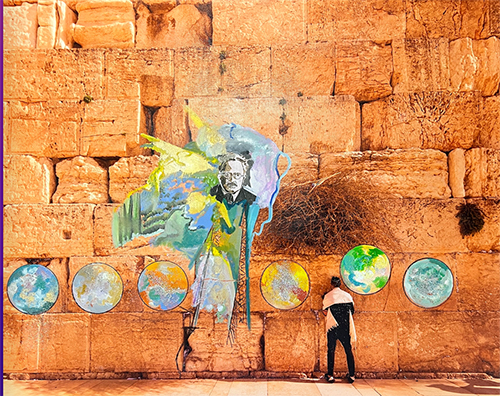
Degard with her latest series is exploring the bricks of The Western/Wailing Wall in Jerusalem. She acknowledges from a pantheistic and visionary point of view the depth of meaning that bricks can have. Each brick of her painting series known as The Visionary Wall contains powerful significance; none of these bricks are the same as each other. Post-modern work attempts to strip out all richness of meaning, exuberance of thought, even explanation of the art itself. This is a situation Degard wishes to change.

This painting above shows the Aura of Walter Benjamin as he would have become if he had not taken his life due to Nazi persecution. Benjamin was one of the most powerful thinkers of the 20th century and wrote extensively on why and how the atrocities of the 20th century could come about. As a Jewish thinker he understood the persecution ahead of him at a concentration camp and decided to take his own life. This painting commemorates his life and shows us in his aura the man he would have become. The circles represent the scientific diagrams which are shown to represent human life simply composed of six elements. This comparison is intended to show the vast discrepancy between scientific thinking and the visionary i.e., life itself. The Auric patterning, colour, form, and light shows a man with a love of the natural, a simple symbolic landscape. Further the ladder type structure underneath his head reveals a desire to ascend; he was after all an intellectual giant. There are also two or three significant people in his aura.
Degard highlights the value of Contemporary Visionary art and all Visionary artists at The Visionary Brit Museum at https://www.visionarybritmuseum.co.uk.
The Visionary Brit Museum is a red heritage telephone box outside of the British Museum which hosts Visionary art exhibitions exclusively. Degard says, ‘We often receive up to 3000 visitors who take photos of the work inside the Vis Brit weekly!’ This is a statement that the visionary in art is no longer an aspect of an artist’s practice that needs to be hidden.
Degard is also doing a Doctorate in Fine Art on the Visionary in Art which she finds very challenging and exhilarating. Degard explains.
‘Defining the visionary in art as a methodology in its own right is so thrilling. I am creating an index of terms which can be referred to by all future visionary artists.”.
Degard has exhibited extensively with recent exhibitions, Aura II at Brook Street Gallery opposite Claridge’s, London, Quintessence of Consciousness at The Royal College of Art, solo show at Museum Al Zubair, Oman, and Saatchi Art. She has hosted and arranged talks ‘Art with…’, at the Royal Society of Art, where she is a Fellow. Degard works alongside Anxiety UK to bring Art into mental health. Degard has recently published a paper with The Astropolitics Institute ‘Space and Art’. Degard is represented by Laura I Gallery, London.
Degard has written four books all of which can be found in The British Library, is a committee member of The Colour Group and a fellow of The Galileo Commission for the Scientific and Medical Network. Degard graduated from The Royal College of Art. She received awards from the Alan Davie Foundation.
Degard’s Art joins a long history into the study of consciousness, perception, cognition studies interwoven with visionary experience; as exemplified by visionary artists, Susan Hiller, Kandinsky, Hilma af Klint and William Blake. Degard’s Art brings this visionary and mystical genre, into a contemporary, socio-political context.
Molly Hackney, writer of The Medium’s Medium (written for an exhibition at Frieze, London 2019) says of one of Degard’s recent exhibitions, The Power of Things, Drip: Still Lifes https://my.matterport.com/show/?m=HgyLejEty25
‘The canvases at Drip enchant the viewer with this glimpse into spirit connection. It is her choice of objects that give this exhibition such magnetism.’
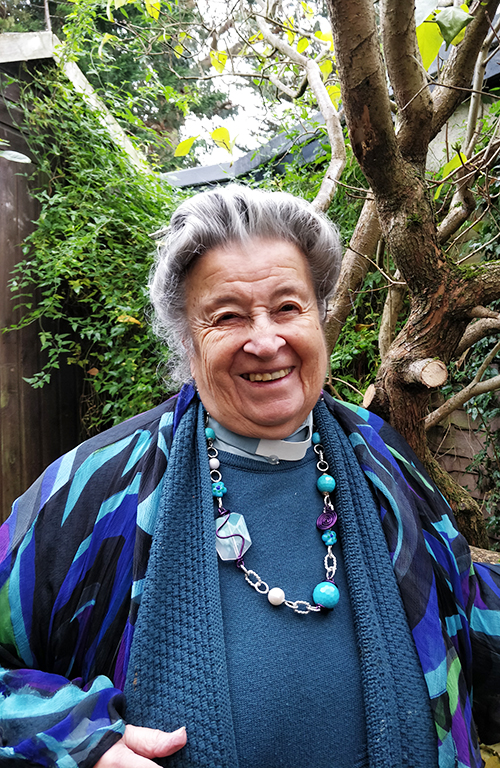
I was born during the war and very early in my life had a sense of the Divine watching over me. My parents’ garden and early life in the New Forest fostered my relationship with the natural world and I fell in love with its sounds and scents.
I had visionary experiences and tended an altar next to my bed. I created small songs in my playing which was largely on my own. When I started the piano at seven, again I loved creating new pieces. The one I still have is called The Still Lake – an inspiration from the natural world.
I was taken regularly to church and can still sing much of the hymn repertoire by heart. As a teenager I encountered the Anglican choral tradition – singing in a classical church choir. These pieces did move me into another way of knowing – in the incredible white space of St Mary’s Southampton and the rich acoustics and the impressive organ.
At Oxford University I was responsible for chapel music; this in the end led to embracing the growing folk traditions in worship such as Sydney Carter who was then regarded as relatively radical with songs such as the now very familiar Lord of Dance.
My interest in the joining of spirituality with justice persisted in the heady days of working in Notting Hill just after the race riots. I became not only the writer of anthems (for women’s voices) but also folk songs with the five chords I had learned. In my repertoire, Bob Dylan rubbed shoulders with Estelle White and women who were finding their feet as song writers. I was in a community that wrote songs around current events – developing a spirituality born out of the injustices of that time.
In my teaching in schools, these traditions coexisted, and youngsters started writing their own material. My doctoral research included spirituality as an important part of the process. This research into children’s musical development was translated into five languages and I was delighted to explore this in lecture tours and in-service training. I received an MBE for my work in music and education.
I have published widely on music education, including an edited book on spirituality and music education. With the two children that I bore in my marriage I became fascinated by how connection was made with babies which engaged me using improvising chanting and creating material.
Following a serious illness, I entered the world of shamanism and the so –called New Age where I found a different spirituality filled with drums, rattles, journeys, chakras and general appreciation of resonance. Ideas of embodiment and dance often drawing on various drumming traditions filled this exciting world which opened up new areas within me. I was healed by this world of musicking, ritual, meditation and started to compose in a new style acknowledging systems such as chakras and energies in the natural world.
At this point my academic research took a new turn on the work of Hildegard of Bingen (1098-1179) the medieval mystic and visionary – song writer, theologian, healer, and so on. I caught her connections between music and spirituality, and I started to perform pieces about her using her music around the world. It initiated many discussions of spirituality and gave me sufficient confidence to realise my own performing skills. I became a hymn writer, and my work is used internationally - a collection published by Stainer and Bell of inclusive language and ecological hymns – A Rainbow to Heaven.
Around this time there arose a massive interest in spirituality – in education, in religion, in business, in psychotherapy. I attended various groups and was fascinated about how they overlapped and yet were also distinct. As Professor of Applied Music at Winchester University and an Extra-ordinary Professor at North West University, South Africa I initiated arts projects especially those involving wellbeing with various groups of people.
These community arts events included interfaith dialogue through music. These continued on the ZOOM platform. Others included diverse people. Radical musical inclusion resulted in composed pieces for various cathedrals including professional musicians, community choirs, adults and children with learning difficulties and school children.

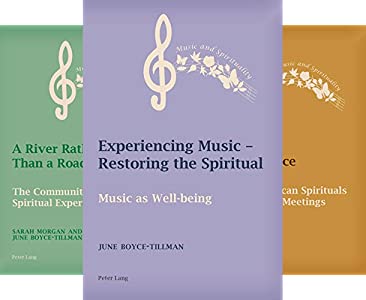
I began supervising research into music and spirituality in various contexts. I still lecture internationally on wellbeing, spirituality, and radical musical inclusion culturally and personally. I initiated a considerable series of books on music and spirituality for the publisher Peter Lang drawing on these diverse worlds and the experience of many people from five continents.
These include my own book, Experiencing Music-Restoring the Spiritual; Music as Wellbeing, the edited collection Queering Freedom: Music, Identity and Spirituality: Perspectives from Ten Countries and my own autobiography Freedom Song: Faith, Abuse, Music and Spirituality: A Lived Experience.
I founded MSW – Music, Spirituality and Wellbeing – an international network sharing expertise and experience in this area with members in five continents (website link below).
I became ordained as an Anglican priest with a desire to bridge the various worlds I inhabit in music and spirituality. I am now nearly retired from paid work but with more and more work in composing, performing, and writing and am exploring the resonance of the natural world through the digital technology of The Music of the Plants working with my friends in Living with Harmony and recording improvised music for meditation. I am moving further and further into this world. The visions, the chants, the liturgy, the rituals are brought together in new and (I hope) healing ways.

I am an Indian born New Zealand citizen who presents myself as an actor, author of ‘Seeking the Spirit Within’ and ’29 Seasons’. I came to New Zealand when I were 18 to pursue a BSc in Physics from the University of Auckland.
In 2018, I proudly received the ‘Award of Distinction’ at the Plain English Awards in Wellington, New Zealand and the Rotary Youth Leadership Awards in the same year. I have also featured in Riverside radio as a guest in London recently.
My passion for writing stems from my father who is himself a voracious reader and an eloquent writer. I learnt reiki healing at the age of 15. My love for the healing arts was introduced by my mother who is herself a Reiki Master.
My profound eclectic experiences in New Zealand led me to spiritualist practices such as shamanism and varied other healing modalities.
I also have had deep spiritual journeys in New Zealand with the acclaimed Medicine Woman program for spiritual seekers which led me to self-discovery and enhanced psychic abilities.
My other features include an excerpt in a book titled ‘Echo, Untitled III – page 48’.
One must look beyond the physical into the spiritual…
…which can only take place when one is receptive to all that is good.
In a melodramatic multidimensional world that we reside in, it has taken a potpourri of spiritual experiences to bring me to a point of summing up all that I have been exposed to in my spiritual book.
I was brought up in Hinduism all my 18 years of life, after high school, I moved to New Zealand which brought forth a whole new world of change. I made Christian friends in the university which thereby made me curious enough to imbibe Christian values and seek baptism in an ocean.
Once I got baptized at the age of 22 to a world of unknown, I became a staunch fanatic of new age Christianity. One afternoon, I was contemplating on the vagaries of life which made me feel melancholic about the way human life is limited in its potential. That was the day of Easter.
After the Easter church service, I was going back home when I felt the touch of the Holy Ghost in my spirit. That was the most surreal spiritual experience of my life so far. It purged me out of the dimmed lights of despondency and enlivened my spirits to the zenith. I was so ecstatic beyond words that I could never imagine I was even depressed a moment ago. The fire of the Holy Spirit was what touched my spirit within. I became jubilant, fiery, and overjoyed by this sudden breakthrough.
I wanted to immediately go preach the Gospel to all the ends of the world…I have never been happier and more exuberant in my life.
The touch of the Holy Ghost lasted for a week, almost keeping me wide awake at night with spiritual elation, it felt like nirvana.
The book sums up my eastern and western views as to what it takes to inculcate spiritual values that humans in a physical world take for granted.
The seven years of Christian life I led were interspersed with the excitement of a new life, new ways of living and worshipping, a whole new way of being and creating…albeit it lasted only so long due to other inferior and unforeseen circumstances.
In my heart of hearts today, I still pray to Jesus, but I have been exposed to Buddhism before I did become a Christian and all these vivid memories of who I was and who I aspire to be became somewhat mystical.
I believe in transcendence after all. The one supreme force that binds the mass and elementary particles of this universe together. The omniscient being that traverses its own course in this big wide star system. Although we are blinded by our ego to the point we ignore our inner truth or see ourselves for what we truly are, the laws of the universe are intricate and inescapable.
Karma has its own laws and what we need is a law-abiding force to be fair and square to each and every being. The whole human existence and the reasons behind our daily mundane life are like little stories that we co-create together. How good or bad a life is not always determined by our actions, but in a whole grand scheme of things, left to the universal forces of nature.
Sometimes, a mere mortal life seems mundane but intrinsic to the spiritual growth of a human life. The only way to break this monotony and seemingly endless problems in life is to meditate and become one with the Almighty.
Spiritual values such as love, kindness, bravery, compassion is all highlighted in my book that highlight the importance of becoming as pure as God, but in a mundane life, it can be challenging to imbibe such core values. My personal mantra is to do your best and be at your best and leave the rest to God. The good actions shall reap good rewards, whereas the bad deeds will sow what they reap. It is as simple as that.
Even our thoughts, our words have little karmic consequences which ultimately teach us to become better spiritual versions of ourselves. It Is the ego that separates us from the spiritual truth and all we need is an open mind and a receptive heart to understand the spiritual laws of the universe and attract the very best.
We would not take our wealth to the heavens, but it is only our actions and the consequences thereof that are counted when we return to heaven. Whatever good we have put in, will always come back in one form or the other, whether it is the current life or the next, but we must endeavour to always be good. God truly perceives every word, every action, every inaction, and every little detail that resides in us.

My connection with spiritual art has been a gradual journey of discovery, which began when I was a child growing up in West Yorkshire. I was an imaginative and creative child with an inclination to drift away into my own imaginary world.
I recall drawing and painting from an early age, and credit my father for helping lay the foundations for my interest and abilities in art. He would encourage me to copy drawings from illustrations in books, such as Dean’s Nursery Rhymes, which was often an escape into a magical world.
When I was sixteen years old, I found a friend and mentor named Mr Gooding, a gifted artist who studied at the Slade School of Fine Art. He was the first who recognised my abilities, and helped nurture my artistic skills. Another important figure in my life was Brian Needham, an artist with a studio and gallery in Manor Row in Bradford, West Yorkshire. He was very interested in my art and could see I had potential. He took me under his wing and invited me to his weekly watercolour classes.
During this period, I found employment as a self-employed picture framer, which lasted for seven-years. I then decided to leave my hometown because I wanted to travel further and explore different places.
This is when I received a call to relocate to a natural region. I found the perfect location, with a small cottage, nestled in a dense oak forest, overlooking a secluded cove in Exmoor. It was time to develop my creativity and I had many visions, and psychic experiences, which inspired my art.
Later, I moved to Glastonbury, which was an important period in my life as it acted as a powerful catalyst for spiritual growth. I found the energies to be highly transformative and curative. It was an intensely healing journey, which also opened me to many spiritual experiences.

During this period, I started to specialise in oil painting because it is slow drying and lends itself to my channelled approach to art. I have developed and utilised the technique, which is applied in a combination of thin opaque and translucent layers.
In 2016, I had a solo exhibition at Glastonbury Galleries, Glastonbury. In 2017, I was invited to become a member of a private network by Austrian artist Otto Rapp, who is founder of Visionary Art Gallery (vagallery.com) - which includes some of the most renowned Visionary, Surrealistic and Fantastic Realist artists worldwide. My art is also featured in an Encyclopaedia of women artists within the Visionary and Fantastic art tradition. The publication is called: The Lexicon of Fantastic Artists by Professor Gerhard Habarta: ISBN 9783746035307.
During my time in Glastonbury, my interests developed, including my artistic leanings, which were in the esoteric, spirituality, Jungian psychology and healing. In parallel, both dreams and the hypnagogic state began to play a part in facilitating my creative approach.
My art is a reflection of my own inner world, which transcends that of the physical dimension. I believe art is an offshoot of our deepest innermost self, which often manifests in the form of dreams, symbols and visions.
I believe that it is our challenge, as artists, to find a new direction, which honours art and spirit. It is a calling to all Spiritual and Visionary artists to infuse their natural creativity and imagination, and to follow their own original and unique vision. This is the essence of what spiritual art is, it is an expression of the higher self.
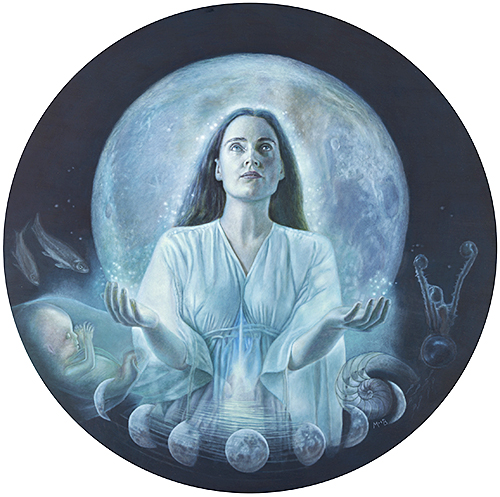
I am an open channel for energies and this can sometimes be intense, but it is what inspires me to paint! I ‘see’ and sense the presence of angels, spirit guides, and elementals. They appear to me as impressions and in clear visions, often in glowing and radiant detail.
I am also influenced, in a creative way by the hypnagogic state, which is like being a receptor to different frequencies, which coalesce and overlap at the transitional state between wakefulness and sleep. Hypnagogic visions are of a radiant, hyper real heightened reality. It is like experiencing a multitude of hallucinatory visions - such as colourful and illuminated scenes, humans, animals or strange composite creatures, abstracted forms, geometric shapes, bright lights and a full range of auditory sensory perceptions like sounds and voices. This is the fertile borderline half asleep state that instils flashes of insight and inspiration. It is this hypnagogic process, which has birthed many of my creations.
It is my belief that whenever we are in a relaxed state of reverie, we are receptive to the spirit realm. Spirits watch over us and inspire us to create beautiful art, writing and music. They are often silently present, and guiding us, not only in visions, but also giving us creative insights and inspiration.
I have always followed a creative path, and have been met with many challenges along the way. There have been times of sheer struggle, where I have been tested to the limits. Art is my passion, and despite all the setbacks, I have always been dedicated to my craft.
Part of my development is to open up and share my inner world with others. It has taken many years to understand this, and it has gradually been realised through my own inner guidance and learning.
I also have an avid interest in the fertile world of the imagination where we can access the strange and powerful images within the unconscious. This inner world is latent with endless creative potential, forming a wellspring of ideas and visions. Imagination and fantasies form the creative interplay between our inner and outer world. Many artists enhance their creativity by tapping into this ‘inner realm’, which provides an endless source of inspiration.

When I was going through an intensely challenging time in Glastonbury, I experienced a ‘visitation’ while in a very relaxed hypnagogic state. The entity bore the name of ‘White Hawk’ who came to me as a spiritual messenger and guide, and hovered above, while wrapping his protective wings around me. He had the features of a hawk and a human body, and was adorned with white feathers. I was reassured that there was a way forward and I needed to rise to a higher vantage point in order to find clarity and a solution. I did a drawing of the vision, which was later used as a blueprint for an oil painting.
Angels often feature in my art, and they are such a source of inspiration! I see them as beings of light that act as a powerful, guiding influence in my life. I always sense their presence and often see speckles and flashes of vivid colours, whenever they are present.
I was recently commissioned to paint an Angel of Healing for The Birmingham Holistic Health Centre. Stuart Morris, the founder and director said to me:“I believe you were meant to paint this and channel the presence of the angel that will bring light to many at the centre.” It is a place that has been described as a “portal for angels,” and it has a special energy where both practitioners and visitors have had many different sightings of bright illuminated orbs.
More recently, I have formed a close connection with Mother Mary, and she now plays an important part in my spiritual and devotional practice. She came to me in an unexpected way, while I was going through a very difficult time, which I can only describe as a Dark Night of The Soul. She has blessed me with visions of white and golden roses, and has appeared in a dream where she was adorned with a bright luminous star. My experiences with Mary and the visions that I have seen have inspired me to paint, and write in her honour.
My future plans are to continue with my paintings, which are very much in alignment with my spiritual practices. In addition, I am working on a book, which is a synthesis of my spiritual and creative interests. I am also very interested in connecting with other Visionary and Spiritual artists. I hope to develop more of an affiliation with creative people – from all different backgrounds – and genres. I am especially interested in participating in events, exhibitions and other venues such as workshops, and in engaging with like-minded people through social gatherings.

Founder Sarida Brown recalls the beginnings of Caduceus and, together with current editor Simon Best, remembers some special issues.
As I began to recall the early days, the reality of ‘Caduceus Journal’ flooded into my awareness as constellations of remarkable contributors, advisers and designers flowed through my heart’s memory.
Initiators, explorers, teachers and communicators of transformation in consciousness, healing, science, ecology, arts – all touched by the yearning to resolve apparent paradoxes into deeper/higher knowledge and unity, both in their particular fields and in service to humanity and the planet.
How did Caduceus start? In summer, 1985, I was on a 6-day, individual retreat, camping high in the French Alps, guided personally by Pir Vilayat Khan. On the last day he asked me to contemplate how I could serve in life. The answer came clear: to create a magazine about healing that represented all traditions, holistic and scientific, of all ages and regions (an innovative approach for that time); it was puzzling because I’d never written, nor edited, nor run any business.
New Year, 1986: a gathering of about eight friends at my Sufi guide, Rabia Joyce Purcell’s centre, Barton Farm in Bradford-on-Avon. Still puzzled, I recounted my guidance and the group said, ‘We’ll do it’. A wonderful designer, Charles Hill, offered to design a leaflet and the template. June, 1987, around a garden table at David Lorimer’s, Lyn Macwhinnie proposed the name Caduceus, in part because it denoted freedom from any specific group. I had no idea what a house editing style was, so editor Ian Macwhinnie designed one.I had no idea what a business plan was, so we managed without one – in pre-publication subscriptions we received exactly the amount needed for the first issue, which came out in August, 1987.
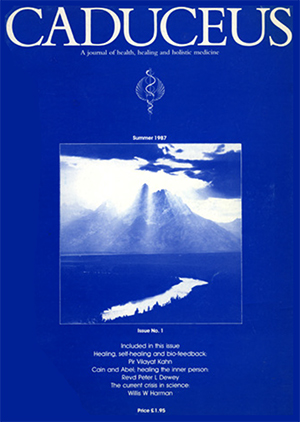
This was before computers: Carol typed the copy on a typewriter and Roy pasted columns and graphics onto pages to be photographed at the press. There was no Internet: people relied on us for information about leading edge topics and luminaries, courses, events and books.
Caduceus was soon valued for its pioneering exploration of themes that had been ignored or considered taboo. For example, in Issue 9, Leo Sides (a wonderful, heart-full man) broke through the silence about AIDS, at that time still a disease for which there was no medical alleviation or cure – Leo, and his friends, subsequently died of it.
Issue 13, Intuition. Issue 14, Dying – at that time, summer 1991, death was a no-go subject; the quality of articles and quotes are still riveting and relevant. Issue 18, Surviving and Transcending Abuse – again, definitely at the time an unmentionable subject. Issue 20, Birth. Issue 25, Anger. Issue 26, Love. His Holiness the Dalai Lama wrote an article, World Peace, to celebrate our 50th issue (actually in issue 51). Issue 54 (Winter, 2001-2), The Spirit of Afghanistan. So many great contributors to honour, from all holistic fields. Issue 12 (Winter, ‘90-91) was our first colour cover, but it was not until no 65 (Winter, ‘04-05) that we produced our first, full-colour issue. Just before that, in 2002, we launched our website.
I called Caduceus Journal my dervish, who required that I stay awake at all hours, on many levels, giving me the richest dervish teaching. I feel awe at the privilege I have been given in this lifetime of editing Caduceus, gratitude to the spirit of Pir Vilayat who opened this opportunity for me, humility when I think of such wonderful people who have contributed to the Journal over the years, and admiration and deep appreciation for Simon, editor since 2006, for his skill, intelligence and dedication.

Simon Best
I took over the reins from Sarida with issue 67, after she had decided she wanted more time to pursue her other interests. At first it continued to be produced at her house in Leamington Spa, but in due course I carried on producing it from my then home in Midhurst, W Sussex.
Among some special issues, I recall issue 71, which highlighted tributes to Eileen Caddy, co-founder of the Findhorn community, among which were two articles by Mike Scott, of The Waterboys, who had lived next to her at Findhorn in the early days – and now here, in issue 100, also remembers Jay (p 5). No 71 also featured the stunning revelations of cymatics, which we have continued to cover in articles by pioneer John Stuart Reid.
EMR hazards are a long-term interest of mine and so have featured in many issues, including this one. Similarly, we have covered many health areas including vitamin D, iodine, raw milk, seaweed, cholesterol and statins, vaccines, Fukushima radiation and ozone therapy. Issue 97 was devoted to the latest theories and research into cancer, one of our most important issues. On the spiritual side, subjects have included Jesus’ family and its Glastonbury connections, Yogananda and Kriya Yoga, the warnings of the Kogi Indians, the mysteries of Rosslyn Chapel, sacred geometry, shamanism and the spiritual effects of sound and light.

The way forward
This issue is a watershed in many ways. When I took it over in 2006 its finances and prospects were buoyant but the ‘08/’09 recession undermined the situation significantly, as it did for many niche market publications. Some went online only to save costs, others simply ceased. Caduceus could have gone digital only, but readers made it clear that most preferred to read a print version. So, it continued in that form, but it came at a cost – letting go the advertising manager, subscriptions/diary secretary and other help. This was a struggle but I was determined to keep it going.
And so it has continued to be; we have no wealthy donors nor business sponsors, unlike some other publications. But the effort has finally culminated in this 100th issue which, with gathering the tributes to Jay, has involved a huge amount of time and work to make it one of our best issues to date.
But the way forward has to be to ask each reader to become more actively involved in helping to promote Caduceus if it is to survive and expand. This means asking you to promote it on all social media available to you. Caduceus has limited resources to promote itself online, but certainly wants and needs to increase its presence; this would be multiplied many, many fold if you, the reader, helped in as many ways available to you. After each issue Jay would email his entire network about it, which always resulted in new subscriptions. I would ask you to follow his example and do what you can to help Caduceus to thrive again.
Since writing the above in issue 100, we have covered many topics, up to the current issue, 108, that include: Sleep; Vitamin C preventing infant vax damage; Vitamin D benefits to prevent Covid (issue 104); glyphosate damage; Ivermectin treats Covid; Water (issue 106), including Deuterium-Depleted water to treat cancer, 4th Phase water, and Molecular Hydrogen health benefits; Spike protein detox, Importance of IR in sunshine, and Sadguru Sri Sharavana Baba (issue 107); Weaponizing the weather (issue 108), how the heart really works and the Open Air Factor.
Full current and back issue contents can be viewed on our website below and from the free, downloadable PDF under the Back Issues menu on the site. For more information on Caduceus please contact Simon Best on 01373 455260.

Nicole Frobusch, is a multidisciplinary artist, born on the 6th of May 1970 in Muenster, Germany.
A single child, she connected deeply with animals and nature as her companions.
Nicole was very close to her grandmother, who’s stories transported her into different worlds, never quite feeling at home in this one. Her intuition knew there was so much more than what she was told. It made her ask a lot of questions, feeling she needed to uncover and rediscover something far more magical.
At college her psychology teacher handed her the book “The journey to Ixtlan”, by Carlos Castaneda, and that was the start of her spiritual quest at the age of 17.
The path of the indigenous, their connection with the Starnations, animal kingdom, minerals and nature, where all is spirit and sacred, made her feel less lost.
Her curiosity made Nicole study many diverse spiritual traditions and philosophies over the past 35 years, always looking for the golden thread, which unifies the All.

She learned alternative healing methods alongside natural healing through plants and is a Reiki Masters and holder of the Munai Ki Rites, alongside shamanic and the old ways ceremonial and ritual practices.
Nicole grew up between Italy and Germany and moved to London in 1992 after completing her A-levels in Art & Psychology.
In London she became pupil of legendary expressionistic dancer/teacher Hilde Holger and spent years in her basement studio in Camden Town. Performing and teaching contemporary dance and improvisation, she founded her own dance Company “The Akashic Dance Theatre”.
In 1996 she was invited by her friends to join an all-female choir, performing their debut gig in Stoke Newington’s cemetery by candlelight, all dressed in white. They would name themselves The Mediaeval Baebes and signed a record deal with Virgin Classical.
Many adventures were lived, invitations to perform in strange & magical places.
Creativity and seeking to understand what it means to be a conscious human is fundamental to Nicole.
Nature and the Cosmos, symbolism, alchemical transformation, mysticism and the importance of rituals are the inspirations behind her artworks.

Foraging for plant and minerals, earths and fruits to extract their colours and to make them into paints and inks. Inspired by her daughters Nicole completed her Masters with distinction at the Prince’s Foundation School of Traditional Arts in the Summer of 2022. She received the Kairos Award for best hand drawn and sensitive Geometry presented by Gail and Amanda Critchlow.
For her MA she researched the divine feminine, as a response to the lack of inclusion she experienced in the literature and teachings she received.
Focusing on the mediaeval period she looked for craftswoman, geometers, architects, stonemasons, alchemists, visionary females honouring and giving them a voice. Raising the attention to the limits of ingrained behaviour, social, academic and religious inculcation of the feminine.
To recognise the contributions of women from the past and to account for the denial of the feminine, to shine a light on the devaluation and the utter importance and necessity of her inclusion in all fields of academia , religious studies , philosophies and the traditional arts.
Through the trajectory of female spirituality in high and later Middle Ages where thousands of mothers, sisters and daughters were killed. The regulation of sanctity and the inquisitional procedure, as an instrument for assessing and proving, the authenticity of women’s spiritual lives.
Casting doubt on mystical experiences and implementing dreadful accusations and murders.
Nicole created paintings, clay sculptures and ritual water vessels as a response, which were exhibited as part of the degree show at The Garrison Chapel Gallery in Chelsea, London in July 2022. In October Nicole exhibited at the College of Psychic studies “Creative Spirits” alongside an amazing array of fellow and deceased artists.
Momentarily Nicole is living between her home in Hackney and a Shepardess Hut on the welsh border immersed in nature. In seclusion she connects deeply with the land and waters, inspired in creating new work from her experiences.


My spiritual journey began when I was a small child. I would sit at my grandmother’s knee as she read the tea leaves for her eager customers in the East End of London. It all seemed so colourful and exciting. At that young age I heard all sort of things a child shouldn’t hear, but that just made me even keener to develop a skill of my own. I decided by the time I was eight years old that I wanted to be a psychic, just like my nan. The problem was I didn’t appear to have any natural ability. Try as I might to have a premonition, nothing ever happened.
In my teens I vowed to find out how intuition worked, and to develop my own. Getting information was difficult in those days. We didn’t have the internet or the vast array of spiritual books we see in bookshops today. I soon realised that to find what I needed; I would have to travel. So, in my late teens I set off for the mystical centre of the world - India. At that time India was in the media because the Beatles and other famous people were heading there to meet gurus and to gain enlightenment. It was the place to go if you wanted to develop your spirituality.
Truthfully, I was pretty naïve. I expected to sit at the feet of some amazing guru listening to pearls of wisdom and assumed ‘it’ would all happen in the blink of an eye. In fact, I found myself sitting on a mat beside a very wise old beggar on a dusty roadside in Calcutta. Vikram taught me so much about intuition and how time works. He taught me about creating energy, and through him I became fascinated by reincarnation and past-life regression. His teachings made total sense to me and helped me to open up my psychic abilities.
On my return, I resolved to uncover my past lives. This was, in fact, much harder than I had expected; regressionists were few and far between, and it was a number of years before I had my first session.
By then I had met my next spiritual mentor, an incredible woman called Greta Gill. To this day I have never met anyone like her. Tiny, yet full of energy, she seemed to have a direct line to the Universe. Everyone who met her was touched by her warmth and insight. The spiritual path was still pretty new to me, but through Greta I met a whole range of fascinating people who would talk at length about their experiences and give me advice.
One of them, an astrologer named Shelley, had been regressed to several of her past lives. I could hardly breathe as she recounted her visions of having been a slave girl in one past life and a rich merchant in another. Now I was even more determined than ever to be able to access other lives. I pleaded with the Universe to find me a good past-life regressionist and my request was answered when I discovered a flyer advertising a past-life workshop in London with the famous American regressionist Denise Linn.

Together with my best friend Terri, I attended the event on a swelteringly hot day. Throughout the day I experienced several past lives, but the one that made the biggest impression was my first, in which I saw myself as a young black lad in North Africa. It was very odd to see myself with the long arms and legs of a gangly African teenager. The vision was short: I watched myself as I walked inside my home – a small hut – then, suddenly, a knife penetrated my abdomen. Next, I could feel myself floating out of my body and looking down on myself. It was not upsetting – much like watching a movie – and it left a big impression on me; now I knew I simply had to give this experience to others.
By now I was also becoming a competent Tarot reader (to this day, I still love working with the cards which ‘speak’ to me), as well as studying meditation and hypnotherapy, while remaining unwavering in my desire to work with past-life regression. For several years I looked for training, but just as I’d struggled to find a good regressionist, training was proving even more elusive. Luckily, however, I had built up a willing bank of clients to practice on and I discovered I instinctively knew what to do. Soon my clients were undergoing wonderful and profound past-life experiences.
That was my life for over twenty years – working with Tarot cards and past life regression, while fine-tuning my psychic abilities – until one day, two young soldiers dropped into my little office in Slough for a regression session. From that day on my life changed forever.
THE SOLDIERS
Steve and Dave had a deep fascination with regression, and they proved to be such outstanding subjects that I began to work with them regularly, always curious as to what the next session would reveal. Over weeks and months they uncovered many past lives they had shared together, sometimes fighting alongside each other, at other times against each other. I took them through my past-life training and they both became excellent past-life regressionists.
One day, in 2001, Steve told me, ‘Dave and I have both seen you in our practice sessions. We’ve all known each other before.’ He added, ‘I have a feeling there’s a reason why we have met again this time around.’
I’d had the same feeling myself and decided to find some answers. I brought in one of my best past-life students to take all three of us back to the life we’d shared together, to see if it held any clues. My student Dan began skillfully guiding us back to a previous existence connecting all three of us – but instead of going back in time, something strange happened: we all simultaneously jumped forward to a future event. At the time it made no sense to us; then, two weeks later, on 11 September, our visions were to become a shocking reality.
As we watched the scenes of the Twin Towers collapsing on our television screens, exactly as we’d foreseen, we were horrified. If only we’d seen more; if only we’d known enough to stop this terrible event. The question was: could we do this at will? Could we see future events in detail? Suddenly everything between us fell into place, and we knew we had work to do.
From that moment we began experimenting to see if we could predict more world events. Our results were consistently accurate. Within a fortnight Dave had predicted, among other things, that America would invade Iraq looking for weapons of mass destruction.
DISCOVERING FUTURE LIFE PROGRESSION
It was time to begin experimenting again, using a similar process to past-life regression, but now taking clients a few years into the future. Again, the results were amazing. They would see where they would be living, the people who were in their lives and how their work was progressing. Soon they were calling me to report that what they had seen was happening – but the remarkable thing was that events they’d seen many years ahead were happening much sooner than expected: things they’d seen occurring in five or ten years’ time would happen within months or even weeks. Clients were rapidly meeting their ideal partners, getting businesses off the ground and even resolving issues with their health or finances. In many cases, they had seen more than one possible future, enabling them to choose the best for themselves.
I realised that we were not just seeing the future; somehow, we were fast-tracking our futures. It was as if the very act of seeing them was bringing them forward into the now, as if bringing an event into our current consciousness enabled it to happen.
From that moment on our lives changed forever. We now teach FLP worldwide helping people to find a better future for themselves and the world. Today we are using FLP in many ways, we are developing: Future vision coaching, working with teens, addictions and so much more. Our FLP Practitioner training has given many people the skills to help others see the future.

Hello, I am Sheila Moore and I’m a Medium, Artist and Healer and animal lover (especially dogs). I was born in the war years and brought up by my grandmother near London. Like most families of that era, we didn’t have much but that was life at that time. As a child I did have a sense of ‘knowing things before they happened’ but I thought everyone did.
I grew up, married, and had two children: and then aged around thirty years things changed.
I had always liked art especially portraiture and I suddenly found that I could draw pictures and then information regarding the picture would come into my mind. Words came into my mind that were sometimes very beautiful, sometimes spiritual, and often giving me information about forthcoming events. I found this all a bit disturbing so acting on the advice of a friend I started to visit the local Spiritualist Church, and that was the start of my spiritual journey. The president was also an artist and he encouraged me to develop this type of art, generally known as ‘Psychic Art’, in a safe atmosphere.
During the years of the family growing up I’m a bit ashamed to say that I treated this gift as a bit of fun. I met lots of gifted mediums and one of them had a connection to the North American Indian Lakota nation. She used to go out and visit her friends there at specific times each year, so I heard quite a lot about them, I even gave one of my dogs, a German Shepherd, an Indian name (Luta). I received a lot of writing (inspirational writing), apparently from Indians and at one point they referred to me as “She who has dogs of the north” which puzzled me as German Shepherds come from Germany.
Then suddenly in 1999 my world fell apart, my husband died unexpectedly, and I was left on my own with thirteen dogs to look after, as we had been involved in the world of showing the German Shepherd Dogs. I lost touch with that friend and my involvement with spiritual things slowed down.

The next few years were very difficult, and then after most of my German Shepherd Dogs had passed on, in 2004 I decided to have a new puppy of a different breed. An Alaskan Malamute, a dog of the north.
Husky followers have a yearly event at Aviemore in Scotland: and I decided to go and have a look. I knew that there was a very spiritual place called Findhorn up on the west coast of Scotland and I could visit there at the same time.
Scotland is beautiful and spiritual anyway but there was something very special about the wild lonely beaches that touched my soul. So, I went to Findhorn and on the way back I stopped at a beach, the sea was wild and there was just one man and his dog there and I knew I had to paint that picture. That was when my personal spiritual life returned.
I began drawing and painting, studying crystals and crystal healing and generally immersing myself in my spiritual life again, only this time, with respect. In 2007 I moved to Norfolk and began to connect with many other people involved in all aspects of spiritual work, I studied Reiki to Master’s Level and also Colour Therapy which combined with the spiritual aspect of the art.
Healing was my main interest at this time and using colour and pictures to help people became a useful asset. I would paint a picture and a few days later words would come into my mind. I would then produce cards and leaflets from these pictures and words, and I did regularly use the picture of Findhorn for this with a written meditation.
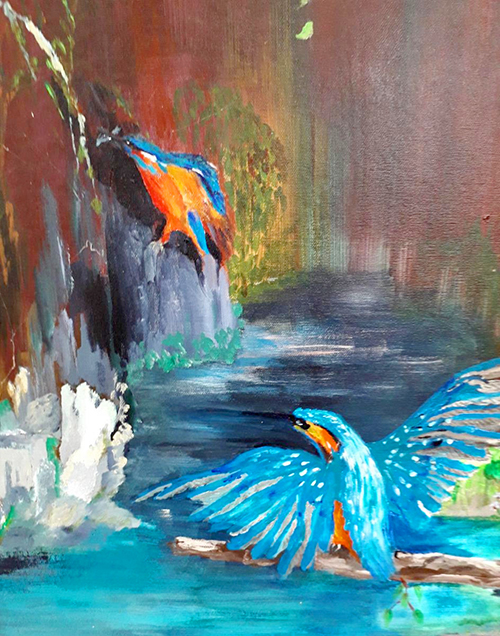
In 2014 a local event was being organised whereby artists could open their homes for people to come and view their work, and also see the artists actually working, so I joined in. I felt strongly impressed to draw a cardinal, a man of the church, and spent some time doing just that, but I made the mistake of drawing a modern cardinal. I could feel energy coming from the picture and the words Juan and Pedro came into my head. So, I asked, “Who are you” and the name Rodriguez came straight back. After doing some research I found that in 1481 an artist called Juan Rodriguez de Segovia painted a picture of Cardinal Pedro Gonzalez de Mendoza. I felt that for a while that artist was influencing the way I was drawing and painting and like most artists of that time their work tended to have religious connotations. It was also the point when I realised that I needed to write about these events and so began ‘Unexpected Art And Words of Spirit Wisdom’ my first spiritual book. It was published in 2016 in America by Balboa Publishing, and the book they produced was beautifully done but perhaps a bit too large. There is a Kindle version.
Throughout these years I had joined a group of people who sat in circles for mediumship and trance, and we all had spiritual helpers or ‘guides’ as we like to call them. One of mine was an Indian Chief called ‘Chief Little Wound’ and he was seen clairvoyantly by several people when we were in our groups. I found him on the internet, and he was a chief of the Oglala tribes which were part of the Lakota Nation so that Indian contact was returning to me and supporting me when I spoke in circle.
I have always enjoyed taking part in events that involve all aspects of spiritual work: we usually refer to them as Mind Body and Soul events. I was at one of these events in 2017 and was showing many of the portraits that had come through to me to some ladies. There was one picture of a young man who looked like a lawyer and one of the ladies said, “I know who that is, it’s Wilberforce”. I was stunned. I said, “Do you mean William Wilberforce, the abolitionist?” She told me that it was exactly what she meant. Many of the pictures were of people from the past and I had wondered why that was. A selection of these pictures can be seen on my website.

I then started researching some of these portraits and my next book started coming to life. Throughout the next four years I received contact, through pictures, from many people that had been enslaved and there were times when I had to stop work because the emotional effect was too great. That is why it was given the title ‘My Soul: Enslaved’ as that is how I felt. There was also contact from people who had been the slave masters and saw nothing wrong in it.
One incident in particular stands out. Bearing in mind that mediumship is a contact with the spiritual world each medium will have their specific way of receiving that contact. I draw the pictures and I physically feel the emotions coming through. I felt the need to draw, and it was a young woman, she indicated that she was from the island of Dominica and referred to herself as ‘Mulatto’. Suddenly a wave of intense fear came over me, I realised that it was coming from her, and it was directed at my dogs. I had three at that time. I didn’t understand then but made a point of sending healing to her and the situation and settling things down. Much later when I was researching those islands it was mentioned that one of the punishments suffered by the slaves was to be thrown from a cliff to the wild dogs below.
Every picture in the book had a purpose and carried a spiritual message in some way. Some were quite unusual and took my research to areas that are not often mentioned when slavery is discussed. I was also very grateful to the many people who gave me snippets of information and took an interest in what I was doing. This book was published at the end of 2019 just when various events were bringing slavery back into question. I didn’t want to get involved in the rather heated arguments that were taking place and so I didn’t advertise it too much. I believe, that at this point in time, the way I work with the psychic art is a bit unusual, but it blends well with my own health and abilities just now.

When we had the shutdown for Covid all our events stopped as did everything else. Many people started using the ‘Zoom’ streaming platforms and I had the opportunity to get involved with some people in America. We were in contact every week and I started to receive lots of pictures relating to the subjects we were studying together which tended to be somewhat Shamanic. We studied the gods and goddesses and deities that meant a lot to other people around the world including my slaves. One of the modules was a study of the ‘White Buffalo Woman’ so I was back with my North American Indians again. She is very important to them. You will find that many people who do psychic/spiritual art will draw pictures of these Indian people and my feeling is that their way of life is very spiritual.
I know several people who make the leather drums and rattles similar to those used in their ceremonies and meditating to those sounds is very popular as well.
I and some of my friends had begun to use sound and music to express spiritual feelings and were using gongs and pipes and rattles as well as other musical equipment. These events are known as ‘Gong Baths’ and I found vibrations very helpful from a healing point of view. These, too, are streamed on Facebook and YouTube. I also tried the sounds made from Crystal bowls and Tibetan bowls.
I certainly enjoy them and painted this picture as an expression of the effects I felt, as sound can bring pictures to the mind and transport you to other places.
I love to encourage other people to try psychic art and there is a free book to download on my website with helpful advice and instructions. Please go ahead and have a try.
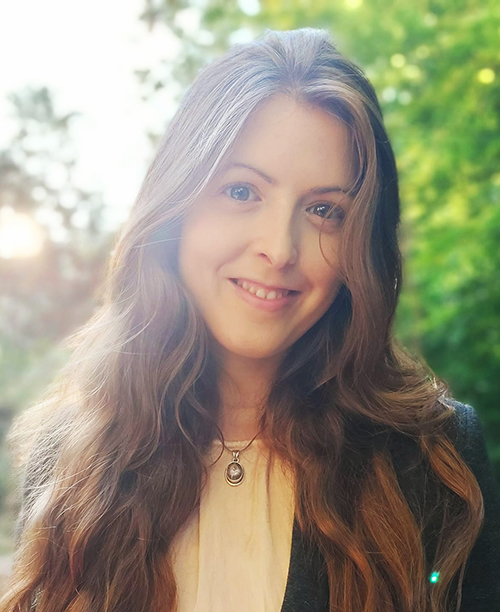
Although I can look back now and see all the spiritual and paranormal events of my childhood, including out of body experiences, astral travel, channelled writing and seeing spirit; my conscious spiritual journey didn’t really begin until I was 21.
I had a bad case of sciatica, which I was complaining about to my mum over the phone, while browsing in a second-hand bookshop in West Wales. The owner of the bookshop waited until I ended my call, and then informed me that I should immediately seek out Peter, the local healer, to sort out my back trouble.
Slightly amused by this, but in so much pain I would have tried anything to ease it, I found myself climbing the tiny spiral stone staircase to a dimly lit room above the local hairdressers, to meet the healer.
What I found threw out all of my preconceived ideas of what it meant to be a spiritual healer. Peter was an ex-rugby player, who smoked, drank and swore in a delightfully strong welsh accent. During that very first session, whilst he was healing my back, Peter declared that I should be doing as he was, and healing people. I had heard of palm readings, but this was a whole other level.
Over the course of a few sessions, Peter showed me how to channel healing energy, protect myself from lower energies, and introduced me to dowsing.
Dowsing formed the backbone of my spiritual path, as I learned about Geopathic Stress, and how my health had been affected by stress lines throughout my childhood.
Over the next few years, I read everything I could find about crystals, life after death, angels, mediumship, healing and anything deemed to be under the ‘Mind Body Spirit’ banner. I also did crystal healing courses and practiced hands on healing.

At 24, I moved to New York and whilst working in a job with plenty of downtime, I read the entire spiritual section of the Westchester Library, including the majority of works by my favourite author of all time, Neale Donald Walsch.
I was fortunate during those ten months to attend a talk by Neale in the city, but when I met him, everything I wanted to say about how I resonated with his works, and how they were shaping my journey, flew out of my brain, and I just nodded and smiled as he signed my book.
Five years later, I flew to Oregon to attend his five day retreat, and this time, I was able to speak to him. I discovered how incredibly down to earth and humble he is, and how he merely saw himself as the messenger, not as an international bestselling author. His grounded attitude and his incredible books are what shaped my own writing career. As did his glowing comments on my first novel, which he said kept him awake until the early hours, because he had to keep reading.
That first novel, was The Earth Angel Training Academy. The idea had come to me when I was in New York, reading about Earth Angels.
I began writing the book in JFK Airport, as I headed back to England. I finished it two months later, but it wasn’t until I had written the sequel and another novel that I began to publish.
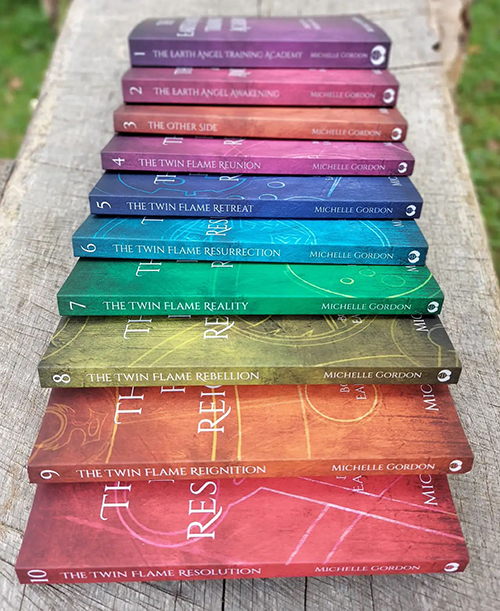
I considered taking the traditional route to publishing, but seeing as my genre was very niche and not even a category on Amazon yet, I decided to publish it myself. I also rather liked the idea of being in control of the process, and being able to choose my own cover artwork and have final say on the contents.
I began publishing in 2011, and for the next several years, I wrote and published two books a year. That first book became the first in a series, of which there are currently ten books, and I am planning on there being two more. In total I have 20 books in print, including a sweary, unicorn themed self-help book, a poetry book, the first two books in a children’s series, and a several standalones, including my latest novel for adults, The Girl Who Loved Too Much.
I had known from the age of 8 that I wanted to be an author. I would devour books and be left hungry for more, and I knew I wanted to be the one who created entire worlds with words. What I hadn’t known, at that age, was that the only subjects I would write about would be spiritual or paranormal in nature. In 2016, I went on a tour in the states with the five-year anniversary edition of my first book, and as part of the tour I was filmed by Crystal Dawne for her angel documentary, The Illumined Ones, and I also went on a morning TV show in Tucson, AZ.

I was also featured on podcasts and radio shows. In preparation for one of the podcast interviews, the host read all of the books available in the Earth Angel Series (six, by then, I think) and her very first question to me on that interview was – ‘Why do you only write about death?’
Having never really considered the overall themes of my books, I was shocked by her question at first, but then quickly realised that she was right. Death is the central theme of my books because it is such a huge trigger for most. As a teen I was terrified of death, and would have panic attacks at the idea of not existing anymore. I was in my 30s before I realised that my overwhelming fear of death was in fact my greatest gift. And not just because it provided the main theme of my novels to come, but because ironically, it was this fear that kept me alive.
One of the main things that Earth Angels feel is that they don’t belong. They don’t fit in. The longing to go home, to be with those who understand them, can be so strong, that they often check out and journey to the other side.
This is because Earth Angels are indeed not from here. They are from other realms and planets and dimensions. This is how I felt in my teens, but thankfully, my fear of death kept me alive long enough to realise that I had chosen to be here, and that I could find others who felt the same way, and form friendships that would help me to feel like I belonged, even though I knew that Earth was not really home.
Writing the Earth Angel Series helped me to connect to Earth Angels all over the world, and form lifelong friendships that have got me through even the darkest of moments. I have also heard from my readers who have found themselves relating to the books in a way that has made things a little easier for them, and helped them to find their way on this bizarre planet.

In an attempt to reach more Earth Angels, in 2018 I agreed to be part of an article in the Daily Mail about Earth Angels, and as a result was asked to be a guest on This Morning, where myself and two fellow Earth Angels spoke of what it means to be an Earth Angel, and that Holly and Phil are Earth Angels themselves.
Over the last ten years I have helped many other writers to become authors, by editing, proofreading and publishing their books with them. Though I have helped to publish books of all genres, the majority of them are spiritual in nature. These books have also helped people around the world to heal, create and find love and joy.
My favourite thing about this spiritual journey is that no matter how much I think I know or understand, I can always be shocked or awestruck by a new experience or revelation, that makes me realise that I know very little! The ability to adapt and shift is paramount, and to hold onto our beliefs and ideas as loosely as possible.
Going with the flow and being kind to yourself is also key, as is understanding that everyone is on their own spiritual journey, which might be completely different to yours. If you feel you would like to read about Earth Angels or life after death, my books are all available online, and on my website you can find links to interviews, videos and my YouTube show, EarthAngelTV.

The integrative approach found in Vocal Tai Chi (the other project I am presenting as part of the Spiritual Arts Foundation) was taken further in 2015. I was itching to put this unusual voicework (Vocal Tai Chi) in public concert form. One day I clocked that ‘conduction’ might be the way to do that: Sun Ra, Frank Zappa, John Zorn, Phil Minton and Peter Wiegold and The Improvisers’ Orchestra are examples of others who have used conduction. I called auditions for creative professional singers and formed a conduction choir.
I auditioned twenty-five singers and selected ten of them. December 2015 marked the first performance with The Improvisers’ Choir (TIC) at the Vortex Jazz Club. There was a sense of euphoric breakthrough afterwards, as none of us had done a performance like it before and the energy was unmistakable. The singers were from multiple genres and I conducted the improvisations with agreed hand signals, shaping the music as it unfolded. Since then, in some of the concerts, special guests (Ian Shaw, Cleveland Watkiss) have been invited to collaborate, devising music with the choir around the guest’s music and allowing them to find ways into the choirs.
As conductor, I integrate the guest, hold the overall space, shape ‘symphonic’ long-lines (over the course of an evening) and aim to realise the ‘implicit journey’ of the whole, across each piece and the complete concert. In 2018 TIC recorded an album which became the soundtrack to a film by Sara Pozin whose brief was to articulate, in moving images, the essence of the musical worlds of each piece. ‘Land Mass,’ – a music-film – ‘a spontaneous vocal-visual liturgy for the land’ is the result.
The only professional review, so far, for The Improvisers’ Choir, in March 2019, called TIC’s music ‘a societal allegory.’ This speaks of a performance practice that points beyond music, to its social implications.
The allegorical quality in The Improvisers’ Choir, has several facets, which I will explore below. The choir are delivering publicly in an unusual social/musical set up, to bring about new music. They look unlike a conventional choir who have their eyes in their scores, or an ensemble of instrumentalists, sitting behind music stands. The singers stand in a semi-circle, without scores, looking directly at the conductor, the audience, and each other. It is a transparent situation, especially as the music is yet to be plucked from thin air.
Here is the full review comment: ‘Jenni Roditi’s vocal improvisation choir was poignantly reaffirming of the power of the individual voice, and the difference it can make as part of a collective, not least in the creative practice of collaborative music-making, but as a societal allegory.

What is the ‘social allegory’ of the conductor in this context? The conductor is the convener of the practice and takes on leadership responsibility. Holding the space and using an ear that draws on compositional as well as performance sensibility without the dogma of a full score – the conductor is also reliant on the choir to spark the music into life. There is a high level of trust needed between all.
The conductor’s role delineates a fine membrane between the singers and herself. This is a defining edge, but also a porous and flowing one, with influences moving to and frow across the membrane. As in an earlier reference to Vocal Tai Chi, where yin and yang are ‘opposite but interconnected forces’, this allegory symbolizes leadership as a publicly observed exchange of agreed creative cooperation. The membrane sits at the point of equal, opposite and interconnected force. The conductor is one force, and the singers are the other. Yet, there is a third force that interconnects both - the whole group together, and event itself. This includes the audience, the room, the theme and context of the event and so on.
The Improvisers’ Choir project works on the basis that a leadership role is necessary for a musical overview and, if done well, adds inspiration and support to the singers. Working in an improvising vocal group without a leader, suggests a different stance, and a different allegory - one of consensus as opposed to leadership. That has a different social narrative. With conduction, it is accepted that a responsive, receptive leader who, at the same time makes creative interventions, can helpfully move things on, shake things up, start, stop, and sensitively orchestrate the space, as overseer-overhearer.

Conduction helps make the most of the potential in each choir member, encouraging individual journeys through each piece. Conduction also works with past and future time- space in the music. As a conductor it is possible to recall something musically that happened five minutes ago, and signal a return to that, just when the latest episode is running dry, and the piece might die without some recapitulation. Oppositely, a conductor can keep things moving with a change of tempo, meter, mood, pitch area, fresh groupings etc.
In group vocal improvisations without a conductor, I’ve heard instances where the piece comes to an end because there is no overview of its compositional line. The music could not lift off more fully because it was dependent on moving forward, episode by episode. Cross cutting, dramatic shifts, and changes in tempo, meter, tessitura and grouping were not so easy, as no one was steering (or willing to steer from within) the space, to help the music sit in a broader space and timeline.
Of course, this is not to say leaderless group improvisation doesn’t implicitly have shared or individual leadership from one or several group members, it does, but it has a different creative stance. It leans towards no one being, so-called, ‘on the outside.’ Such separation may seem hierarchically unhelpful, but I believe it to be musically useful and like the breathing diaphragm, a membrane, that is both an integrated, and a separate, form and useful force.
As well as social cohesion and allegories within the music, being part of an improvising choir is to be part of a social community. The Improvisers’ Choir has been a creative opportunity for each person to bring their vocal ideas to the group. Feedback from all the singers, suggests that they felt a sense of homecoming, as the music-making gave them a chance to offer their own original contributions.
This article consists of some short and adapted extracts of text from the chapter “Beyond Music Workshops – A Composer and A Community” written by Jenni Roditi, to appear in the “Routledge Companion to Women’s Musical Leadership – The Nineteenth Century And Beyond” – forthcoming, November 2023.
To find out more about Land Mass, the trailer, audience feedback, and the link to the complete film, please visit the link below.

Born in 1957, and brought up in suburban Bexleyheath, it was the 1960s! The mainstream psychedelic, anti-materialism was becoming jaded and faded, but like a dying star blasting off its last layers of incandescent gas, there were the few golden years of innovative Rock Music remaining, with their fabulous gate fold album sleeves and an all-pervasive atmosphere of medievalism, surrealism and science fiction seen through the lens of late Victorian/Edwardian sensibilities. Living a quarter of a mile from William Morris’s Red House, I’m sure Psychic Geography played its part in my early inspirations.
Imagine our joy at school when our fencing master, exasperated, exclaimed “It’s meant to be an Olympic sport, you look like Victorian gentlemen duelling!” (and yes, that was the very flamboyant, very Spanish, British Olympic Fencing Coach teaching us at Bexleyheath Comprehensive…. ‘those were the days’)
Magic certainly filled the air, and whilst still at school I started to experience weird, ecstatic out of body experiences. I was approached by someone from the local Spiritualist Church and asked if I would like to join their sessions. I certainly hadn’t mentioned my strange internal experiences, had I inadvertently wandered into someone else on the Astral Plane? Or perhaps it was just my looking like a Biblical Prophet? It was an image I was carefully cultivating, and the height of fashion at the time!
I quickly found myself in a regular ‘Development Circle’ with some of the top Spiritualist Mediums in the country. The aim was to develop and practice Trance Mediumship, the complete taking over of the body by ‘another self’. In the Spiritualist belief system, this would be the spirit of someone who had ‘passed over’ and was usually known to someone else in the circle. The spirit would offer up proof as to their identity, by giving information that would only be known by them and the relevant sitter, or could be researched later. The purpose was mainly to provide the comfort of showing that there was an afterlife, but often advice was given regards an earthly concern. Clairvoyance was also practiced, where the medium, in a trance state, sees visions and receives information, again hopefully relevant to someone else in the circle. Other phenomena sometimes occurred where a distressed spirit might break through, or some kind of non-human entity, such as a pagan god or Angel.
The most striking thing about these sessions was how seemingly highly grounded ‘ordinary people’ could take on a persona and describe different times and places in great detail with great poetic eloquence. The relaying of private shared knowledge was often spectacularly accurate, but has been explained away as Cold Reading, a technique used by Stage Magicians. Another explanation, which does away with a spirit world, is that telepathy is taking place, still an ‘out-there’ explanation, but perhaps not quite as far out.
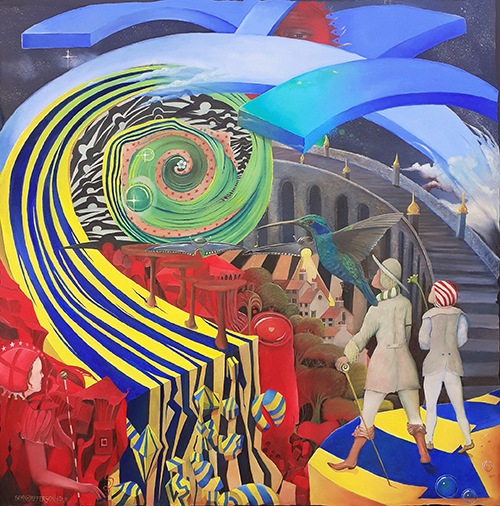
Cold Reading requires intense observational skills, and a lot of practice to be convincing. Perhaps some people have it as a natural skill? I am certain the clairvoyants I saw working at very close range were certainly not out to deceive. In conclusion, very strange things happened, certainly at a cerebral level and sometimes a physical level as well.
I was beginning to feel the need to share all this weirdness (more accurately Wyrdness in the Anglo-Saxon sense) but I couldn’t see how. And then on April Fools Day 1976, Max Ernst died, and a number of his paintings appeared in an obituary in an early evening magazine TV show. This was a revelation to me, as the images (even on the small screen) captured exactly the visions and feelings I experienced in the seance room. I threw myself into researching Surrealism and went to see Dali’s Metamorphosis of Narcissus at the Tate Gallery, which confirmed my conclusion that oil painting was to be the next stage in my investigations into what I think can be described as ‘The Greater Nature’, without limiting it to any belief system.
(By the way, my use of the word ‘Wyrd’ (as opposed to weird) is to signify a more specific meaning - something between the conventional meaning and something akin to the Chinese Tao, a concept from Anglo Saxon Shamanism. For more see Brian Bates).
At that time, the degree to which Spiritualist and other traditionally occult methods had been used in Surrealism was not widely known. Any inkling of a belief in discarnate intelligent entities was getting a bit close to religious belief, an anathema to that particular group of card carrying Communists. The early thinking was surprisingly systematic, rooted as it was in Psychoanalysis. Jung’s Analytical Psychology derived from Psychoanalysis, and far more spiritual in my opinion is, I think, a better fit, certainly with Symbolist Art, which I believe is a forerunner of Surrealism. Arnold Bocklin was an influence on Ernst. The hidden hand of occultism behind Surrealism has now been fully exposed in literature. Of particular interest to me was Kenneth Grant’s observation of the similarities between Dali’s methodology, Paranoid Critical Method and Accommodations of Desire, with the full-on magical practice of Austin Osman Spare. Interestingly, Spare used Psychoanalytical terminology as well as terms from Spiritualism and witchcraft to describe his system, but called Freud and Jung, Fraud and Junk, possibly due to the link made between Depth Psychology and Surrealism with which he had fundamental disagreements with.

(Incidentally, Austin Osman Spare’s objection to Surrealism, was the idea that an Artistic training would stand in the way of ‘pure psychic automatism’. Spare thought a high level of competence was required to obtain meaningful results, at least to other people, a position borne out by Dali’s highly competent and successful work. Or that in other media, such as jazz improvisation, a high level of skill produces the more startling results).
Perhaps paradoxically, I had gained a place at Imperial College to study Life Sciences. The College was then the High Temple of evidence based scientific investigation, with a total dedication to a constantly evolving mathematical - often statistical - model of the physical world. Upon graduation, I had hard wired into me the scientific method, which has proved ever useful in my later ‘spiritual adventures’ and an ability to draw from life after hours of accurate drawing of biological specimens.
By now (around 1977) I had realised that Surrealism was actually a philosophy for life which I had adopted, which combined in me with a cynicism so extreme that I came to totally mistrust cynicism itself! The constant ‘What if?’ is key to my artistic endeavour, which has always felt like a scientific investigation into the ‘Wyrd’ and the beautiful.
At that time, a massive cultural shift occurred, just down the The Kings Road, as it happened. Punk culture changed everything, or perhaps the rise of Thatcherism, which swept away the last vestiges of bucolic 60s utopianism. The Loadsamoney era had arrived.
I had by now taken the, what then appeared to be the mad idea of becoming a full time professional ‘Artist’. I worked hard on my painting ability and automatic drawing technique as described in Spare’s Book of Pleasure. I had by now discovered Symbolist Art, with its deep occult roots and Victorian Fairy painting which was a serious genre in its day and foreshadowed both Symbolism and Surrealism. Another important influence were the largely anonymous, agricultural naïve paintings, often of animals, which had unintended but revealing surrealistic twists. This work, once housed in a large gallery in Bath, was of particular interest, as these were self-taught representational Artists, often sign writers or rat catchers!

By then, I had somewhat outgrown Spiritualism, and now was experimenting with Qabalistic practices, Tarot and particularly the Enochian System of magic set out by Dr John De, occult advisor to Elizabeth 1st and Sir Edward Kelly, principally an Alchemist. All of this I did now in the service of Art. I also completed a three year course in Hypnotherapy and Psychotherapy in the mid-1980s, and continue to study the more obscure roots of Visionary Art to this day.
Initially, I had success with The Portal Gallery in Bond Street, The Garden Gallery in New Cross Gate, and I secured solo exhibitions in Moscow, Amsterdam and London.
My most recent outings have been eight paintings in the recent Creative Spirits exhibition at The College of Psychic Studies (in the Conan Doyle room) and a solo stand at the Winter Olympia Art and Antique Fair, representing Messums St.James’s, both during November last year. Incidentally, as was evident in the recent Creative Spirits exhibition, there are obviously two main strands of spiritual art: the trained and the spontaneous, more ‘Art Brut’ type of work, but there is of course room for both!
A relatively full CV is on my section in the Messums St.James’s website, along with images of all my work in my 2020 exhibition at Bury Street. The high-quality printed catalogue for that exhibition is available from the Gallery (I am down to my last copy!)
My latest work is incorporating psychedelic elements, referencing back to the 1960s as the era initiated in the mid-1970s seems to have run its course, and projects such as The Spiritual Arts Foundation gather traction.
